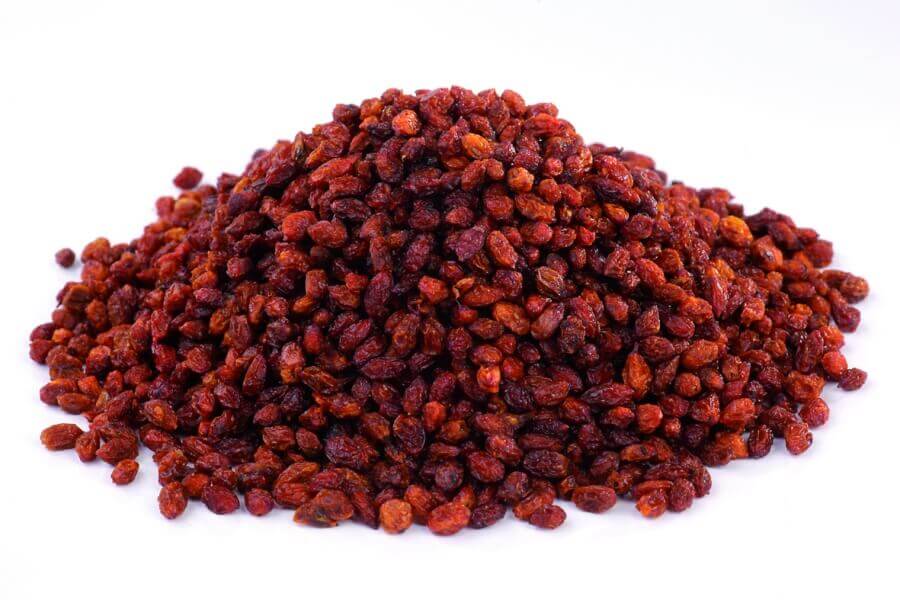
Dried organic sea buckthorn berries - unsweetened & wild harvested Why buy sea buckthorn berries? An analysis carried out by the retailer provided proof of the sensational amounts of vital substances in sea buckthorn. The berries have a very high omega 7 fatty acid and B12 content. This high content is probably only found in Uzbek wild-collected organic sea buckthorn. Cultivated sea buckthorn generally has much lower levels and vitamin B12 in plant foods is very rare! Dried sea buckthorn contains most of the same vital substances and nutrients as fresh sea buckthorn, only in a more concentrated form because the water has been removed. These wild sea buckthorn berries have an intense, spicy and very tart flavour. They have a strong, intense light to dark orange colour. The flesh surrounds a stone, which is also dried. This results in a crispy consistency. What makes our wild organic sea buckthorn berries special? When fully ripe, the wild sea buckthorn berries are picked by hand, washed and gently dried in the sun. The drying process used is a very environmentally friendly solar drying method that is extremely gentle on the product. The organic sea buckthorn berries are - unsulphurised (in accordance with the EU Organic Regulation)- without artificial additives- without preservatives- without colourings Where do our organic sea buckthorn berries come from? Organic sea buckthorn berries from wild collection are very difficult to obtain. We were able to buy a batch from Ukraine. These wild sea buckthorn berries come from the Lviv region in western Ukraine, close to the Polish border. They are packed in 125g bags. How to integrate them into your daily diet? The dried organic sea buckthorn berries are suitable as a small, refreshing snack or as a varied ingredient in your power muesli. To round off the tart flavour, you can combine the sea buckthorn with nuts and sweet dried fruits such as sultanas. Or you can use a healthy sweetener such as agave, yacon or apple syrup. Origin Collected wild and processed in Ukraine. Nutritional values of sea buckthorn berries per 100g Energy value 1116kJ/270kcalFat 21.5gof which saturated fatty acids 1.2gCarbohydrates 8.9gof which sugar 8.8gProtein 5.5gSalt 0.037g All information is subject to the usual fluctuations of natural products. Storage: Store in a cool, dry and dark place.
Content: 125 Gramm (CHF 13.68 / 100 Gramm)

Sea buckthorn powder | Organic, sun-dried (100% natural) Update: The sea buckthorn powder complements our existing range of sea buckthorn and fruit powders and is available in 125g sachets. The best-before date for the current batch is 30 June 2027. We also continue to stock dried sea buckthorn berriesand sea buckthorn juice in our range. What is sea buckthorn powder? Our organic sea buckthorn powder is 100% pure fruit powder, with no sweeteners or other additives. It has a fruity, tangy flavour. What makes our organic sea buckthorn powder special? The sea buckthorn berries are wild-harvested by smallholders in the Samarkand region of Uzbekistan, picked by hand, gently sun- and air-dried, and then ground into valuable whole-fruit powder. Processing takes place at temperatures below 42°C – raw food quality. Our sea buckthorn powder has a dark orange to brownish colour. Tips for use The sea buckthorn powder has a good flow and is ideal for muesli and smoothies. Mix 1 heaped teaspoon (approx. 5g) into muesli, yoghurt or a smoothie. Nutritional values for organic sea buckthorn powder per 100gEnergy 2045 kJ/489 kcalFat 25gof which saturated fatty acids 4gCarbohydrates 24gof which sugars 14gFibre 28gProtein 13gSalt 0.06g Additional information Ingredients: sea buckthorn berries. May contain traces of nuts.
Content: 125 Gramm (CHF 12.16 / 100 Gramm)
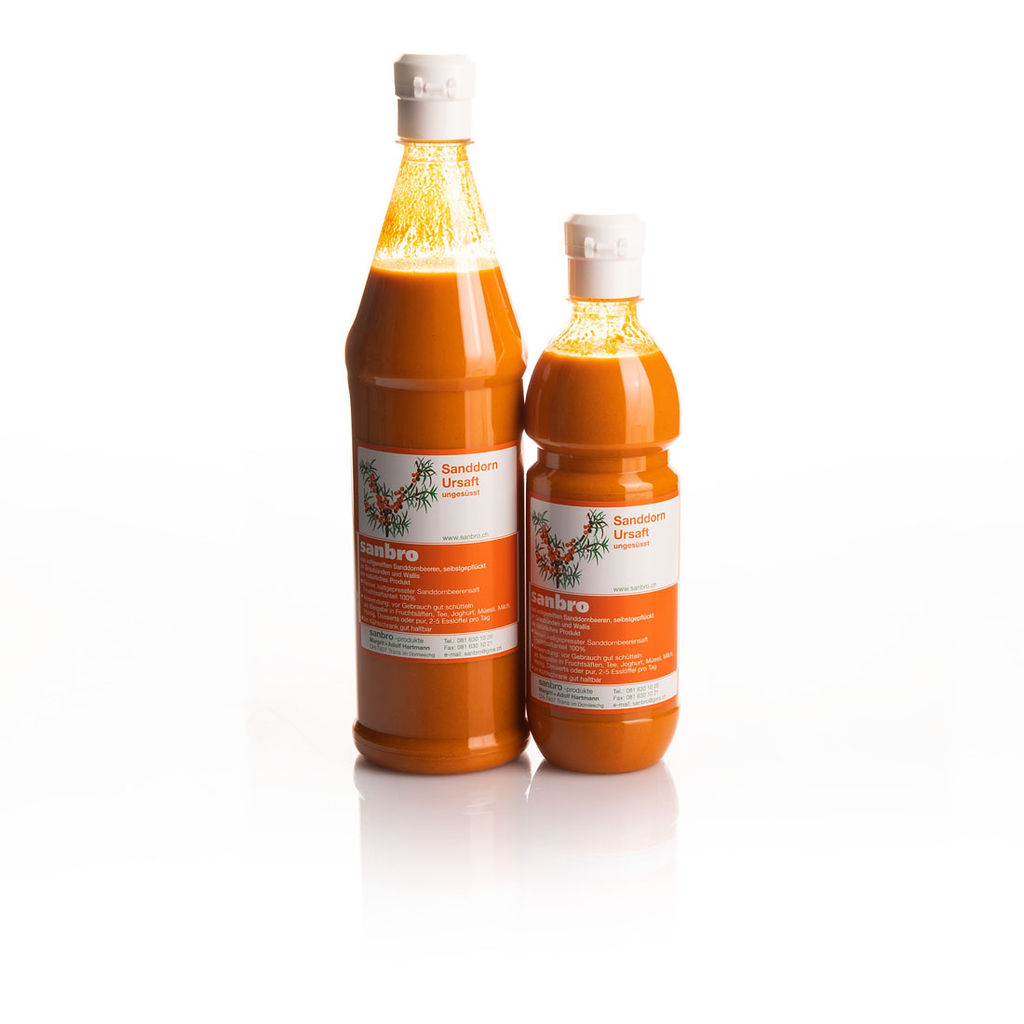
Sea buckthorn - the berries richest in vitamin C in Europe Original juice means that this sea buckthorn juice contains no additives, is gently cold-pressed and is not pasteurised. This is not even necessary due to the naturally high vitamin C content. This makes this sea buckthorn juice one of the few in raw food quality! Further advantages of this unique product: Wild collections: In contrast to sea buckthorn from plantations, these berries from wild collections are significantly smaller and have a thicker skin. The vitamin and vital substance content is unique and incomparably high, approx. five times that of sea buckthorn from plantations. Local: The berries come from hard-to-reach areas in the Grisons Oberland and Valais and are processed by Margrit and Adolf Hartmann in Trans GR. Regular fresh pressings: After harvesting, some of the berries are frozen so that they can be pressed fresh regularly until the following summer. The wild sea buckthorn berries naturally tolerate the cold very well. Family business: The wild berries are harvested by hand by Mr and Mrs Hartmann. The whole bushes are cut off and rolled up in jute sacks. The two donkeys, Fiona and Meli, help with the transport down to the valley. Fair prices: At first glance, the price may seem high compared to other sea buckthorn juices. If you consider the origin and all the manual labour, the price is more than justified. Hartmanns do not maximise profits and have not increased prices for over 20 years. Harvested from wild sea buckthorn bushes in the Swiss Alps The orange berries of the sea buckthorn bush, which are collected in the remote Swiss mountain valleys, are highly regarded by experts. The vital substance content is very high, especially vitamin C. The vitamin C content has been repeatedly tested by the manufacturer in Swiss test laboratories. These revealed vitamin C values of 18000 to 22000 mg/kg juice. Usual values for good plantation varieties are 3000 to 5000 mg/kg juice. This is 36 to 44 times more than that of fresh orange juice. The richness of all its ingredients is unrivalled. More than 12 vitamins: A, B1, B2, B5, B6, B12, C, E, F, H, P, PP, glycosides, flavonoids, saponins, omega-3, -6 and -9 fatty acids, fruit acids and mineral trace elements are contained in ripe sea buckthorn berries. Vitamin C is most effective in natural combination with other vital substances. Sea buckthorn juice also contains sea buckthorn pulp oil. Sea buckthorn juice in raw food quality The whole berries are pressed very gently at low temperatures. The very high acid content - due to the high vitamin C content - and the clean processing mean that the juice does not need to be pasteurised and can be kept for at least 6 months. This preserves all the vital substances. The juice is very refreshing thanks to its vitamin C content and strong sea buckthorn flavour. The high vitamin P content supports the stability and absorption of vitamin C. Harvesting and processing the berries to make sea buckthorn juice The berries, which grow wild at around 1000 metres above sea level, are harvested by Margrit and Adolf Hartmann by hand in rough terrain in the Valais and Grisons Oberland. Compared to cultivated plants, these berries are smaller but richer in vitamins. Harvest time is between August and October. The berries and thorny branches are cut off with electric shears and placed in large jute sacks. The two donkeys "Fiona" and "Meli" help to carry the heavy sacks down into the valley. All the sea buckthorn berries are processed on the Hartmann couple's farm in Trans im Domleschg. In the comprehensive report by nau.ch Sanddorn - Das Alpengold aus Graubünden (nau.ch) and in the 5-minute TeleZüri report "Heimisch exotisch" from 5 August 2020, you can see how the harvest takes place: Heimisch exotisch: Sea buckthorn - TeleZüri (telezueri.ch). Sea buckthorn juice or syrup For people who don't like this completely unsweetened original juice, we recommend sea buckthorn syrup, which is pleasantly sweetened with fructose and birnel. The sea buckthorn fruit content of the syrup is still 60%. Note: The berries are wild fruits and are grown without pesticides or agrochemicals. However, due to the very large harvesting area, organic certification is not financially viable. Use of Swiss sea buckthorn juice Sea buckthorn juice tastes best on its own, slightly sweetened or added to water, fruit juices, tea, yoghurt, muesli and desserts. Take 2 to 5 tablespoons a day, depending on your personal requirements. Storage As the sea buckthorn juice is unpasteurised, we generally recommend storing it in a cool place. This is the best way to preserve the vitamins and fresh flavour. We deliberately only order small batches from the producer every few weeks so that we can offer freshly pressed sea buckthorn juice on a regular basis. Size variations Sea buckthorn juice is available in a 5dl bottle for CHF 28 and in an inexpensive 7.5dl bottle for CHF 39. A quantity discount of 5% is granted for orders of 3 or more.
Content: 500 ml (CHF 5.32 / 100 ml)
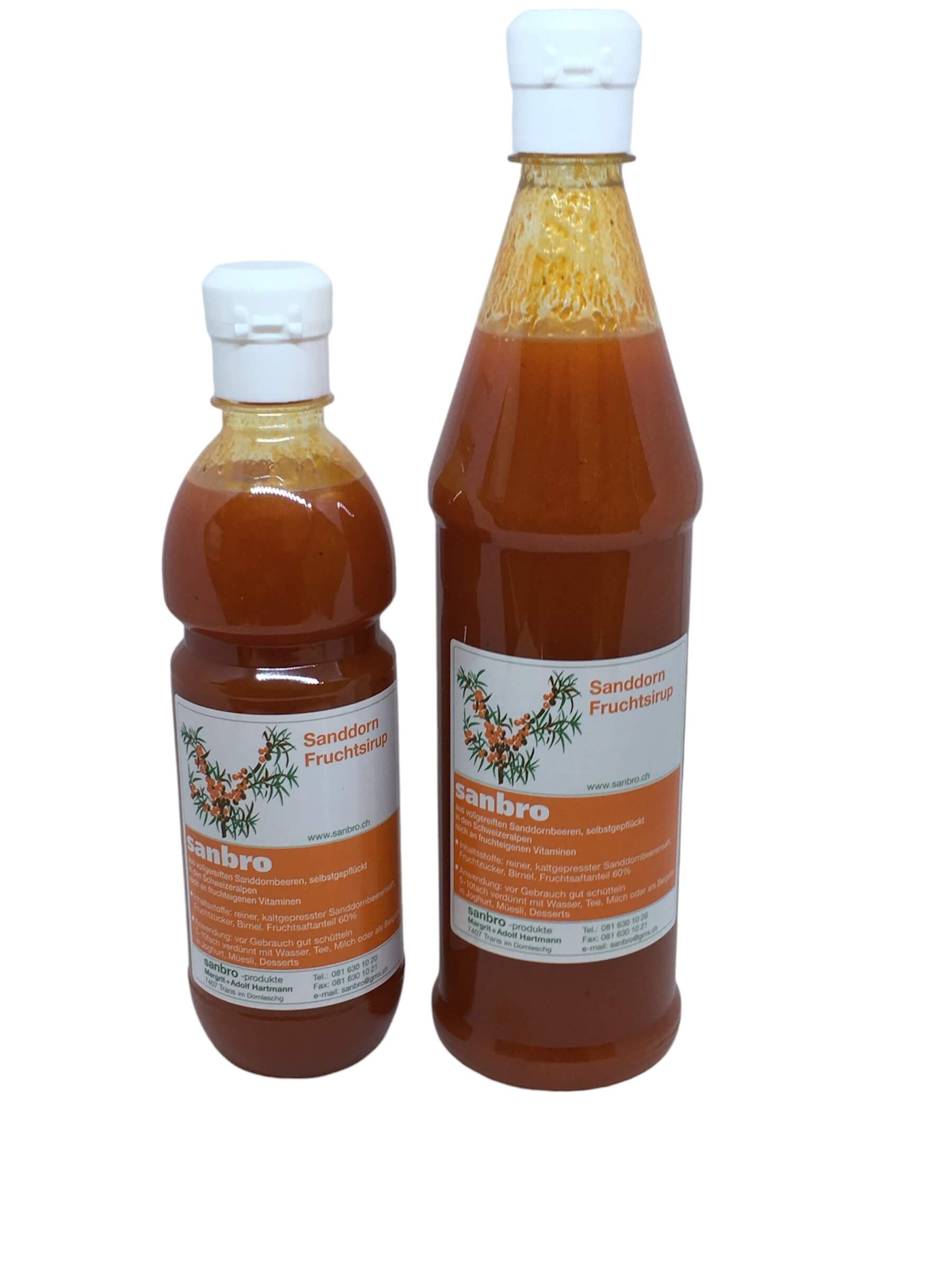
Sea buckthorn syrup - from the berry richest in vitamin C in Europe Harvested from wild sea buckthorn bushes in the Swiss Alps The orange berries of the sea buckthorn bush, which are collected in the remote Swiss mountain valleys, are highly regarded by experts. The vital substance content is very high, especially vitamin C. The vitamin C content has been repeatedly tested by the manufacturer in Swiss test laboratories. These revealed vitamin C values of 18000 to 22000 mg/kg juice. Usual values for good plantation varieties are 3000 to 5000 mg/kg juice. This is 36 to 44 times more than that of fresh orange juice. The richness of all its ingredients is unrivalled. More than 12 vitamins: A, B1, B2, B5, B6, B12, C, E, F, H, P, PP, glycosides, flavonoids, saponins, omega-3, -6 and -9 fatty acids, fruit acids and mineral trace elements are contained in ripe sea buckthorn berries. Vitamin C is most effective in natural combination with other vital substances. Sea buckthorn juice also contains sea buckthorn pulp oil. Sea buckthorn syrup in raw food quality The whole berries are pressed very gently at low temperatures. The very high acidity - due to the high vitamin C content - and the clean processing mean that the juice does not need to be pasteurised and can be kept for at least 6 months. This preserves all the vital substances. The juice is very refreshing thanks to its vitamin C content and strong sea buckthorn flavour. The high vitamin P content supports the stability and absorption of vitamin C. Harvesting and processing the berries to make sea buckthorn juice The berries, which grow wild at around 1000 metres above sea level, are harvested by Margrit and Adolf Hartmann by hand in rough terrain in the Valais and Grisons Oberland. Compared to cultivated plants, these berries are smaller but richer in vitamins. Harvest time is between August and October. The berries and thorny branches are cut off with electric shears and placed in large jute sacks. The two donkeys "Fiona" and "Meli" help to carry the heavy sacks down into the valley. All the sea buckthorn berries are processed on the Hartmann couple's farm in Trans im Domleschg. Sea buckthorn syrup or juice In contrast to the original juice, which is completely unsweetened and very sour due to its very high vitamin C content, the sea buckthorn syrup is pleasantly sweetened with fructose and birnel. The sea buckthorn fruit content of the syrup is still 60%. Note: The berries are wild fruits and are grown without pesticides or agrochemicals. However, due to the very large harvesting area, organic certification is not financially viable. Use of Swiss sea buckthorn syrup Sea buckthorn syrup tastes best when added to water, tea, yoghurt, muesli and desserts. Take 1 to 5 tablespoons a day, depending on your personal requirements. Large varieties Sea buckthorn syrup is available in both the 650g (equivalent to approx. 5dl) and the inexpensive 1kg (equivalent to approx. 7.5dl) bottle!
Content: 650 Gramm (CHF 3.07 / 100 Gramm)
Sea Buckthorn Products – the Orange Berry in Different Forms
Sea buckthorn is known for its bright orange berries and their distinctive fruity, tart flavour. At SamaraNatura, you can discover a selection of sea buckthorn products in different forms: organic sea buckthorn powder, dried organic sea buckthorn berries, Swiss pure sea buckthorn juice and sea buckthorn syrup.
Depending on the product, the sea buckthorn berries are gently dried or processed into juice. Part of our range is made from wild-harvested berries. This allows you to enjoy sea buckthorn in a variety of ways – in muesli, yoghurt, smoothies and drinks or simply on its own.
Which Sea Buckthorn Products Are Available?
Sea buckthorn can be processed in different ways. As a result, our products vary not only in taste and texture but also in how they can be used.
Organic Sea Buckthorn Powder
Our organic sea buckthorn powder is made from 100 % sea buckthorn and is gently sun-dried. The finely ground fruit powder is easy to incorporate into your daily diet. It is ideal for smoothies, muesli and yoghurt, adding the characteristic fruity and tart flavour of sea buckthorn.
Dried Organic Sea Buckthorn Berries
If you prefer to enjoy sea buckthorn in a particularly natural form, try our dried organic sea buckthorn berries. The wild-harvested berries are hand-picked and gently sun-dried. As the seeds are dried together with the berries, they have a crunchy texture and an intensely tart flavour. Enjoy them on their own or add them to muesli, nuts and sweeter dried fruits.
Swiss Pure Sea Buckthorn Juice
Our Swiss pure sea buckthorn juice is made from wild sea buckthorn berries harvested in the Valais and the Grisons region of Switzerland. The whole berries are gently pressed at low temperatures. The juice is unsweetened, unpasteurised and free from additives and has the intense, naturally tart flavour typical of sea buckthorn.
You can drink pure sea buckthorn juice on its own or mix it with water, fruit juice or tea. It is also a versatile addition to yoghurt, muesli and desserts.
Swiss Sea Buckthorn Syrup
If pure sea buckthorn juice is too tart for your taste, our Swiss sea buckthorn syrup offers a milder alternative. It contains 60 % sea buckthorn fruit and is sweetened with fructose and concentrated pear juice. Diluted with water, it makes a fruity, pleasantly tart drink. The syrup can also be added to tea, yoghurt, muesli and desserts.
Wild-Harvested Sea Buckthorn
A special feature of our range is our selection of wild-harvested sea buckthorn products. The berries used for our Swiss pure sea buckthorn juice and syrup, for example, grow wild in remote areas of the Valais and the Grisons region. They are harvested by hand and then processed by a small Swiss family business.
Our dried organic sea buckthorn berries are also wild-harvested. This means you can enjoy sea buckthorn in a variety of forms – from whole dried berries and finely ground fruit powder to pure juice.
How Can You Use Sea Buckthorn?
With several different forms to choose from, sea buckthorn can easily be incorporated into your daily diet. Sea buckthorn powder can be mixed directly into smoothies, muesli or yoghurt. Dried sea buckthorn berries can be enjoyed as they are or added to muesli and nut mixes for a fruity, tart flavour.
Pure sea buckthorn juice can be enjoyed on its own or diluted, while the milder sea buckthorn syrup works particularly well with water or tea. The best sea buckthorn product for you therefore depends mainly on whether you prefer sea buckthorn as a powder, whole berries or in liquid form.
Discover Sea Buckthorn Products at SamaraNatura
Discover our carefully selected range of sea buckthorn products and choose from organic sea buckthorn powder, dried organic sea buckthorn berries, Swiss pure sea buckthorn juice and Swiss sea buckthorn syrup. We focus on products that are as natural as possible, gentle processing methods and carefully selected raw materials.
