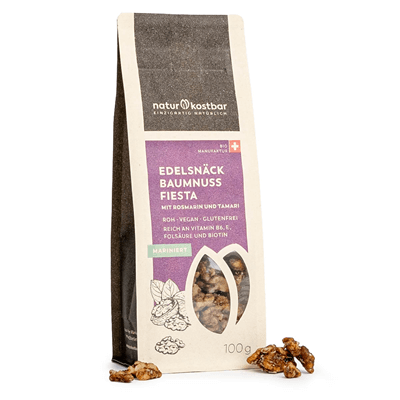
Baumnuss Fiesta Naturkostbar Bio


| Quantity | Unit price |
|---|---|
| To 2 |
CHF 9.90
|
| From 3 |
CHF 9.41
|
Available, delivery time: 1-4 days
Product information "Baumnuss Fiesta Naturkostbar Bio"
The sprouted, marinated walnuts are now called Edelsnäck Walnut Fiesta
Naturkostbar germinates the wild-harvested Swiss walnuts and, after gently drying them (below 40°C), flavours them with a delicious rosemary and tamari marinade – mmm, absolutely delicious!
Origin and processing
The walnuts come from old, majestic walnut trees in the Swiss Seeland region. Local farmers harvest the wild walnuts by hand. A Swiss nutcracker carefully removes the hard shell.
Naturkostbar allows the walnuts to sprout so that they can develop their full nutritional potential. The second important step in the processing is the marinating. The marinade contains Nama Organic Tamari soy sauce, rosemary,coconut blossom sugar, salt and garlic.
Natural indulgence
The result is crunchy, savoury-sweet tree nuts. They have a well-balanced nutty flavour and entice with a subtle rosemary aroma.
✓ Wild-harvested in Switzerland
✓ Organic, vegan and raw food quality
✓ Sprouted
✓ Gluten-free
Uses for marinated walnuts
These delicious rosemary walnuts are perfect for any aperitif, as a topping for salads or as brain food at the office.
Ingredients
Walnuts**, tamari*, coconut blossom sugar*, walnut oil, garlic powder*, rock salt.
*from organic farming, **sprouted
Nutritional information for marinated walnuts
| Energy / Nutrient per 100g | g/mg/μg | %*1 |
|---|---|---|
| *1 Reference intake/daily allowance for an average adult (8400 kJ/2000 kcal) | ||
| Energy | 2,792 kJ (677 kcal) | 33% |
| Fat | 62.9 g | 90% |
| of which saturated fatty acids | 5.63g | 28% |
| Carbohydrates | 11.9g | 5% |
| of which sugars | 5.2g | 6% |
| Protein | 14.3g | 29% |
| Salt | 1.25g | 21% |
Login
These products might also interest you
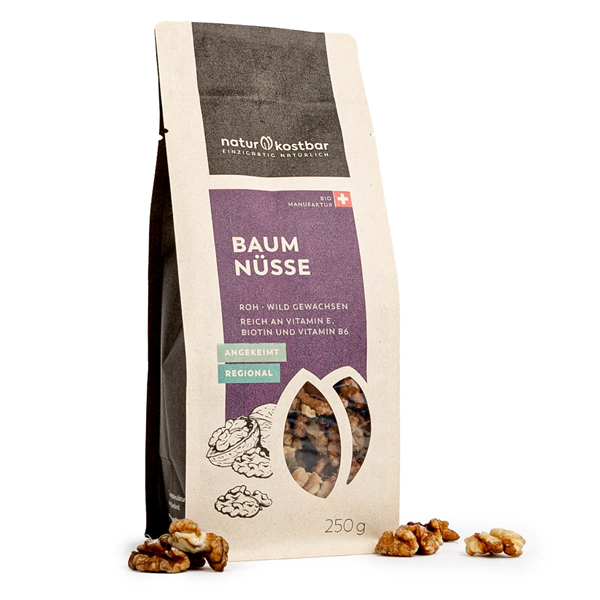
Sprouted walnuts – easier to digest The Swiss organic walnuts are soaked and sprouted at Naturkostbar Manufaktur for several hours. They are then dried for 24 hours at a maximum temperature of 42°C. The sprouting process neutralises the phytic acid present in the walnuts and significantly increases their nutrient density. It also makes the walnuts easier to digest, which in turn improves nutrient absorption. Uses for sprouted walnuts Like normal walnuts, the sprouted walnuts are ideal as a snack on their own or mixed with dried fruit and cocoa beans to make a delicious trail mix. Additional information Contents: 250g bag. Warning: May contain shell fragments. Origin and production: Organic walnuts from Switzerland, sprouted at the Naturkostbar Manufaktur in Uetendorf near Thun. Organic certification: CH-BIO-086 Nutritional information for sprouted walnuts Average nutritional valuesper 100g/100ml%11Reference intake for an average adult (8400 kJ/2000 kcal) Energy 3,060 kJ (742 kcal) 36% Fat 70.8 g 101% of which saturated fatty acids 6.3g 32% of which monounsaturated fatty acids 11.9g 79% of which polyunsaturated fatty acids 49.4g - Carbohydrates 7g 3% of which sugars 2g 2% Fibre 6.7g 13% Protein 15.9g 32% Salt - - Beta-carotene (provitamin A) - - Vitamin A - - Vitamin B1 0.36 mg 33% Vitamin B2 0.1 mg 7% Vitamin B3 1.3 mg 8% Vitamin B6 0.4 mg 29% Vitamin B12 - - Vitamin C - - Vitamin D - - Vitamin E 30 mg 250% Vitamin K - - Biotin 20 µg 40% Calcium 78 mg 10% Chloride 23 mg 3% Chromium - - Iron 3 mg 21% Fluoride - - Folic acid/folacin 140 µg 70% Iodine 2 µg 1% Potassium 420 mg 21% Copper - - Magnesium 140 mg 37% Manganese - - Molybdenum - - Pantothenic acid 0.8 mg 13% Phosphorus 360 mg 51% Selenium - - Zinc 4 mg 40%
Content: 250 Gramm (CHF 7.56 / 100 Gramm)
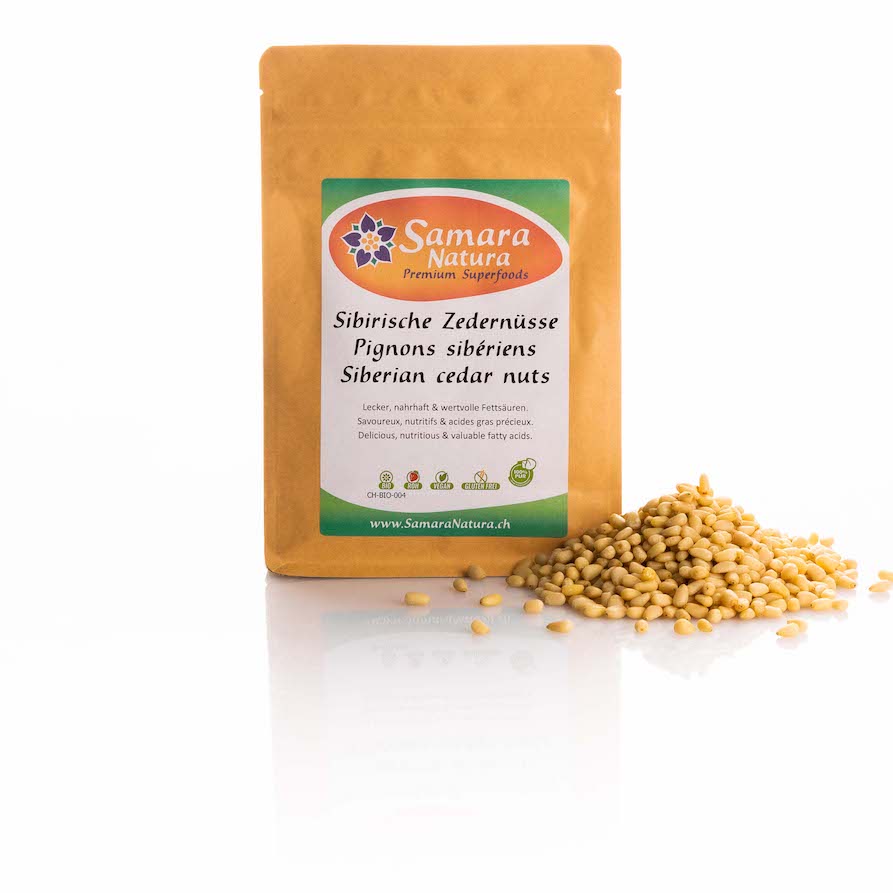
Update: The new batch has been packed and all sizes are available again: 250g, 500g and 1kg bags. Cedar nuts from Siberia – a treasure of nature Cedar nuts taste similar to other pine nuts, but are slightly sweeter and more flavourful. Unlike almost all pine nuts available in shops, our raw cedar nuts are not heat-treated. Why eat cedar nuts? Cedar nuts contain approx. 55% valuable unsaturated fatty acids, primarily linoleic and alpha-linolenic acid, as well as the rare pinolic acid. They are rich in tocopherols (vitamin E) – which act as antioxidants – as well as high-quality proteins (around 17 per cent). Furthermore, they contain many minerals (particularly magnesium, potassium and phosphorus), trace elements (copper, manganese and zinc), vitamins (K and B) and flavonoids. For centuries, the people of Siberia have valued the Siberian cedar (Pinus sibirica), a Swiss stone pine that is widespread in the region, not only as a source of valuable timber but also for its tasty and highly nutritious seeds, which are found inside the cedar cones. What makes our cedar nuts special? Virtually all pine nuts available on the market are heat-treated to extend their shelf life. Our cedar nuts, on the other hand, are completely untreated, which preserves their wide range of nutrients. Where do our pine nuts come from? They come from the Lake Baikal region in Siberia and are harvested by hand. The Siberian pine is a true treasure of Siberian nature and forms vast areas of unspoilt forest throughout northern Russia. These huge, magnificent trees (up to 40 metres tall) grow slowly, and the first cones bearing seeds only appear when the trees are around 30 years old. They are among the longest-living tree species in existence, as they can live for between 300 and 800 years! The evergreen cedar is a storehouse of cosmic light energy; throughout its long lifespan, it captures the energy rays from outer space in its millions of needles. Thousands of years ago, the peoples of antiquity already valued the properties of the cedar tree, which they called ‘the Eternal One’. The twigs were used to prepare a vitamin-rich drink, the resin to heal wounds and ulcers, and the seeds and their oil helped people survive the long, harsh winters in Siberia. How can cedar nuts be used in everyday life? Cedar nuts taste delicious on their own as a snack or mixed with dried fruit and other nuts, along with goji berries and cocoa nibs. They can be sprinkled over salads and other dishes or used in mayonnaise, creams and milk. Cedar nuts lend a certain elegance to your cooking. Cedar nuts and their oil are also excellent for skin care and regeneration. We recommend, particularly in summer, storing the cedar nuts in the fridge once opened. Customer review of the product “I really like cedar nuts. I enjoy mixing them with a bit of water and then using them to create either sweet or savoury dishes, depending on what I fancy. Vegan salad dressing, a cheese substitute … or simply snacking on a handful every now and then.” by Mirjam F. Nutritional values for cedar nuts per 100g Energy 2927 kJ/699 kcal,Fat 62g,of which saturated fatty acids 4g, monounsaturated fatty acids 15g, polyunsaturated fatty acids 41g,Carbohydrates 8 g, of which sugars 6gprotein 19g,salt <0.1g, Magnesium 270mg (72%*), Vitamin E 9 mg (75%*), Vitamin B1 0.6 mg (57%*). *of the recommended daily intake.
Content: 250 Gramm (CHF 7.98 / 100 Gramm)
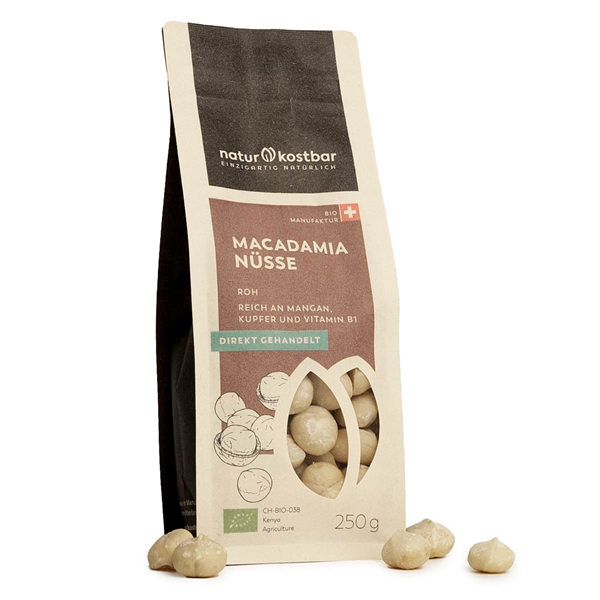
Organic macadamia nuts from Kenya Naturkostbar macadamia nuts are particularly large,crunchy and buttery sweet. Macadamia nuts are among the most expensive nuts in the world due to their difficult cultivation and fluctuating quality, which is why the macadamia nut is also known as the "queen of nuts". Origin and processing These macadamia nuts grow in one of the most fertile regions of Africa, at the foot of Mount Kenya. Due to the high altitude and the associated cold nights, the nuts are of a very high quality. The Kenyan farmers cultivate the nut trees in harmony with nature. After harvesting, the macadamia nuts are gently dried and shelled in the region. They are then imported directly to Switzerland by Naturkostbar. Use The natural macadamia nuts are a special snack thanks to their delicate, creamy sweet flavour. Of course, the delicious nuts can also be used for macadamia milk or in desserts, although macadamia nut is better suited to this. Nutritional information organic macadamia nuts per 100g Energy / nutrient per 100gg/mg/μg%11 reference quantity/daily dose for an average adult (8400kJ/2000kcal) Energy 3021kJ (734kcal) 36% fat 73.1g 104% of which monounsaturated fatty acids 59.1g 394% of which polyunsaturated fatty acids 1.5g - of which saturated fatty acids 12.5g 63% Carbohydrates 5.1g 2% thereof sugar 4.8g 5% protein 8.5g 17% salt 0g 0% Dietary fibre 10.5g 21% Vitamin A - - Vitamin C 6.1mg 8% Vitamin D - - Vitamin E 0.6mg 5% Vitamin K - - B-carotene (provitamin A) - - Vitamin B1 0.73mg 66% Vitamin B2 0.1mg 7% Vitamin B3 2.4mg 15% Vitamin B6 0.3mg 21% Vitamin B12 - - magnesium 120.8mg 32% Copper 0.6mg 60% Manganese 4.8mg 240% selenium - - iodine - - Folic acid/folacin 10µg 5% chloride - - potassium 366mg 18% biotin - - pantothenic acid - - Calcium 75.8mg 9% Phosphorus 196.3mg 28% Iron 3.2mg 23% Zinc 1.3mg 13% Molybdenum - - fluoride - - chromium - -
Content: 250 Gramm (CHF 6.84 / 100 Gramm)
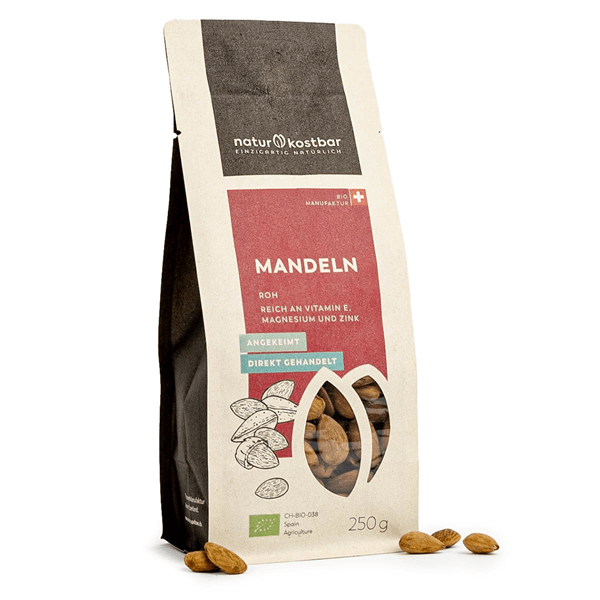
Organic sprouted almonds – double the magnesium and calcium content These organic almonds from Spain are soaked and sprouted at the Naturkostbar factory for several hours. They are then dried for 24 hours at a maximum temperature of 42°C. The sprouting process neutralises the phytic acid present in the almonds and significantly increases their nutrient density. It also makes the almonds easier to digest, which in turn improves nutrient absorption. An analysis of the magnesium and calcium content of raw and sprouted almonds reveals clear differences: Magnesium mg/kg Calcium mg/kg Unsprouted almonds 1140 1430 Sprouted almonds* 2470 3320 *Measured by Wessling Group AG on behalf of Naturkostbar. Uses for sprouted almonds Like normal almonds, sprouted almonds are ideal as a snack on their own or mixed with dried fruit and cocoa nibs to make trail mix. Additional information Contents: 250g bag. Warning: May contain shell fragments. Origin and production: Organic almonds from Spain, sprouted at the Naturkostbar factory in Uetendorf near Thun. Organic certification: CH-BIO-086 Nutritional values for sprouted almonds Nutritional values (average)per 100g/100ml%11Reference intake for an average adult (8400 kJ/2000 kcal) Energy 2508 kJ (607 kcal) 30% Fat 53 g 76% of which saturated fatty acids 5.08g 25% of which monounsaturated fatty acids 36g 240% of which polyunsaturated fatty acids 11.9g - Carbohydrates 3.9g 2% of which sugars 3.5g 4% Fibre 12.6g 25% Protein 22.3g 45% Salt 0.03g 1% Beta-carotene (provitamin A) - - Vitamin A - - Vitamin B1 0.3 mg 27% Vitamin B2 0.4 mg 29% Vitamin B3 4.2 mg 26% Vitamin B6 0.1 mg 7% Vitamin B12 - - Vitamin C - - Vitamin D - - Vitamin E 12 mg 100% Vitamin K - - Biotin 10 µg 20% Calcium 270 mg 34% Chloride 40 mg 5% Chromium - - Iron 4.8 mg 34% Fluoride - - Folic acid/folacin 48 µg 24% Iodine 2 µg 1% Potassium 760 mg 38% Copper - - Magnesium 240 mg 64% Manganese - - Molybdenum - - Pantothenic acid 0.5 mg 8% Phosphorus 510 mg 73% Selenium - - Zinc 6 mg 60%
Content: 250 Gramm (CHF 5.70 / 100 Gramm)
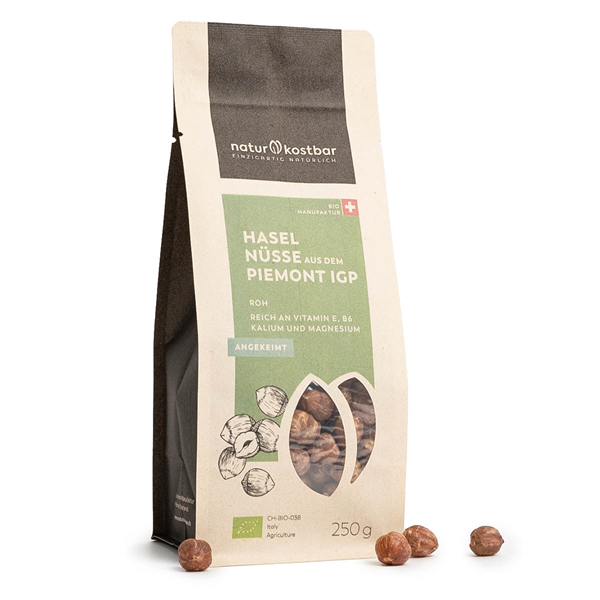
Organic sprouted hazelnuts - double the magnesium and calcium content The organic hazelnuts from Piedmont are soaked and sprouted in the Naturkostbar factory for several hours. They are then dried for 24 hours at a maximum temperature of 42° C. Germination neutralises the phytic acid present in the hazelnuts and significantly increases the nutrient density. In addition, the hazelnuts can be digested better, which also improves nutrient absorption. Use of sprouted hazelnuts Like normal hazelnuts, sprouted hazelnuts are suitable as a snack on their own or mixed with dried fruit and cocoa beans to make a delicious trail mix. Additional information Contents: Bag with 250g. Caution: May contain pieces of shell. Origin and production: Organic hazelnuts from Piedmont (Italy), sprouted in the Naturkostbar Manufaktur in Uetendorf near Thun. Organic certificate: CH-BIO-086 Nutritional values of sprouted hazelnuts Nutritional values Øper 100g/100ml%11 Reference quantity for an average adult (8400kJ/2000kcal) Energy 2650kJ (643kcal) 32% fat 59.5g 85% of which saturated fatty acids 4.2g 21% of which monounsaturated fatty acids 46.6g 311% of which polyunsaturated fatty acids 6.5g - Carbohydrates 6.9g 3% thereof sugar 4.3g 5% Dietary fibre 9.7g 19% Protein 15.2g 30% salt 0.01g 0% B-carotene (provitamin A) - - Vitamin A - - Vitamin B1 0.27mg 25% Vitamin B2 0.1mg 7% Vitamin B3 1.3mg 8% Vitamin B6 0.5mg 36% Vitamin B12 - - Vitamin C - - Vitamin D - - Vitamin E 27mg 225% Vitamin K - - biotin - - calcium 160mg 20% chloride 11mg 1% chromium - - iron 3.6mg 26% fluoride - - Folic acid/folacin 41µg 21% iodine 6.5µg 4% Potassium 720mg 36% Copper - - magnesium 160mg 43% manganese - - molybdenum - - Pantothenic acid 1.2mg 20% phosphorus 320mg 46% selenium - - Zinc 2.9mg 29%
Content: 250 Gramm (CHF 7.56 / 100 Gramm)