These products might also interest you
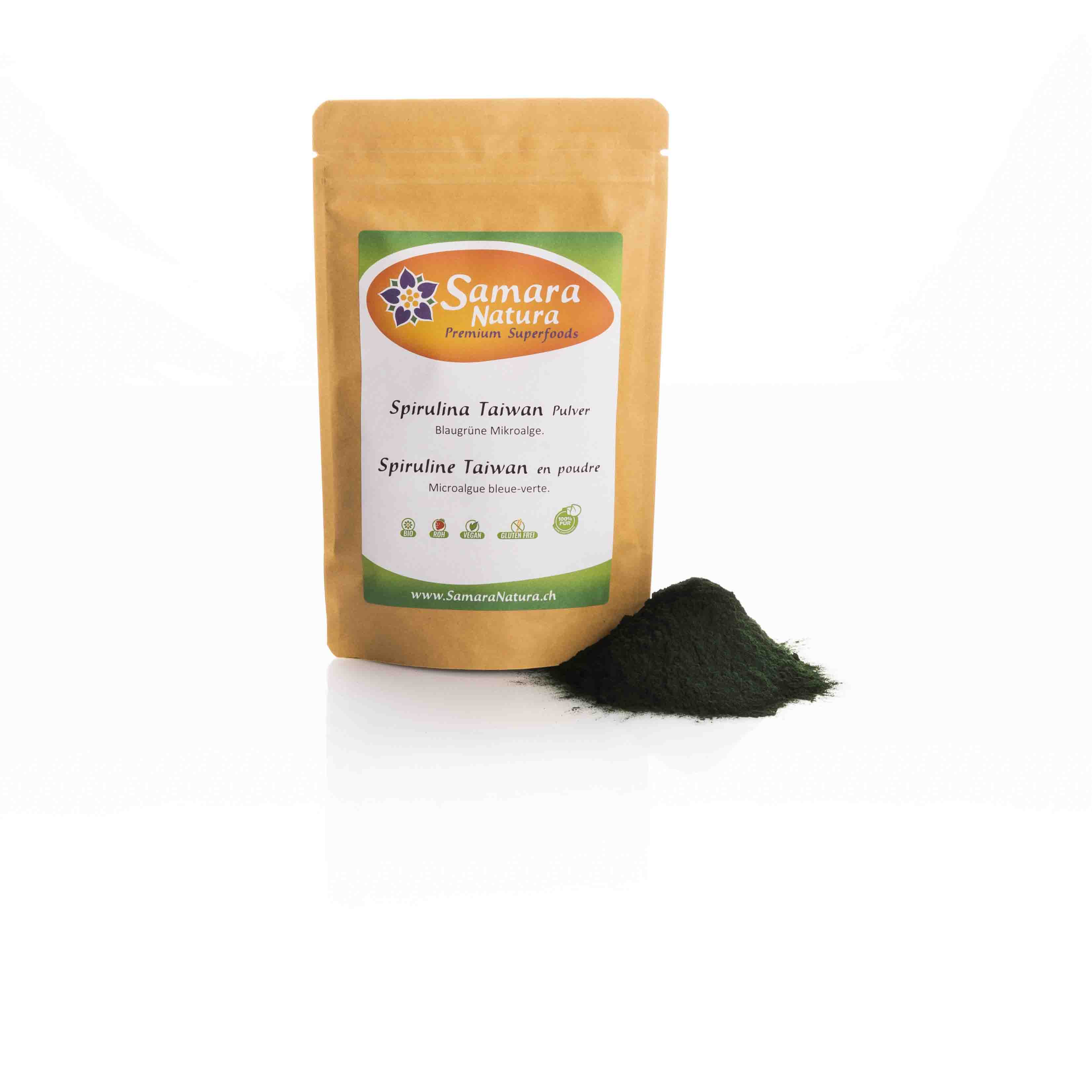
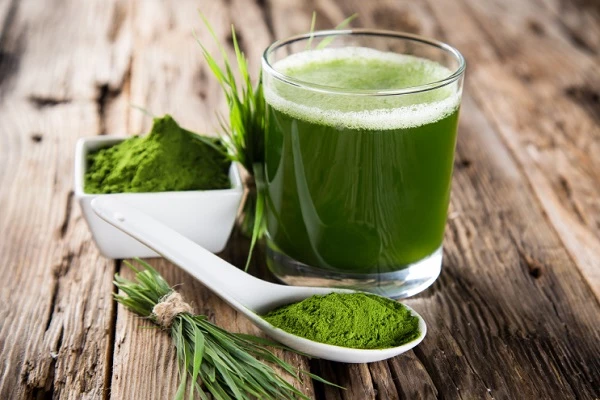
Spirulina algae powder from Taiwan in organic & raw food quality (100% natural) Spirulina platensis is a single-celled, spiral-shaped blue-green algae that has existed on our planet for thousands of years. It gets its typical deep dark colour from the green of the chlorophyll and the blue of the phycocyanin. Spirulina grows in shallow waters with an alkaline pH value between 9 and 11. As it has no cellulose shell, our body can easily break down and digest its components. Why is spirulina useful as a dietary supplement? The blue-green microalgae contains a wealth of nutrients and vital substances. Spirulina powder is particularly rich in protein, provitamin A (β-carotene), iron and vitamin K. The dark colour also indicates a high chlorophyll content. SamaraNatura spirulina algae powder Taiwan BIO Our very high-quality Spirulina platensis in raw food quality comes from controlled organic cultivation in southern Taiwan. It is cultivated in accordance with Naturland guidelines, in pure drinking water under natural climatic conditions and exclusively under sunlight. Compared to other spirulina, it has a very pleasant taste and an incredibly rich blue-green colour. Due to the gentle processing, it has raw food quality. To check the quality, each batch is tested by an independent laboratory in Germany for pesticides, bacteria, algae toxins, heavy metals and radioactivity. How do I use spirulina powder? Mix ½-1 teaspoon with water 3 times a day, as an ingredient for smoothies or with fruit and vegetable juices. As with all food supplements, we recommend starting cautiously and slowly increasing the amount used over the course of a week. This will allow your body to get used to the new product and avoid unwanted side effects such as indigestion. You will usually get used to the somewhat unique flavour quite quickly. If you find using the powder unpleasant even after a few weeks, we recommend using spirulina tablets. Combining spirulina and chlorella The two algae powders are very suitable for combined use due to their nutrients. We recommend taking spirulina together with chlorella in a ratio of 2:1, whereby the total recommended daily dose must not be exceeded. Similar products Spirulina Powder Hawaii | Spirulina Hawaii Tablets | Spirulina Algae Tablets from Taiwan Nutritional values Spirulina algae powder Taiwan BIO per daily portion (3g) Energy value 46kJ/ 11kcal,Fat 0.2g,of which saturated fatty acids 0.1g,Carbohydrates 0.46g,of which sugar 0.02g,Dietary fibre 0.19gProtein 1.75g,salt 0.02g,Provitamin A (β-carotene) 245µg (31%*),Iron 3.9mg (28%*),Vitamin K 13µg (17%*).*the recommended daily intake. Important notes The product is not intended as a substitute for a balanced and varied diet and a healthy lifestyle. The recommended daily dose must not be exceeded. Vitamin A and iron contribute to the normal function of the immune system and normal cell division. Vitamin K contributes to normal blood clotting. Storage As the dry spirulina powder absorbs water from the air, you should always store the packaging tightly closed in a dry place. Even if our sachets have light protection, please do not expose the product directly to the sun.
Content: 125 Gramm (CHF 16.87 / 100 Gramm)
Average rating of 5 out of 5 stars
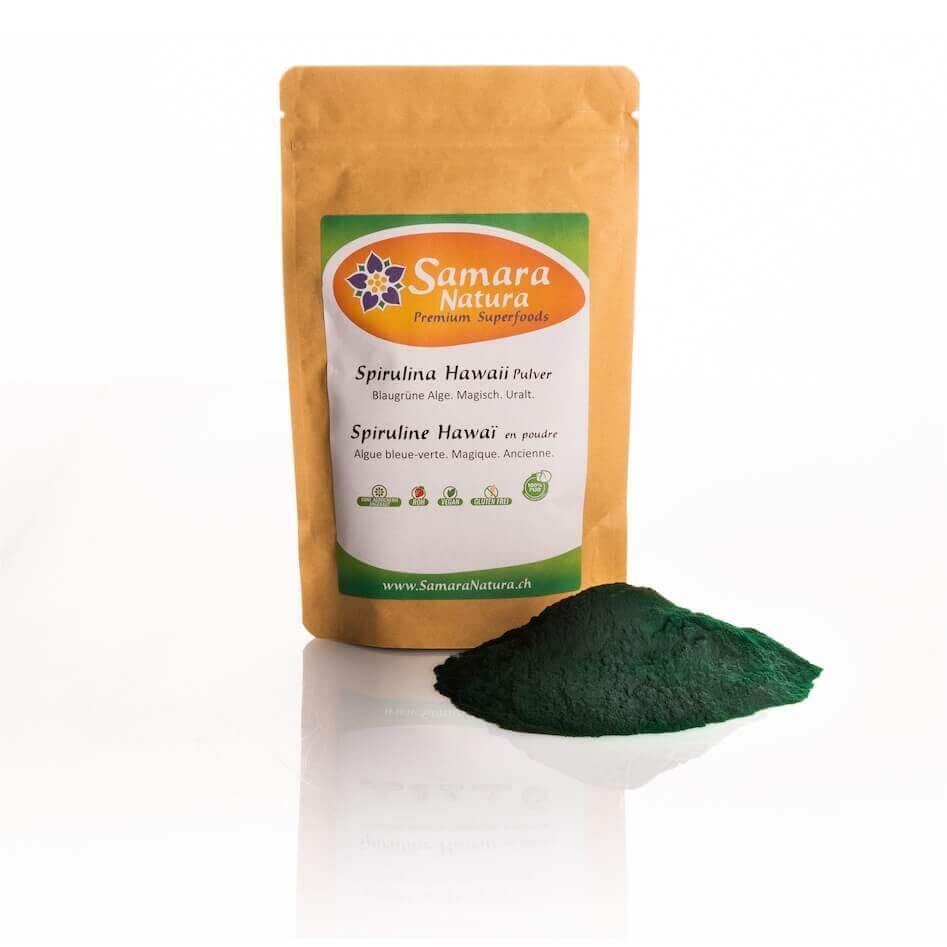
Spirulina powder - the high-quality original from Hawaii (100% natural) What is spirulina? Spirulina is a single-celled, filamentous blue-green algae and one of the first life forms on this planet. Richer in high-quality protein (contains 18 amino acids) than any other food, the microalgae also contains a wealth of vitamins, minerals, important antioxidants such as SOD and phycocyanin, polysaccharides and the rare gamma-linolenic acid. Spirulina is at the forefront of the nutritional revolution. With its rich composition and ability to grow even under unfavourable conditions, the microalgae has great potential to become a food source that will help feed the world's population. By integrating spirulina into our diet, we are making a contribution to solving the food crisis. The effect of spirulina? Spirulina is a valuable food. The algae is incredibly rich, a "wholefood". It is believed to contain all the vital substances that the human body needs. The high density of vital substances brings vitality and well-being. The antioxidants can scavenge free radicals and highly reactive oxygen compounds and are therefore important for the maintenance and function of cells. The detailed nutritional values are listed below. What makes our spirulina powder special? Our Spirulina Pacifica has been cultivated in Hawaii for over 25 years(video with flight over the plantation) and is regarded as one of the highest quality spirulina in the world. In a special, oxygen-free drying system, the spirulina is dried very gently so that more nutrients and enzymes are retained - e.g. over 40% more ß-carotene and over 75% more zeaxanthin - than is possible with conventional drying systems. Spirulina Pacifica is grown in open ponds 20 cm deep, a few hundred metres from the Pacific Ocean. To fill the ponds, fresh water is mixed with seawater from a depth of 600 metres, which is rich in minerals and trace elements. The other most important substances for cultivation in terms of quantity are food-grade baking powder (sodium bicarbonate) and carbon dioxide. Food-grade fertilisers are also used. Paddle wheels move the water to provide the algae with uniform sunlight for optimal growth conditions and nutrient uptake. Spirulina from Hawaii is grown without pesticides or herbicides and does not contain any genetically modified organisms. Our spirulina is called Spirulina Pacifica and is a selected strain of Spirulina platensis that has developed over many years of cultivation in Hawaii. Spirulina Pacifica was intensively analysed by molecular biologists at the University of Hawaii. They identified new enzymes that were not found in other Spirulina platensis strains. Tips for use in everyday nutrition The powder is most often mixed with fruit and vegetable juices. Spring water is also very good and promotes maximum absorption. Spirulina can also be added to food like a spice to avoid loss of nutrients, but it should only be heated a little. Spirulina has a unique flavour that blends well with almost anything. If you are not used to the flavour of green foods, it may take some getting used to at first. If you find that your energy is running low during the day, take some spirulina with water and observe how your body feels 1-2 hours later. You will be amazed. Recommended intake Beginners and children: 1-2 g per day Adults: up to 3g per day It is recommended to start with 1 teaspoon (5 g) or slightly less and gradually increase the intake up to 10 g (1 heaped tablespoon) to avoid indigestion. Taking 1 tsp one hour before meals can help to reduce appetite. The dry powder absorbs water from the air, so the packaging should be tightly sealed and stored in a cool, dry and dark place Complementary product recommendations We recommend taking spirulina together with chlorella in a ratio of 2:1. Similar products Spirulina Hawaii Tablets | Spirulina Algae Powder from Taiwan | Spirulina Algae Tablets from Taiwan Recipes with spirulina Example: Heavy Metal Detox Smoothie 2 bananas 250g wild blueberries (frozen) or 2 tbsp wild blueberry powder 1 large bunch of fresh coriander Juice of 2 oranges 1 tsp spirulina Hawaii powder 1 tsp barley grass juice powder 1 small handful of dulse flakes Water as required More recipes here. Spirulina platensis: Nutritional values per daily portion (3g) Energy value 42kJ/10kcal Protein 2g Carbohydrates <1g Provitamin A (β-carotene) 2,715mg (57%*) Iron 5mg (36%*) Magnesium 15mg (5%*) Vitamin K (K1, K2) 40µg (40%*) Manganese 0.2mg (10%*) Sodium 50mg (3%*) Chlorophyll 19mg Phycocyanin 270mg Gamma-linolenic acid 32mg Carotenoids 13mg Zeaxanthin 3mg *of the recommended daily dose/Apport journ. recommandé Vitamin A and iron contribute to the normal function of the immune system and to normal cell division, vitamin K maintains the normal coagulation capacity of the blood. All information is subject to the usual fluctuations of natural products. The product is not intended as a substitute for a balanced and varied diet and a healthy lifestyle. Keep out of reach of children. The recommended daily dose must not be exceeded.
Content: 125 Gramm (CHF 19.99 / 100 Gramm)
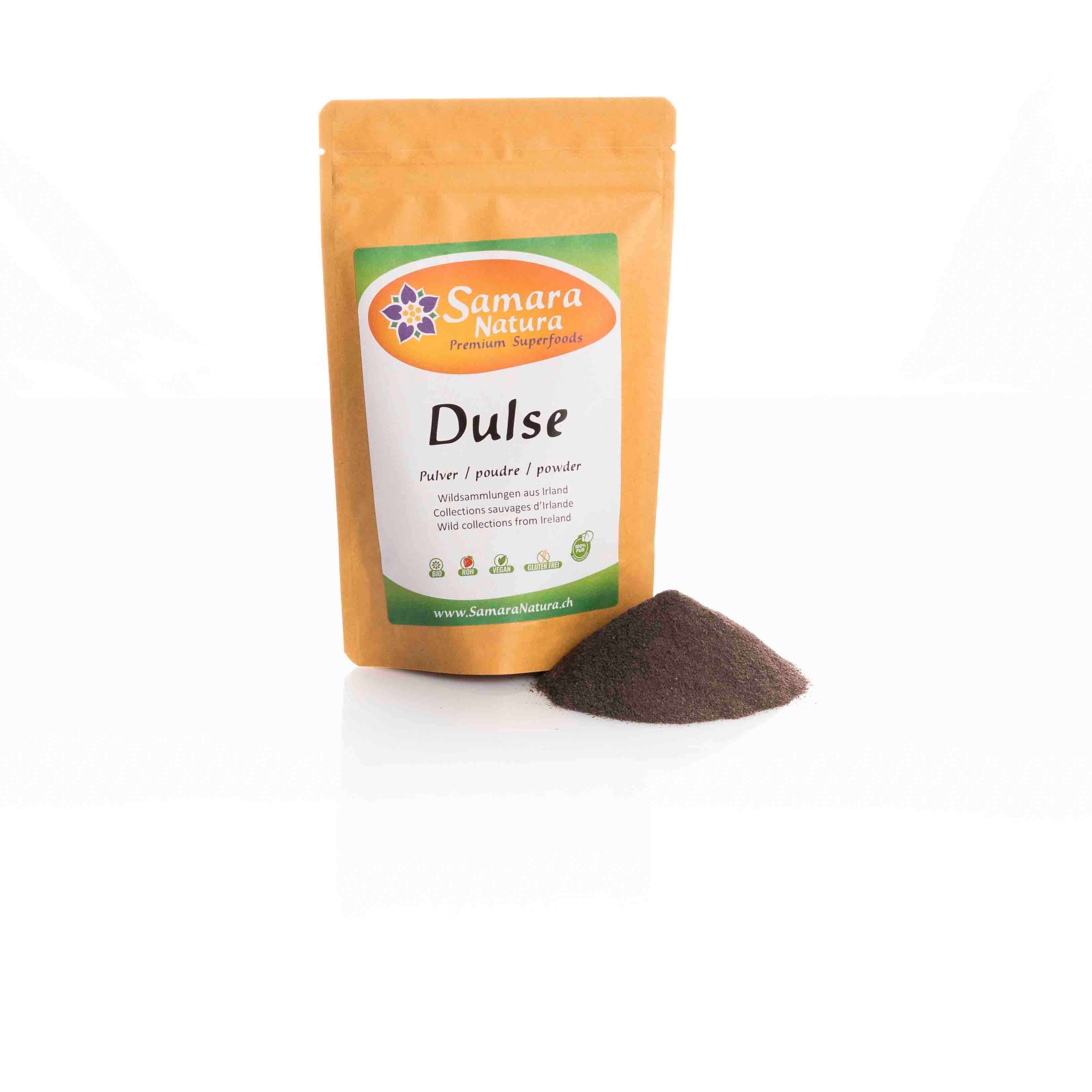
Update: The new batch of dulse powder will be packaged on 6 February. In the meantime, we recommend the finely ground dulse flakes (approx. 1mm in size). Atlantic dulse powder (lobster seaweed, red algae) in organic & raw food quality We have been stocking a wide and high-quality range of organic Atlantic dulse for many years. This dulse powder from Ireland is the simplest form for detox smoothies. It can also be used to flavour food. We also offer dulse flakes from Ireland and dulse leaves cut from Galicia (Spain). Several sizes are available and you can benefit from graduated prices (5% quantity discount from 3 pieces). Atlantic dulse or lobster seaweed (Palmaria palmata) is a red algae, soft with a bite and a strong purple-red colour. It does not need to be cooked or soaked. This makes dulse a great snack or a flavourful topping for potato and lentil dishes as well as salads. In recent years, dulse has also become popular as an ingredient in detox smoothies. Dulse is extremely low in calories, fat- and cholesterol-free, rich in minerals as well as vitamin B6, fibre and protein. It has the highest iron content of all sea vegetables. 10g of dried dulse is equivalent to around 100g of fresh dulse. Why use dulse powder Dulse is one of the easiest sea vegetables to use. It tastes mild and spicy and adds flavour and colour to any dish. It is also one of the few purple coloured foods and purple is the colour of spiritual consciousness, the third eye. Irish dulse from wild collection Our dulse is collected wild in the west of Ireland at low tide and harvested by hand. With the help of a cold air drying system, the organic seaweed is dried very gently and in raw food quality. The leaves are then ground into powder. Variants: Due to the different consumption quantities and requirements, we offer dulse powder in 100g and 250g bags. The larger bag is approx. 16.5% cheaper. Use of dulse Dulse has been traditionally harvested for generations and can be eaten straight from the bag or used as an ingredient in smooties. Dulse is also suitable steamed over potatoes or crispy roasted as a snack or with salads and other dishes. As a raw food straight from the bag or in salads (can be rinsed beforehand if necessary). In soups and stews, ideal with pulses and cereal dishes. Add towards the end of the cooking time. Ingredients 100% organic dulse / lobster kelp (Palmaria palmata). Important notes Due to the high mineral content, we recommend a daily ration of 5g. Particular caution is advised for people with thyroid disorders due to the iodine content. These seaweeds may contain parts of crustaceans and grains of sand due to processing. Therefore, please check the leaves/flakes briefly before consumption. Nutritional values per 100g / per 5g (portion) Energy 320Kcal/1340KJ / 16Kcal/67KJProteins 14.8g / 0.7gCarbohydrates 47.7g / 2.4gof which sugar 12.8g / 0.6gFat 2.56g / 0.1gof which saturated fatty acids 1g / 0.05gDietary fibre 7.9g / 0.4gSalt 5.4g / 0.3gVitamin B12 4.8µg / 0.24µgIron 23mg / 1.2mgSelenium 0.3mg / 0.01mgIodine 32mg / 1.5mg Sea vegetables in general Sea vegetables are wild plants of the ocean that grow on coral reefs and rocky coasts, usually in salt water. Sea vegetables are enjoyed in many coastal regions around the world and enrich most dishes with flavour and nutrients. Sea vegetables contain almost all the minerals and trace elements that the sea has to offer! In general, sea vegetables are an excellent source of calcium, iodine and sodium, a very good source of folic acid and magnesium and a good source of iron, potassium, vitamin B2 and B5. They also contain vitamin K and trace elements such as selenium and chromium, which are often lacking in land vegetables due to depleted soils. Sea vegetables are an ideal substitute for salt in a wide variety of dishes.
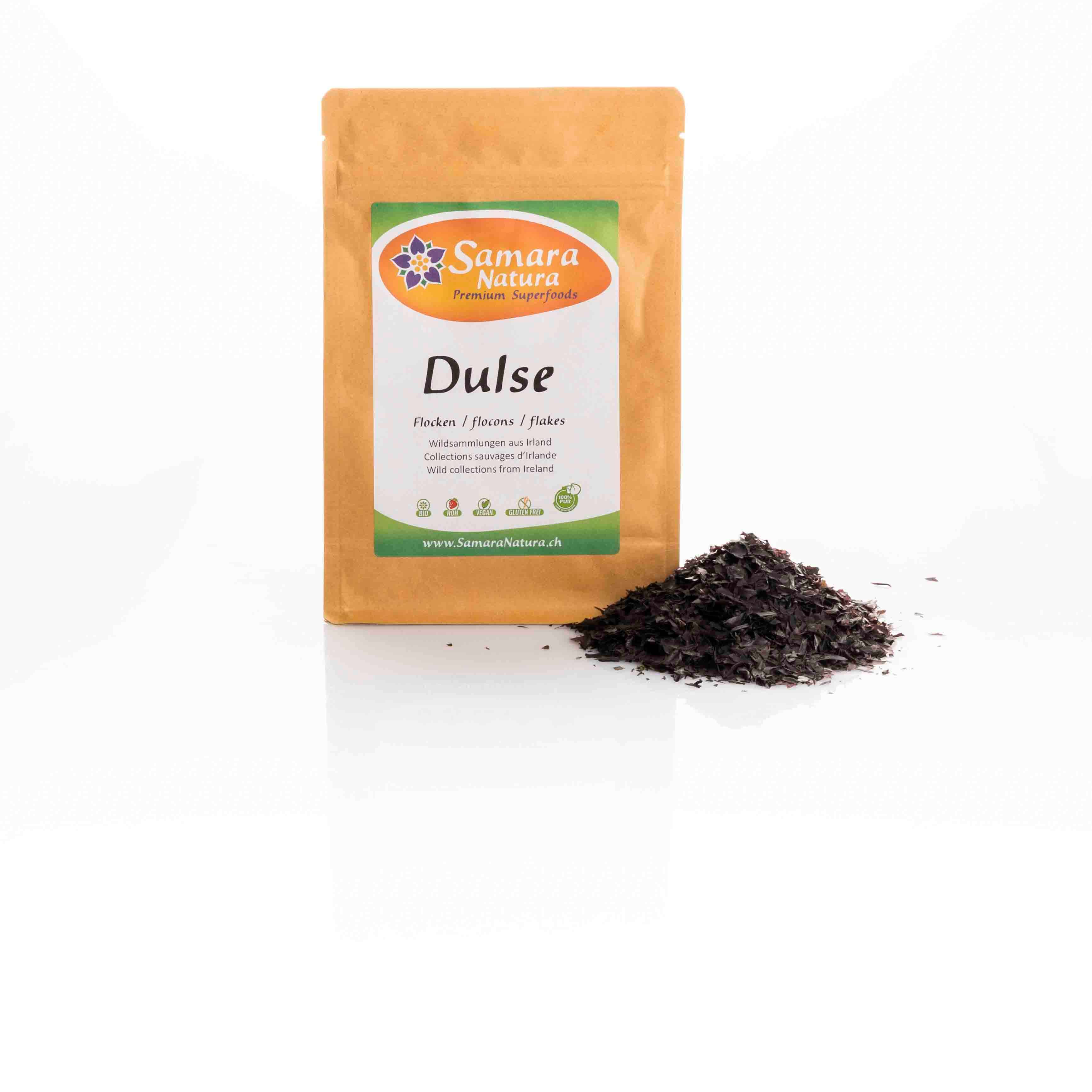
Update: The new batch is ground finer than before. The dulse flakes are only approx. 1 mm in size. Atlantic dulse flakes from Ireland, organic & raw food quality What is dulse? Atlantic dulse or lobster seaweed (Palmaria palmata) is a red algae, crunchy with a bite and a strong purple-red colour. It does not need to be cooked or soaked and can therefore be used in many different ways in the kitchen. Dulse is extremely low in calories, fat- and cholesterol-free, rich in minerals as well as vitamin B6, fibre and protein. It has the highest iron content of all sea vegetables. 10g of dried dulse is equivalent to around 100g of fresh dulse. Why consume dulse? Dulse is one of the easiest sea vegetables to use. It tastes mild and spicy and adds flavour and colour to any dish. It is also one of the few purple-coloured foods and purple is the colour of spiritual consciousness, the third eye. What makes our dulse flakes from Ireland special? The dulse seaweed comes from quality producers in Ireland. After harvesting, the wild-growing organic dulse is dried very gently and in raw food quality using a cold air drying system. They are then ground into flakes. Please note: Due to the wild harvest, small mussels may adhere to the dulse leaves. The producer himself and we check the purity as well as possible when packing into the bags. For safety reasons, we ask you to briefly check the dulse flakes before eating them. Varying consistency (bite resistance) The consistency (firmness) of the dulse flakes can vary depending on the batch and season. This may be due to the time of harvest or the development of the individual plants at the time of harvest. Dulse algae are wild-growing plants. They are generally harvested shortly before flowering so that the plants are still young enough to be sufficiently tender. Prolonged soaking or heating (boiling) reduces the bite strength. How to use dulse flakes? Dulse has been traditionally harvested for generations and can be eaten straight from the bag (rinsed beforehand if necessary) or used as an ingredient in smoothies (e.g. for detox smoothies). They are also suitable as a topping for salads, sandwiches as well as lentil dishes or rice dishes.Dulse is also suitable steamed over potatoes or crispy roasted as a snack and other dishes. In soups and stews, ideal with pulses and cereal dishes. Add towards the end of the cooking time. Ingredients 100% Dulse/ Lappentang (Palmaria Palmata)** from certified organic origin Important notes Due to the high mineral content, we recommend a daily ration of 5g. Particular caution is advised for people with thyroid disorders due to the iodine content. These seaweeds may contain parts of crustaceans and grains of sand due to processing. Therefore, please check the leaves/flakes briefly before consumption. Nutritional values per 100g / per 5g (portion) Energy 320Kcal/1340KJ / 16Kcal/67KJProteins 14.8g / 0.7gCarbohydrates 47.7g / 2.4gof which sugar 12.8g / 0.6gFat 2.56g / 0.1gof which saturated fatty acids 1g / 0.05gDietary fibre 7.9g / 0.4gSalt 5.4g / 0.3gVitamin B12 4.8µg / 0.24µgIron 23mg / 1.2mgSelenium 0.3mg / 0.01mgIodine 32mg / 1.5mg
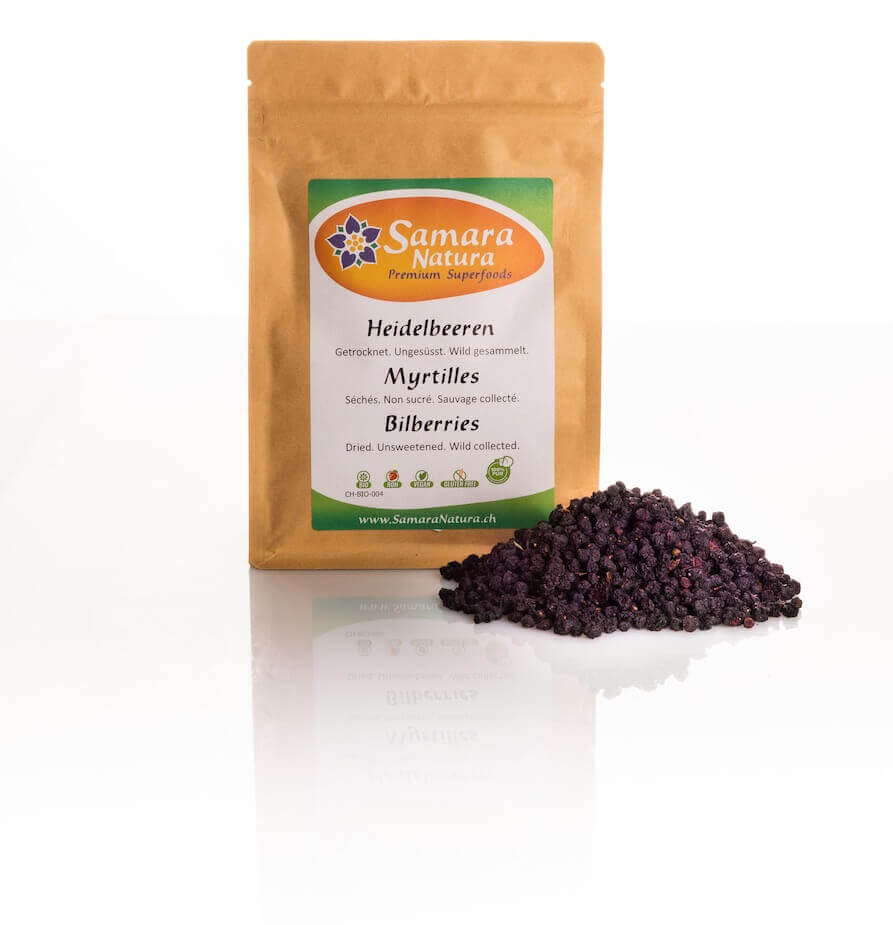
Wild organic blueberries - antioxidants and flavour combined To complement our range, we also offer organic blueberry powder from Bosnia. Packed with healthy nutrients like no other fruit - a real superfruit. Why eat dried organic blueberries from wild harvesting? Great snack: delicious and nutritious Wide range of important nutrients and particularly rich in vitamins C, E and B6 as well as iron, fibre and other vital substances such as resveratrol, zeaxanthin, lutein, anthocyanins and other polyphenolic compounds Because they contain such a high amount of phenols, especially gallic acid, blueberries are known as "nerve protectors". According to researchers from Iran, this means that they can literally protect our brains from degeneration, neurotoxicity and oxidative stress. Particularly for a fruit is its high iron content, which boosts energy levels by producing oxygen-rich blood cells throughout the body. In addition, dried wild blueberries contain a very high antioxidant capacity of around 50,000 µmol TE/100g (ORAC value = Oxygen Radical Absorption Capacity). For healthy skin Skin care products containing bilberry extract are becoming increasingly popular around the world. It has been reported that the broad spectrum of vitamins and minerals helps to restore hormonal balance, which counteracts acne. This makes blueberries an excellent home remedy for acne. Blueberries also contain resveratrol, a natural sunscreen that can tan your skin. What makes our wild organic blueberries special? 100% natural, gently processed and dried (raw food quality) No preservatives, colourings, sweeteners or other unnatural additives Natural flavour: sweet and sour, fruity and very aromatic Dark purple colour (high quality and purity) and quite dry and crispy Different sizes and origins Dried organic blueberries from wild collection are very difficult to obtain. In northern countries they are also often frozen or freeze-dried. The latest batch of air-dried blueberries comes from Bosnia again and we have packed them in 125g, 250g and 1kg bags. The difference between wild and cultivated blueberries They look almost the same. Both are blue, round and taste great. But what are the differences between these two berries? Wild blueberries compared to cultivated blueberries have a higher vitamin content and a much higher anthocyanin content. Blueberry has become a universal name for blue-coloured berries of the Vaccinium genus, but it is good to know the difference between cultivated blueberries (often called American blueberries or blueberries) and wild blueberries (European blueberries). While cultivated blueberries are grown in various places around the world, wild blueberries grow on small bushes mainly in the northern parts of the Northern Hemisphere. The anthocyanins in the wild blueberry are visible to the eye as blue and red pigments in the flesh, which is juicy and bluish-purple in colour. The cultivated blueberry, on the other hand, has an almost transparent white and somewhat floury flesh. The wild blueberry has certainly been used since the 16th century, both the dried berries and the leaves. Modern interest stems in part from the use of the fruit by British pilots during the Second World War, when pilots noticed that their night vision was better on bombing missions after eating bilberry jam. Nowadays, only garden blueberries (American blueberries) from cultivation are available, which are simply not as good and significantly less rich in vital substances than wild blueberries. How to integrate them into your daily diet? Thanks to their intense, typical blueberry flavour, they are perfect as an addition to muesli, smoothies and as a dessert topping. When making smoothies, we recommend soaking the wild blueberries overnight to make them easier to blend. They also go well in yoghurt (including vegan coconut yoghurt) and honey. A real treat! Nutritional values of wild blueberries per 100g Energy value 1310 kJ / 310 kcalProtein 5 gCarbohydrates 58 gof which sugar 37 gFat 6.3 gof which saturated fatty acids 0 gof which monounsaturated fatty acids 3.33 gof which polyunsaturated fatty acids 2.97 gDietary fibre 36.4 gVitamin C 223 mg (278%*)Vitamin E 14.1 mg (117%*)Vitamin B6 0.74 mg (53%*)Iron 5.2 mg (37%*)All information is subject to the usual fluctuations in natural products.*Per cent of the recommended daily intake for an adult according to the LGV. Storage: Store in a cool, dry and dark place.
Content: 125 Gramm (CHF 14.44 / 100 Gramm)
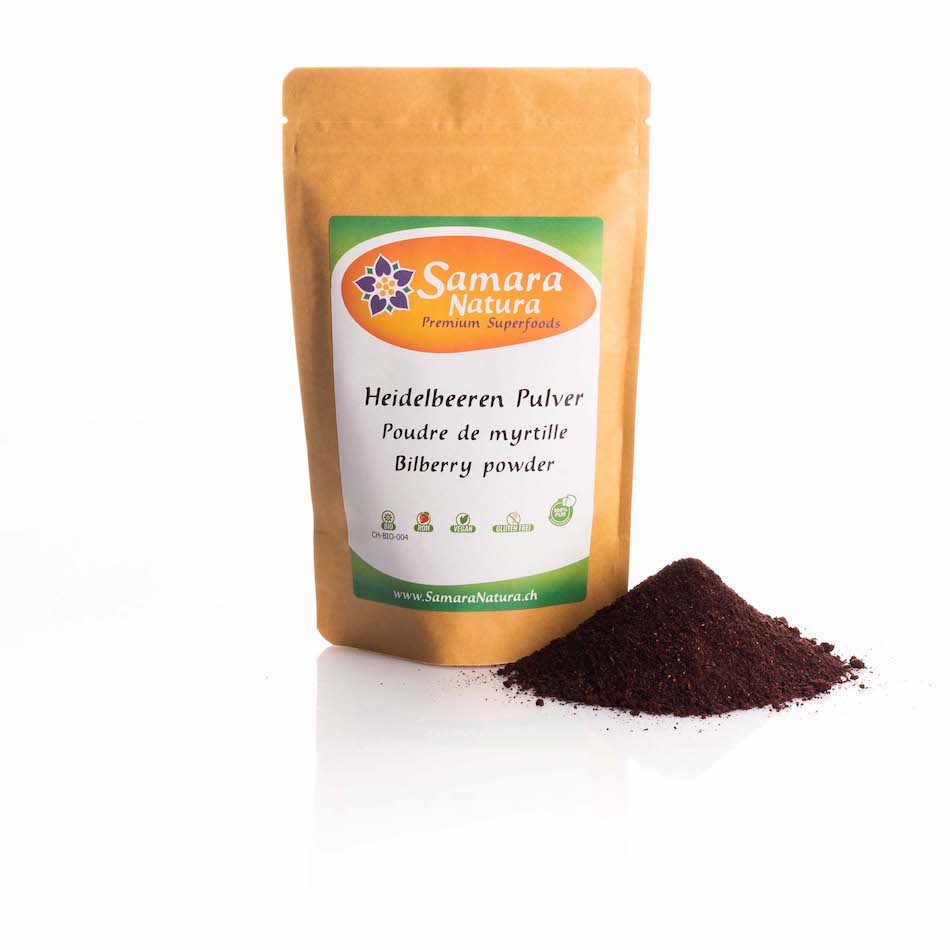
Update: The new batch is now available in all three sizes. To complement this, we also continue to stockdried, whole blueberries (also wild-harvested)in our range. Organic blueberry powder from wild harvests (100% natural) The blueberries are wild-harvested in south-eastern Europe. The current batch comes from Bosnia. Theblueberry powder has an intense dark colour. It is very aromatic and has a fruity, sweet taste. Why consume blueberry powder? Blueberry powder offers a range of health benefits due to its nutrient density and high antioxidant content. Antioxidants: High concentration of antioxidants, particularly anthocyanins, which can help combat free radicals. Anti-inflammatory properties: Helps combat inflammation in the body. Digestive health: Cleanses the digestive tract and aids digestion thanks to its high fibre content. Blueberry powder can also have a positive impact on gut health and heart health. It is a convenient, tasty and simple way to incorporate high-quality nutrients and antioxidants into your diet. What makes our blueberry powder special? 100% pure fruit powder No sweeteners, preservatives or other additives The wild blueberries are processed with care under strict hygienic conditions at temperatures below 42°C = raw food quality Important: This is NOT pomace, but whole, dried wild blueberries that have been ground into a powder. How to use blueberry powder? The blueberry powder has excellent flow properties and is ideal for: Smoothies: Add a teaspoon of blueberry powder to your favourite smoothie to boost its nutritional value Yoghurt: Stir the powder into yoghurt to give it an extra dose of antioxidants and nutrients Baking: Use blueberry powder as an ingredient in baked goods such as cakes, muffins or pancakes Muesli: Add the powder to muesli or porridge to enrich it with extra nutrients and flavour Drinks: Stir the powder into water or juice to create a refreshing and healthy drink Smoothie bowls: Use the powder as a topping on smoothie bowls to make them healthier and tastier What sizes are available? To cater for different customer needs, we currently offer wild blueberry powder in three sizes: 125g, 250g and 500g.Tip: The best-before date is approximately 12 months, so it’s well worth buying a larger pack. For easy use at home, you can also transfer the contents of the pack into a storage jar with a screw-top lid.Nutritional values for blueberry powder per 100g Energy 1309 kJ/310 kcalFat 6.3gof which saturated fatty acids 0gCarbohydrates 58gof which sugars 37.3gDietary fibre 19.7gProtein 5.3gSalt 0.01g
Content: 125 Gramm (CHF 18.62 / 100 Gramm)
Average rating of 5 out of 5 stars
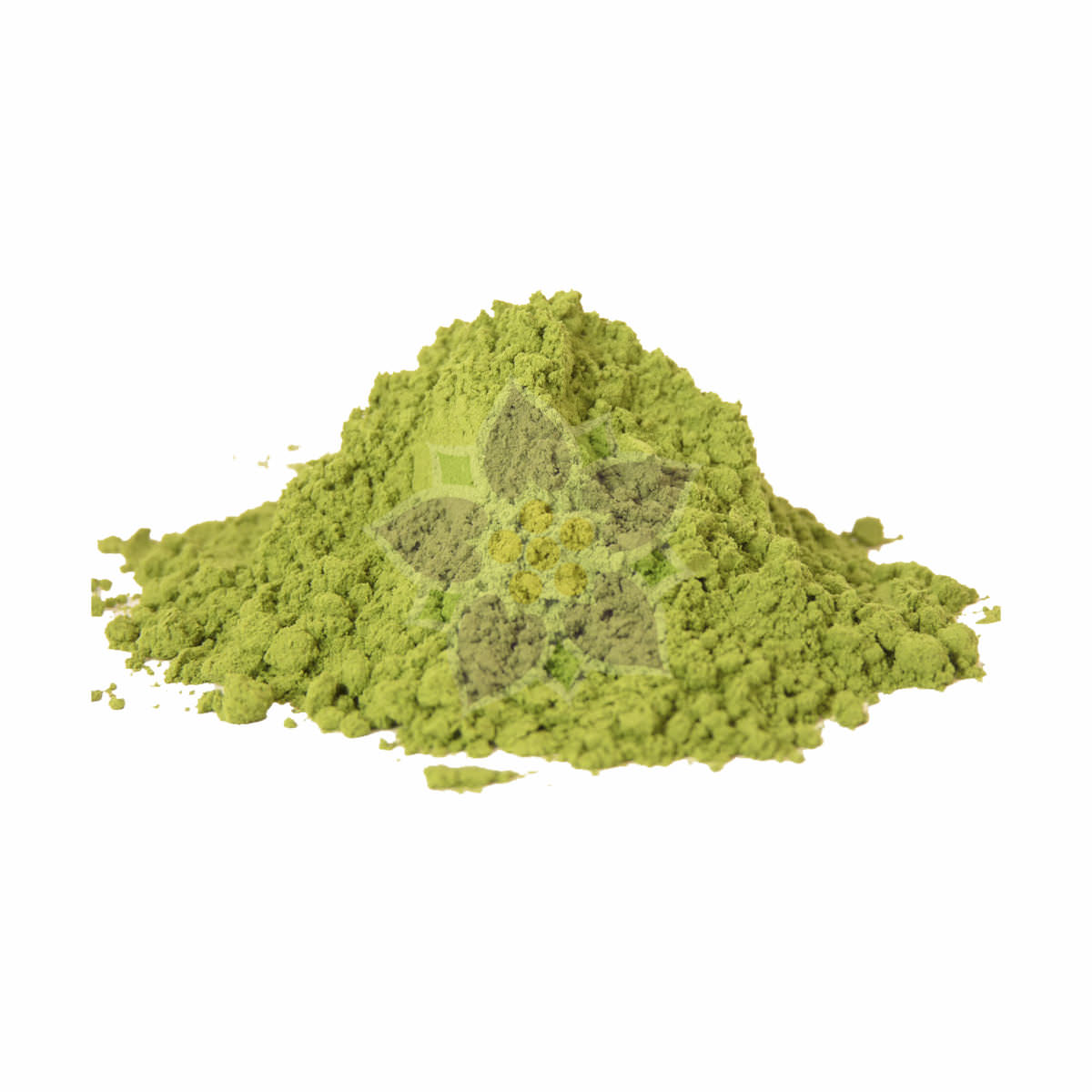
Organic barley grass powder from Germany (100% natural) Why consume barley grass powder? Barley grass contains a variety of vitamins, minerals, enzymes, amino acids, phytochemicals and antioxidants. Regular use of barley grass powder can help the body maintain its optimal level of all necessary nutrients. Barley grass is very easy to digest. It is also cheaper than most multivitamin and multimineral products. It's easier to lead a happy and active life in a body that is fuelled with all the nutrients it needs! What makes our barley grass powder special? Our barley grass powder is 100% pure, grown without pesticides or agrochemicals and is made from young shoots, which is why it has such a rich green colour. The grasses grow exclusively outdoors in the sun-drenched, mineral-rich and fertile soils of southern Germany (Lake Constance region). They are harvested before the stalks develop and immediately dehydrated at low temperatures. Gentle drying and grinding takes place in a regional company at temperatures below 38°C, which preserves many nutrients and vital substances. This ensures that the high-quality nutrients, including the heat-sensitive enzymes and vital substances, are preserved. Where does our barley grass powder come from? Grasses vary in their nutrient content depending on where, when and how they grow. Our organic grass is grown in the fertile soils of southern Germany. Each field is harvested only once, after which it is ploughed up. Use of barley grass powder Add the barley grass powder to water, water kefir, fresh fruit and vegetable juices, smoothies, food or other drinks. Initially ½ tsp daily, increase to 1-2 tsp or more as required. It is best to drink ½ hour before meals. The amount of powder should only be increased gradually so that the body can get used to it. Tip: Mix 1 tsp with 3 litres of apple spritzer. Drink promptly after mixing Note: Barley grass powder can have a high vitamin K content. Cautious use may be appropriate for hypersensitive individuals. Due to its antioxidant properties, grass powders are also suitable for external use. They are ideal for skin and hair care. In powder form, grasses are a good mouthwash and an excellent tooth cleanser. The grasses are also suitable for dogs and cats. You can mix the powder into their food, both in dry and moist form. Origin Grown and regionally produced in southern Germany. Professionally packaged by the Ancora-Meilestei Foundation in Wetzikon. Nutritional values of barley grass powder per 100g and (portion 1 tsp = 2g) Energy value 1125kJ/270kcal (23kJ/5kcal) fat 3.2g (0.06g of which saturated fatty acids 0.4g (0.01g) Carbohydrates 17g (0.34g) thereof sugar 3.8g (0.08g) Dietary fibre 34g (0.68g) protein 23g (0.46g) salt 0.04g (0.00g)
Content: 250 Gramm (CHF 9.50 / 100 Gramm)
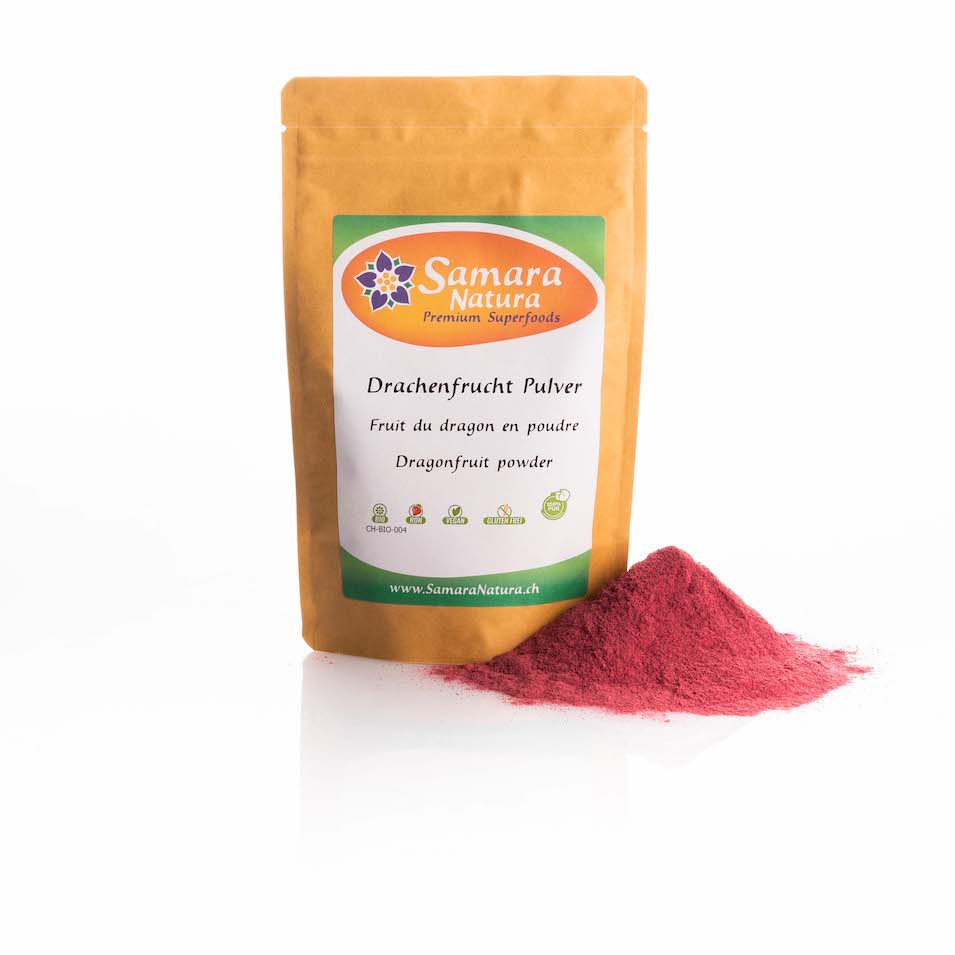
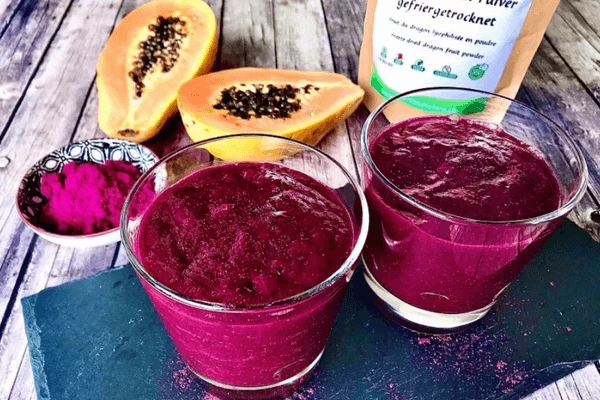
Dragon fruit powder (pitaya) red | organic, sun-dried (100% natural) This is sweeter in taste and has a bright pink colour. For the liver smoothie, however, we recommend this sun/air-dried dragon fruit powder because it is processed more gently. What is dragon fruit powder? Originally from Central and South America, dragon fruit (pitaya or pitahaya) is the fruit of a cactus plant. Why consume organic dragon fruit powder? Organic dragon fruit powder is characterised by its high fibre content and is recommended for liver cleansing. It has a subtle, floral to woody flavour, making it a great ingredient for many dishes and drinks. The natural red colour adds a nice splash of colour to your smoothie! What makes our organic dragon fruit powder special? Our organic dragon fruit powder comes from the species "Hylocereus monacanthus" with red flesh and pink-coloured skin. The organic dragon fruit is grown in Nicaragua, sun-dried and gently ground into a fine powder directly on site. The local value creation guarantees work and income for the local population.The dragon fruit powder is organic and raw food quality and 100% pure, i.e. without any additives. Size variantsWe offer the dragon fruit powder in 2 weight variants: 125g and 250g.Contents: 100% organic dragon fruit powder. Tips for use Mix 2 heaped teaspoons (5g) into muesli, yoghurt or smoothie. For the liver smoothie, 2 tablespoons of red dragon fruit powder are recommended. Liver smoothie recipe Ingredients: 2 tbsp dragon fruit powder2 tbsp dried wild blueberries or 2 tbsp wild blueberry powder2 bananas or 1 papaya (cut into cubes) 120 ml water (as required) Place all the ingredients in the blender. Blend until smooth, adding water until the desired consistency is achieved. Nutritional values of organic red dragon fruit powder (pitaya) per 100g Energy value 1256kJ/300kcalFat 0gof which saturated fatty acids 0.0gCarbohydrates 10gof which sugar 10gDietary fibre 60gProtein 10gSalt 0.05gCalcium 600mgIron 2mg
Content: 125 Gramm (CHF 19.76 / 100 Gramm)
Sea buckthorn powder | organic, sun-dried (100% natural) Update: The sea buckthorn powder has been added to our existing fruit powder range and is available in 125g bags. We also continue to stock dried sea buckthorn berries and sea buckthorn juice. What is sea buckthorn powder? Description follows. Why consume organic sea buckthorn powder? Description follows What makes our organic sea buckthorn powder special? Description follows. Tips for use Add 1 heaped teaspoon (approx. 5g) to muesli, yoghurt or smoothie. Nutritional values of red organic sea buckthorn powder per 100g Energy value 2045kJ/489kcalFat 25gof which saturated fatty acids 4gCarbohydrates 24gthereof sugar 14gDietary fibre 28gProtein 13gSalt 0.06g
Content: 125 Gramm (CHF 14.44 / 100 Gramm)
Average rating of 4.2 out of 5 stars
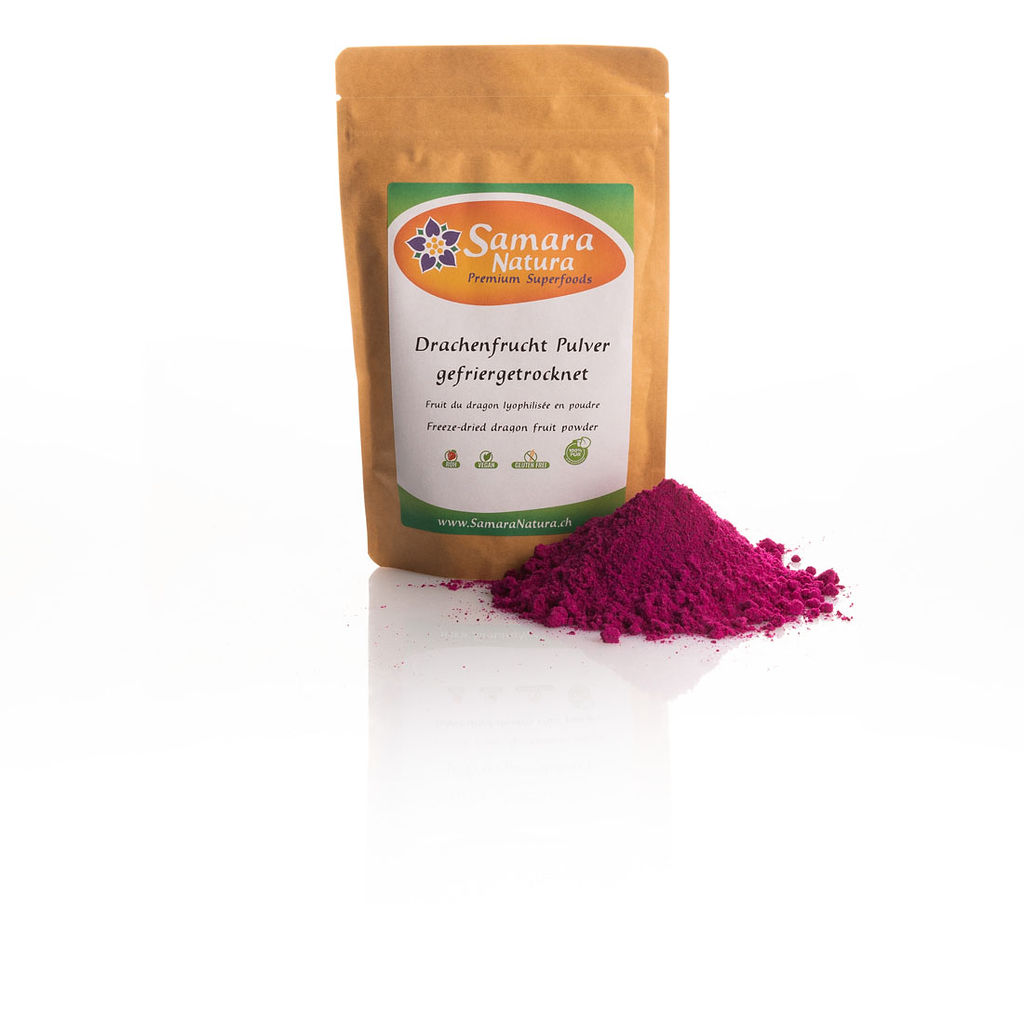
Dragon fruit powder red (pitaya) freeze-dried from 100% organic dragon fruit Update: The new batch of freeze-dried dragon fruit powder has arrived and is now available in 125g and 250g bags. In addition, we continue to offer the sun-dried organic dragon fruit powder from Nicaragua. This freeze-dried dragon fruit powder tastes sweet and has a bright pink colour. To make it stick together less quickly, we have now integrated 1-2 food-safe dry bags into the packaging bags. We also recommend always storing the bag tightly closed at room temperature. Originally from Central and South America, the dragon fruit (pitaya or pitahaya) is the fruit of a cactus plant. Our fruit powder comes from the species "Hylocereus polyrhizus" with red flesh and pink-coloured skin. Why consume dragon fruit powder? Rich in antioxidants: Can help reduce cell damage and strengthen the immune system Digestive system support: Rich in fibre, which can help aid digestion and prevent constipation Nutrient density: Dragon fruit powder is rich in vitamins, iron and calcium = important nutrients for health Energy boost: Dragon fruit powder contains natural sugars and carbohydrates that provide a quick source of energy Healthy skin: The antioxidants can help keep skin healthy and young looking by fighting free radicals that can cause cell damage. Immune system support: The anti-inflammatory properties can help reduce inflammation in the body and strengthen the immune system. What makes our freeze-dried dragon fruit powder special? Raw food quality: The dragon fruit from Vietnam is freeze-dried in the EU and ground into a fine powder. The natural pink colour turns your food and drinks into a visual experience. Organic certification How to use freeze-dried dragon fruit powder? Freeze-dried dragon fruit powder is a versatile ingredient that can be used in a variety of ways. Here are some suggestions on how to incorporate freeze-dried dragon fruit powder into your diet: Smoothies: add one to two teaspoons of dragon fruit powder to your favourite smoothie for fruity flavour and extra nutrients Yoghurt and muesli: sprinkle dragon fruit powder over yoghurt or muesli for extra flavour and nutrients Ice cream and desserts: Add dragon fruit powder to ice cream, pudding or other desserts for a hint of fruitiness and nutrients Drinks: Stir a teaspoon of dragon fruit powder into water or tea for a refreshing and healthy drink Nutritional values of freeze-dried dragon fruit powder per 100g Energy value 1570kJ/375kcalFat 4gof which saturated fatty acids 0.0gCarbohydrates 58gof which sugar 50gDietary fibre 25gProtein 8gSalt 0.0g
Content: 125 Gramm (CHF 20.52 / 100 Gramm)
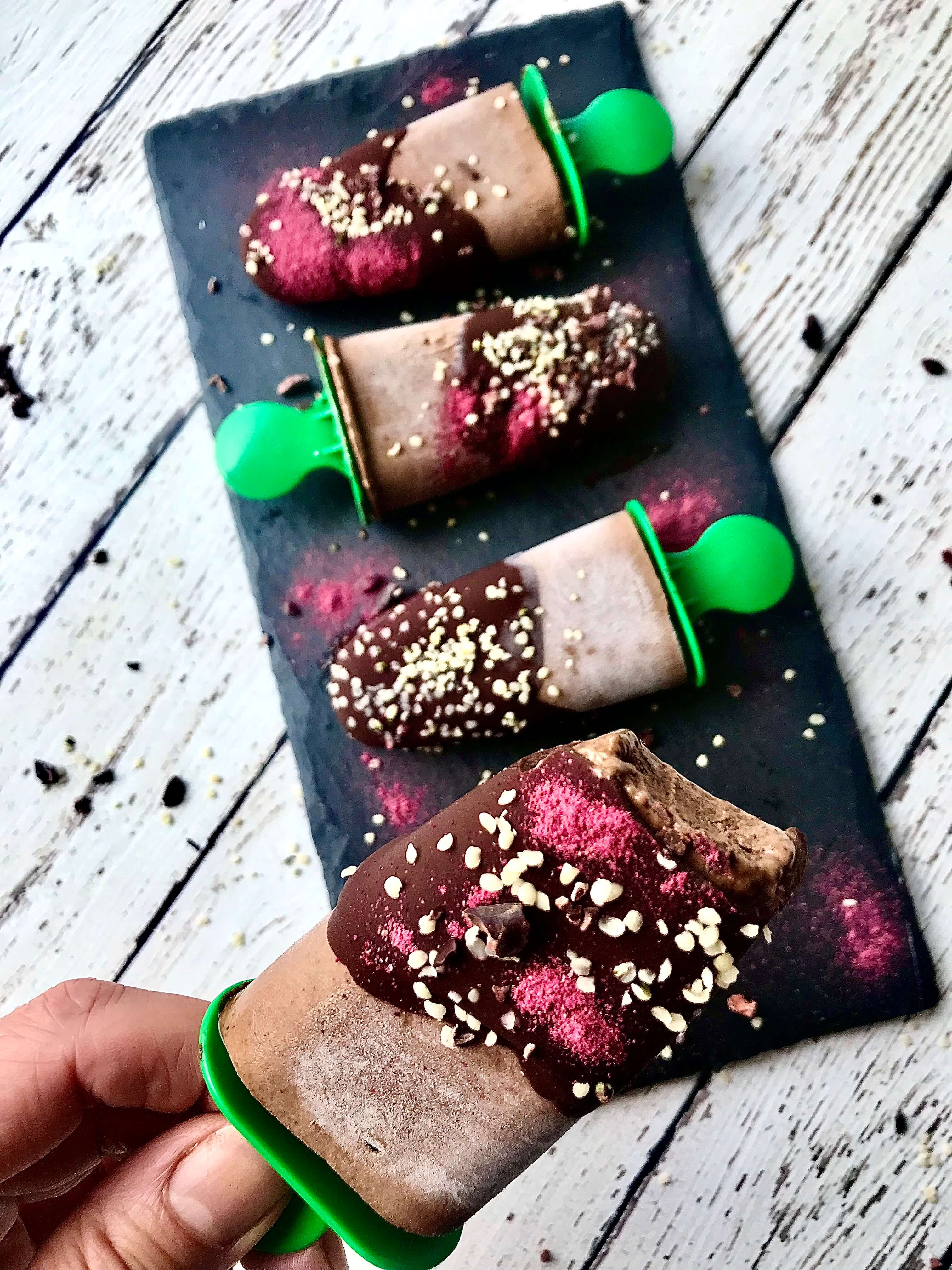
Our promotions - benefit now
Update: The new batch of dulse powder will be packaged on 6 February. In the meantime, we recommend the finely ground dulse flakes (approx. 1mm in size). Atlantic dulse powder (lobster seaweed, red algae) in organic & raw food quality We have been stocking a wide and high-quality range of organic Atlantic dulse for many years. This dulse powder from Ireland is the simplest form for detox smoothies. It can also be used to flavour food. We also offer dulse flakes from Ireland and dulse leaves cut from Galicia (Spain). Several sizes are available and you can benefit from graduated prices (5% quantity discount from 3 pieces). Atlantic dulse or lobster seaweed (Palmaria palmata) is a red algae, soft with a bite and a strong purple-red colour. It does not need to be cooked or soaked. This makes dulse a great snack or a flavourful topping for potato and lentil dishes as well as salads. In recent years, dulse has also become popular as an ingredient in detox smoothies. Dulse is extremely low in calories, fat- and cholesterol-free, rich in minerals as well as vitamin B6, fibre and protein. It has the highest iron content of all sea vegetables. 10g of dried dulse is equivalent to around 100g of fresh dulse. Why use dulse powder Dulse is one of the easiest sea vegetables to use. It tastes mild and spicy and adds flavour and colour to any dish. It is also one of the few purple coloured foods and purple is the colour of spiritual consciousness, the third eye. Irish dulse from wild collection Our dulse is collected wild in the west of Ireland at low tide and harvested by hand. With the help of a cold air drying system, the organic seaweed is dried very gently and in raw food quality. The leaves are then ground into powder. Variants: Due to the different consumption quantities and requirements, we offer dulse powder in 100g and 250g bags. The larger bag is approx. 16.5% cheaper. Use of dulse Dulse has been traditionally harvested for generations and can be eaten straight from the bag or used as an ingredient in smooties. Dulse is also suitable steamed over potatoes or crispy roasted as a snack or with salads and other dishes. As a raw food straight from the bag or in salads (can be rinsed beforehand if necessary). In soups and stews, ideal with pulses and cereal dishes. Add towards the end of the cooking time. Ingredients 100% organic dulse / lobster kelp (Palmaria palmata). Important notes Due to the high mineral content, we recommend a daily ration of 5g. Particular caution is advised for people with thyroid disorders due to the iodine content. These seaweeds may contain parts of crustaceans and grains of sand due to processing. Therefore, please check the leaves/flakes briefly before consumption. Nutritional values per 100g / per 5g (portion) Energy 320Kcal/1340KJ / 16Kcal/67KJProteins 14.8g / 0.7gCarbohydrates 47.7g / 2.4gof which sugar 12.8g / 0.6gFat 2.56g / 0.1gof which saturated fatty acids 1g / 0.05gDietary fibre 7.9g / 0.4gSalt 5.4g / 0.3gVitamin B12 4.8µg / 0.24µgIron 23mg / 1.2mgSelenium 0.3mg / 0.01mgIodine 32mg / 1.5mg Sea vegetables in general Sea vegetables are wild plants of the ocean that grow on coral reefs and rocky coasts, usually in salt water. Sea vegetables are enjoyed in many coastal regions around the world and enrich most dishes with flavour and nutrients. Sea vegetables contain almost all the minerals and trace elements that the sea has to offer! In general, sea vegetables are an excellent source of calcium, iodine and sodium, a very good source of folic acid and magnesium and a good source of iron, potassium, vitamin B2 and B5. They also contain vitamin K and trace elements such as selenium and chromium, which are often lacking in land vegetables due to depleted soils. Sea vegetables are an ideal substitute for salt in a wide variety of dishes.
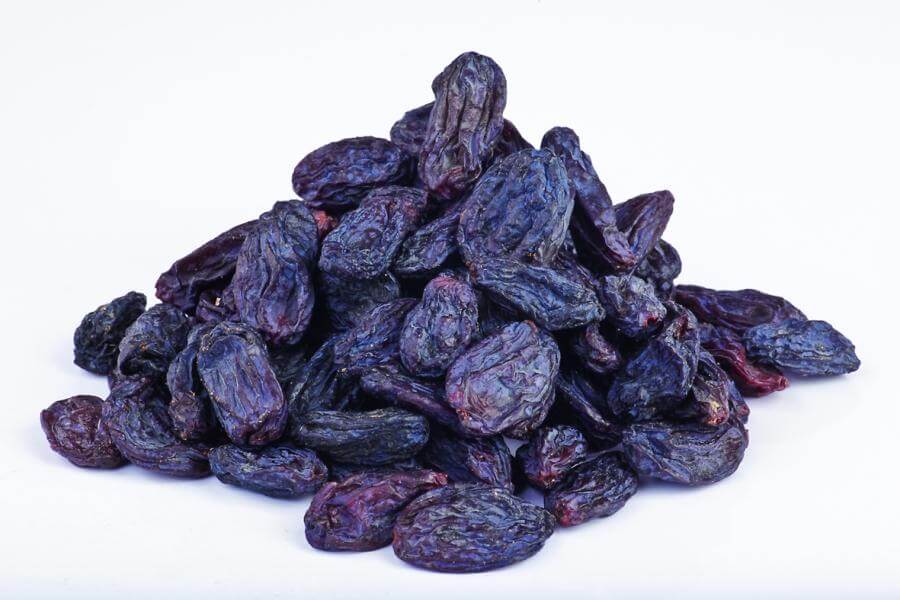
Organic green Khorog sultanas High-quality, raw, unoiled, unsulphurised organic sultanas from Uzbekistan. They are named after the ancient city of Khorog, which lies in the mountains on the old Silk Road. Green Khorog sultanas are no ordinary sultanas. The differences between the various types of sultanas are greater than you might think. They differ greatly in appearance and flavour. In addition to these Khorog sultanas, we also have black Bukhara sultanas and Manucca sultanas in our range. Khorog raisins have a sweet flavour, but are not too sweet. When the bag is open for a longer period of time, they change colour from green to brown. Our Green Khorog are picked at the best stage of ripeness and gently dried in the shade to preserve their natural quality. Use Due to their unique flavour, we recommend enjoying Green Khorog sultanas on their own. However, they can also be added to muesli, trail mix or snack bars and can be used for baking. Khorog sultanas are also particularly suitable for stirring into a curry. Sultanas are a good source of antioxidants, fibre, iron and calcium. And by the way, they are quite high in calories, so watch your portion size! Warnings May contain traces of nuts. Nutritional values of green Khorog sultanas per 100g Energy value 1262 kJ / 298 kcal Fat 0.6g - of which saturated fatty acids 0.2g Carbohydrates 66g - of which sugar 60gDietary fibre 5.2g Protein 2.5g Salt 0.05g
Content: 250 Gramm (CHF 5.13 / 100 Gramm)
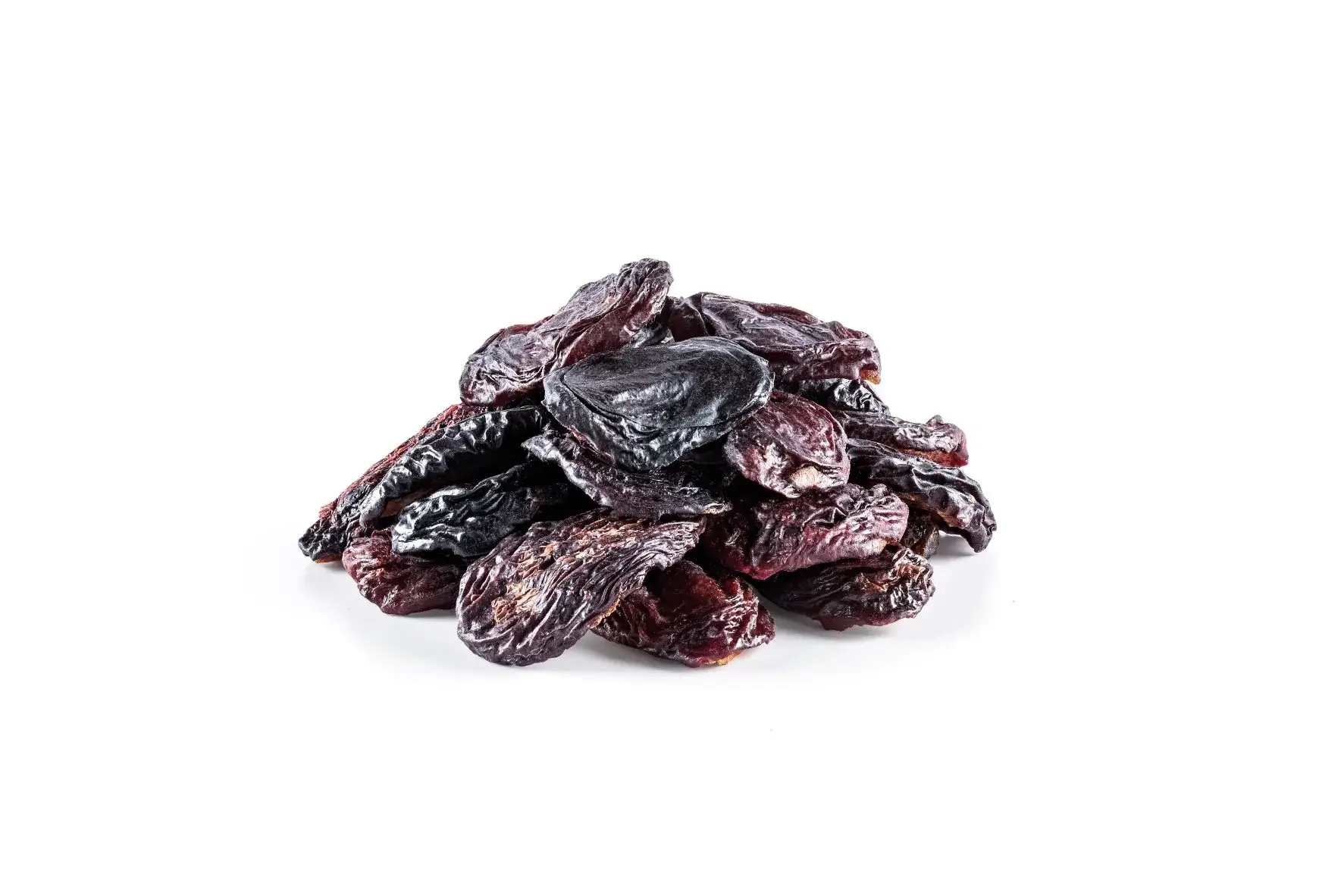
Wild dried plum halves organic bag The raw, unoiled and unsulphured organic prune halves without stones have a delicious, sweet and sour flavour. They grow wild on the mountain slopes along the old Silk Road from Samarkand (Uzbekistan). The wild plums are gently dried in the sun at below 42°C to preserve their natural flavour and nutrients. They are slightly less soft than most plums, but in terms of flavour and nutritional value, they are the best in the world - if you ask us. To make them softer again, you can simply soak the prunes overnight. Why prunes are healthy? We've never understood why "prune" is a dirty word. Because prunes are a valuable food. Prunes are rich in fibre, which can also help with constipation. They also contain sorbitol, which gives them a mild laxative effect. We therefore recommend not snacking on more than a handful. They also contain potassium, niacin, manganese, iron and the mineral boron, which strengthens bones and muscles. Uses The dried fruit can be used in a variety of ways - as a snack between meals, as an exciting addition to muesli, for making your own nut and fruit bars or as an ingredient with a tangy flavour for savoury dishes. Warnings May contain traces of nuts. Nutritional values of dried wild prune halves per 100g Energy value 1000 kJ / 237 kcal Fat 0.6g - of which saturated fatty acids 0.2g Carbohydrates 51g - of which sugar 42gDietary fibre 9g Protein 2.3g Salt 0.02g
Content: 250 Gramm (CHF 5.60 / 100 Gramm)
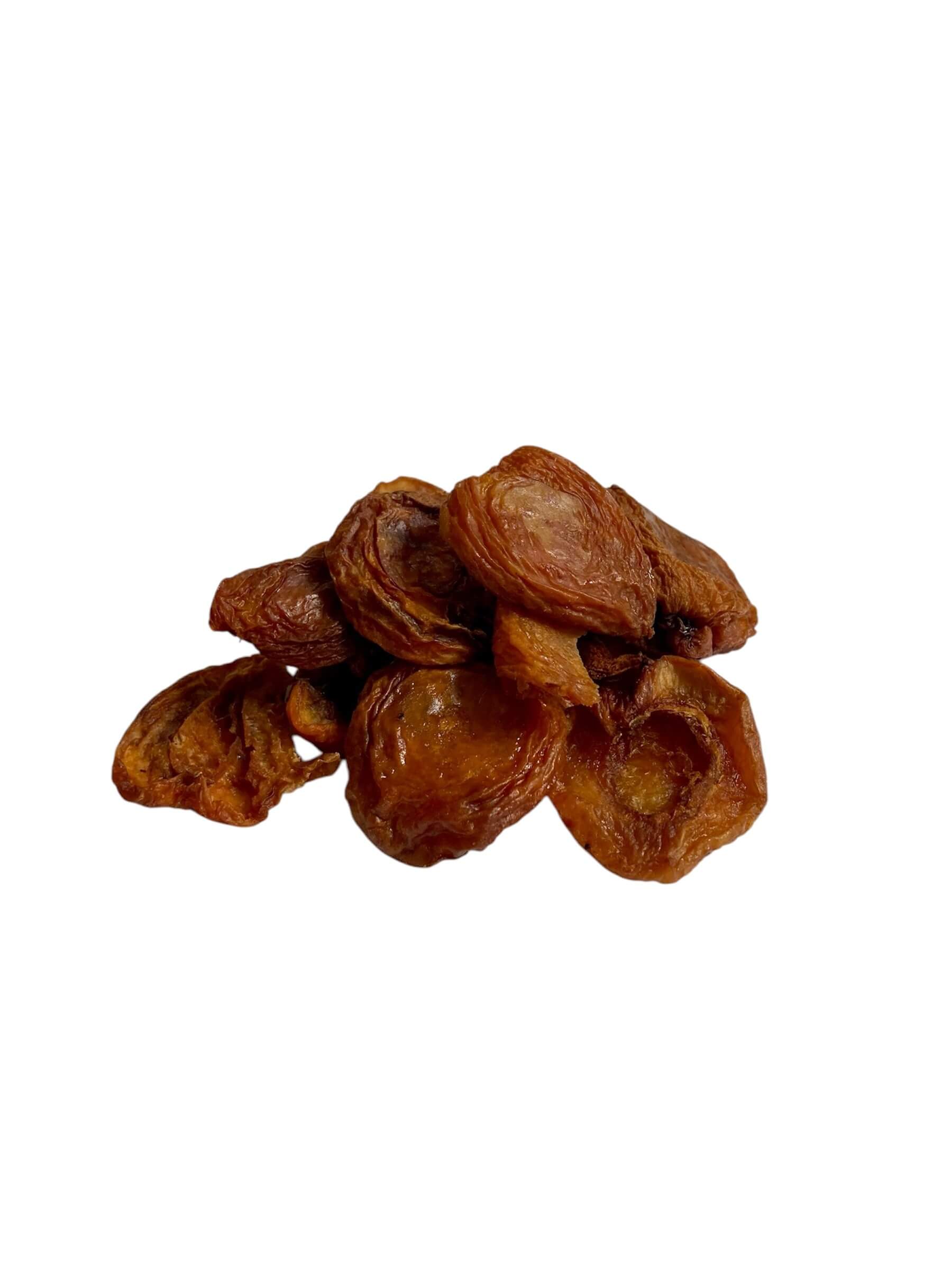
Wild organic Kuraga apricots dried from Uzbekistan The flavoursome Kuraga apricot halves without stones are hand-picked from wild trees. They come from mountainous regions along the old Silk Road in Uzbekistan, where the wild trees contribute to natural biodiversity. The apricots are gently dried in the sun at below 42°C to preserve their natural flavour and nutrients. Kuraga apricots have a stronger sweet and sour flavour than most other apricots. Related to the peach, the apricot is a fragrant fruit with a soft, velvety skin. Uses This versatile fruit is perfect for trail mixes, as a snack, for salads or savoury dishes. Cut into small pieces, Kuraga apricots are also great in muesli or yoghurt. Warnings May contain pits and parts of pits despite careful processing. May contain traces of nuts. Nutritional values Wild Kuraga apricots dried per 100g Energy value 1004 kJ / 238 kcalFat 0.6g - of which saturated fatty acids 0.0gCarbohydrates 48 - of which sugar 45gFibre 11gProtein 5gSalt 0.03g
Content: 250 Gramm (CHF 6.40 / 100 Gramm)
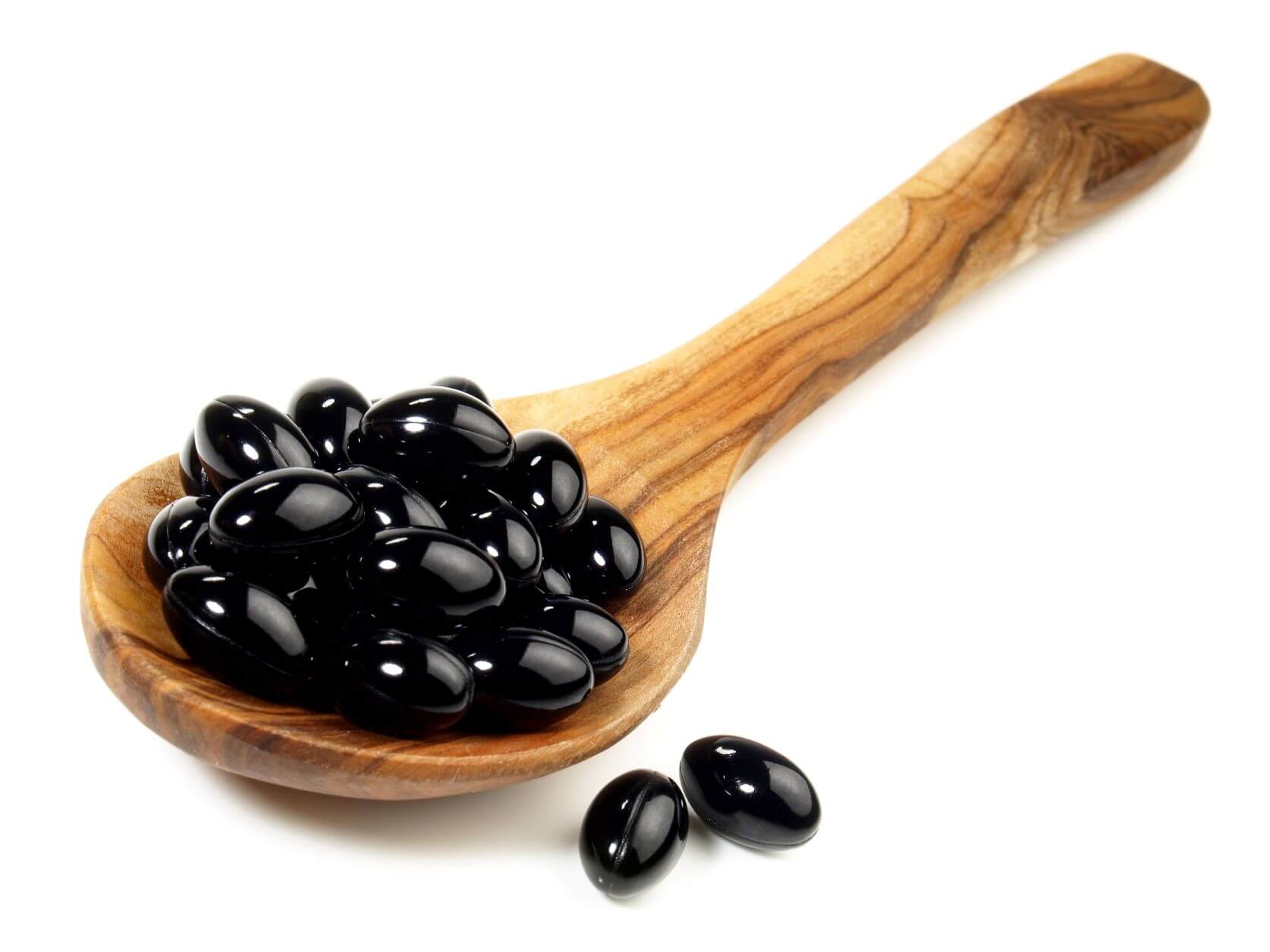
Hawaiian BioAstin® with astaxanthinHawaiian BioAstin® with astaxanthin from the microalgae Haematococcus pluvialis. The carotenoid astaxanthin produced in the blood rain algae is a natural pigment that is also found in fruit and vegetables and gives salmon and crustaceans a reddish colour. Benefits of astaxanthin capsules Antioxidant effectAnti-inflammatory propertiesSupport for eye, skin and brain healthPositive influence on athletic performance Who is it particularly suitable for? People who suffer from increased oxidative stressOlder peoplePeople with skin problemsAthletes Origin and productionThe algae are cultivated in open freshwater ponds on the sunny west coast of Kona (Hawaii) and processed directly on site(video of a flight over the cultivation ponds in Kona, Hawaii). The producer is the market leader in the cultivation of microalgae and has been setting the highest quality standards for three decades. The extraction temperature of the astaxanthin is at least 60 degrees Celsius, which means that the product is not raw. Consumption recommendation Recommended intake: 1-2 capsules daily with the main meal, swallowed with plenty of liquid. Nutrients per 2 capsules BioAstin® 160 mg, of which astaxanthin 8 mg. Ingredients BioAstin® (Haematococcus pluvialis extract, virgin olive oil, safflower oil with high oleic acid content), softgel capsule made from non-genetically modified maize starch, carrageenan (seaweed), glycerine (vegetable), sorbitol, purified water, vitamin E (natural mixed tocopherols from sunflower oil). Bag contents The sachet contains 90 astaxanthin capsules of 0.77g each = total 70g. If 2 capsules are taken per day, one sachet will last for 45 days. Important information Food supplement with astaxanthin: The product is not intended as a substitute for a balanced and varied diet and a healthy lifestyle. The recommended daily dose must not be exceeded. Not suitable for children and adolescents. Not suitable for pregnant and breastfeeding women. In case of medical treatment and uncertainty, consult a specialist about the use of this product. Keep out of the reach of children. Store in a cool, dark and dry place.
Content: 90 Stück (CHF 27.44 / 100 Stück)
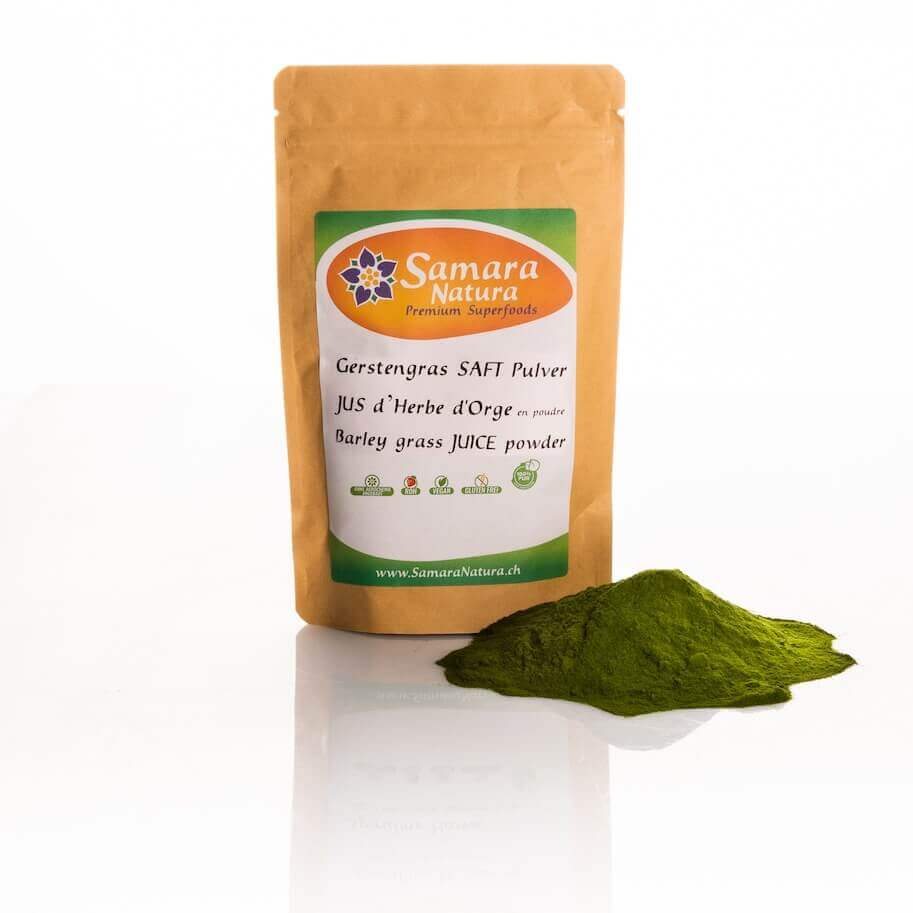
Turmeric capsules (95% curcumin) with piperine & more In addition to the popular turmeric powder, we now have turmeric capsules in our range. These do not simply contain turmeric powder, but a mixture of high-quality plant extracts: Indian turmeric extract with 95% curcumin Indian black pepper extract with 95% piperine Matcha powder The benefits of capsules Turmeric capsules bring convenience and practicality. Compared to turmeric powders or liquids, our capsules offer an extremely easy way to integrate the health benefits of turmeric into your everyday life. Why consume turmeric capsules? Curcumin is a bioenhancer. Bioenhancers themselves have no pharmacological effect. However, they increase the bioavailability of vitamins and minerals. They can also increase the effectiveness of medicines against high blood pressure, tuberculosis, cancer, bacteria or fungi. People taking such medicines should only use turmeric in consultation with their doctor. It has been scientifically proven that mild gastrointestinal complaints such as flatulence and bloating can be alleviated. Recommended intake Swallow 1 capsule daily with the main meal, with plenty of liquid. The recommended daily dose must not be exceeded. The product is not intended as a substitute for a balanced and varied diet and a healthy lifestyle. Nutrients per recommended intake (1 capsule) Curcumin 140mg, piperine 2mg. Ingredients Filler gum arabic (from sustainably produced acacia fibres), turmeric extract 29%, matcha powder, hydroxypropyl methyl cellulose (capsule shell), black pepper extract. Important information Not suitable for children and adolescents. Not suitable for pregnant and breastfeeding women. Consumption may increase the effectiveness of medicines. Keep out of reach of small children. Store in a cool, dry place away from light. Manufactured in Germany. Contents Each sachet contains approx. 90 capsules of 533mg each. The net weight is 48g.
Content: 90 Stück (CHF 30.61 / 100 Stück)
Average rating of 5 out of 5 stars
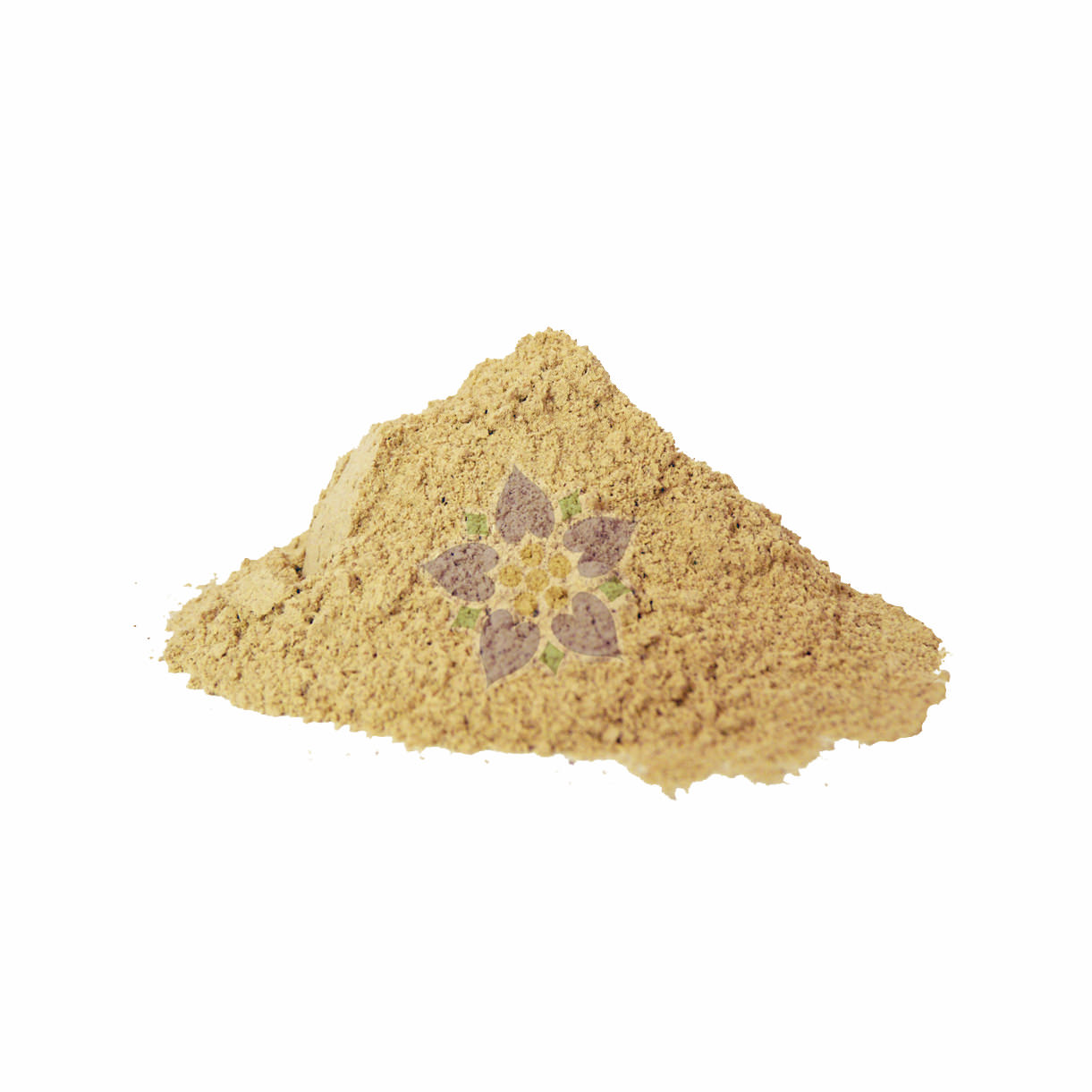
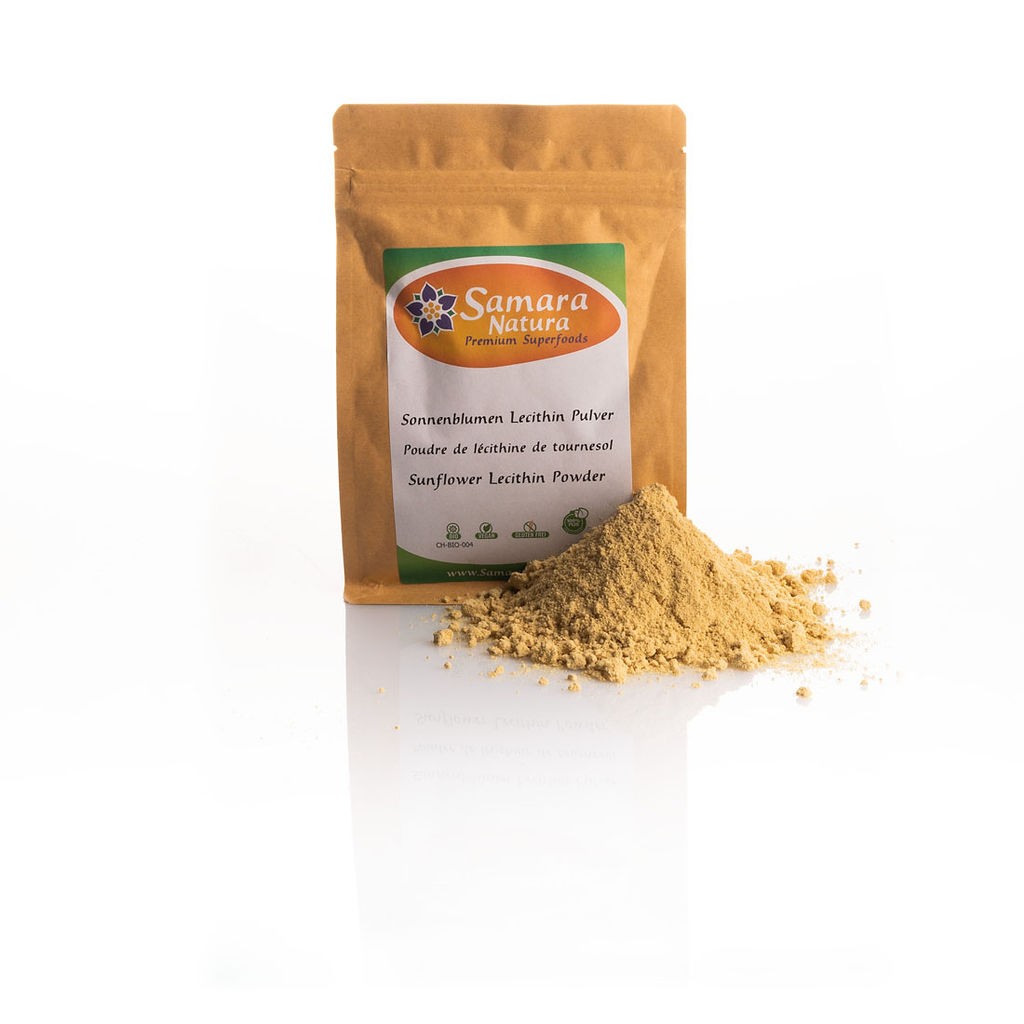
Update: Sale of the current batch with expiry date 30.06.2026 with 67% discount for CHF 10 instead of CHF 31. Organic sunflower lecithin powder with total lecithin complex (100% natural) What makes our sunflower lecithin powder special? Our organic sunflower lecithin powder is a versatile natural emulsifier. Due to its unique structure, it effectively combines fat and water. Sunflower lecithin contains the natural lecithin complex (mixture of various phospholipids) from sunflower seeds. Phospholipids are components of cell membranes, among other things, and play an important role in our entire metabolism. The yellow sunflower lecithin has a neutral flavour and is free from gluten and carriers. It is also generally GMO-free, as no genetic engineering is used in sunflower cultivation (in contrast to soya cultivation). Where and how is our sunflower lecithin powder produced? Our sunflower lecithin powder is produced in China, where the world's only CO2 de-oiling plant is located. The organic sunflower seeds are mechanically pressed to extract the oil. The lecithin is then isolated from the oil by CO2 extraction. The result is a powdered, de-oiled pure lecithin. This process completely dispenses with the use of solvents. How to use sunflower lecithin powder? Sunflower lecithin has a pleasant flavour and is suitable as a food additive for smoothies and muesli as well as an emulsifier. Sprinkle 1 heaped tablespoon (approx. 10g) over muesli or add to smoothies and nut milks. Suitable for chocolate production and for making glacé (ice cream). Can also be eaten on its own. Sunflower lecithin should be stored at room temperature, protected from light and moisture (always seal the bag tightly). Labelling 100% EMULSIFIER ORGANIC SUNFLOWER LECITHIN (E322). Allergic reactions Although it is basically allergen-free, we have received information from a customer who is highly allergic to sunflower seeds that he also has allergic reactions to sunflower lecithin. We therefore recommend that consumers who are allergic to sunflower seeds use sunflower lecithin with caution or avoid it altogether. Possible alternatives would be soya lecithin or almond puree, which also contains lecithin. Uses Sunflower lecithin can be used both as a food supplement and as an emulsifier for drinks. We recommend 1 heaped tablespoon (approx. 10g) as a guide for a smoothie or as an addition to muesli.For the production of almond drink, we recommend 25-40 grams of sunflower lecithin per litre. Packaging sizes Bag with 200g powder. Best before date The current batch has best before 30.06.2026. Nutritional values of sunflower lecithin powder per 100g Energy value 3150kJ/750kcalFat 91gof which saturated fatty acids 11gof which monounsaturated fatty acids 9gof which polyunsaturated fatty acids 30gCarbohydrates 8gthereof sugar 3gProtein <0.3gSalt 0.0g
Content: 200 Gramm (CHF 4.75 / 100 Gramm)
Chaga powder (100% natural) from China Why consume Chaga powder? Antioxidants: Rich in antioxidants, Chaga powder helps fight harmful free radicals and protect cells from oxidative stress. In Russia and Lapland, chaga tea has been consumed as a tonic for centuries Vitamins and minerals: Chaga powder contains a variety of vitamins and minerals and is a natural source of energy for everyday life Skin health: The anti-inflammatory properties of chaga powder can have a positive effect on the appearance of the skin What makes our Chaga powder special? Our organic chaga mushrooms are collected wild in China, then gently dried and very finely ground Brown in colour and has a characteristic earthy, woody taste. When should I be careful with Chaga? Diabetics should only use Chaga powder after consulting a doctor. Chaga can slow down blood clotting. Chaga should not be used if you are taking blood-thinning medication. In case of medical treatment, pregnancy or uncertainty, consult a specialist about the use of this product. Keep out of the reach of children. How to consume Chaga powder? To prepare a cup of tea: Pour hot water (60°C) over 1 teaspoon (2-3g) of Chaga powder and leave to infuse for 15 minutes. Chaga powder can also be added to smoothies, porridge or muesli. Chaga is also an interesting alternative to coffee because it is caffeine-free. Recommended daily dose: 3g. Chaga latte recipe Have you ever tried a chaga latte? Ingredients: 1 tsp Chaga powder 3/4 cup hot water (60°C) 1/4 tsp cinnamon powder 1 tsp coconut blossom sugar 1/4 cup coconut milk Preparation: Pour the hot water over the chaga powder and leave to infuse for 15 minutes. Then mix with the other ingredients in a blender until frothy or simply stir together in a cup. Nutritional values of chaga powder per daily portion of 3g Energy value 44kJ / 10.5kcal fat 0.05g of which saturated fatty acids 0.01g Carbohydrates 1.64g thereof sugar 0.01g Dietary fibre 0.60g protein 0.56g salt 0.00g
Content: 125 Gramm (CHF 19.76 / 100 Gramm)
Average rating of 5 out of 5 stars
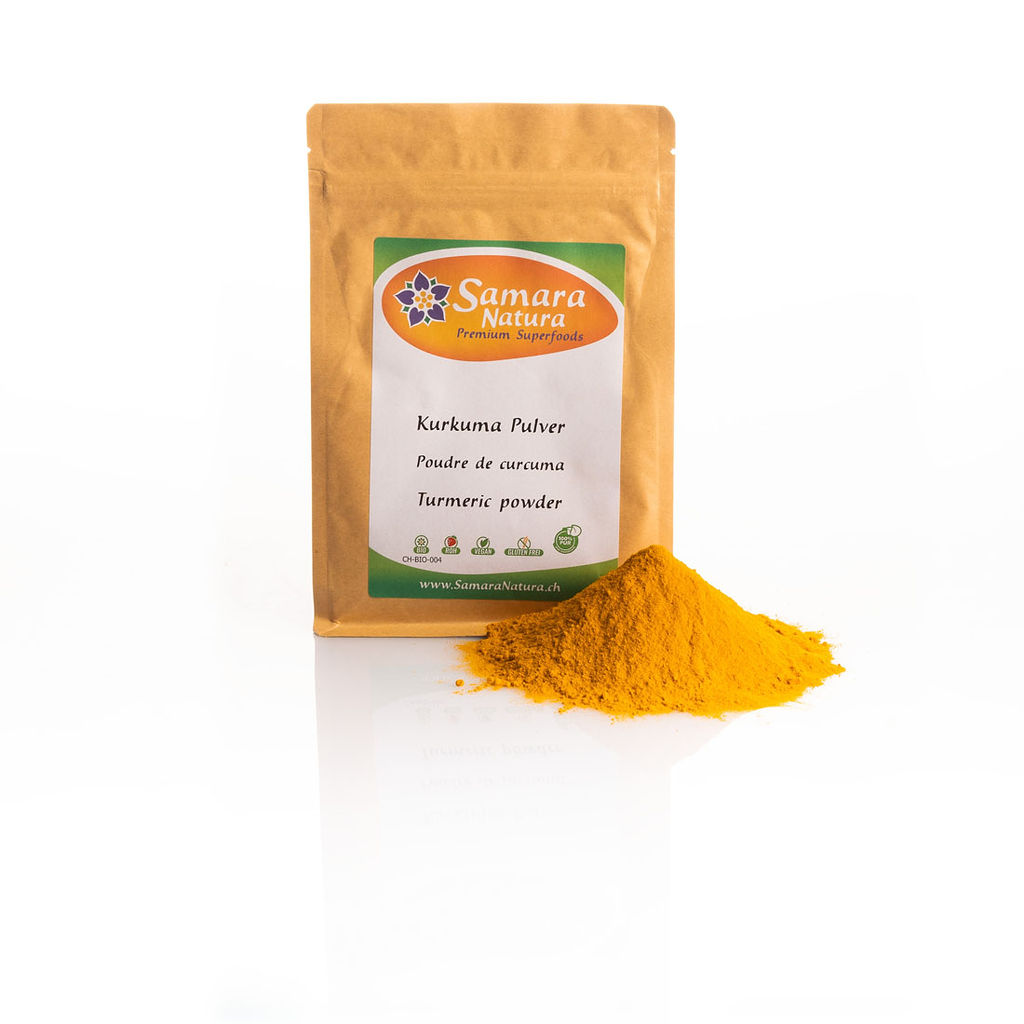
Turmeric powder: the Ayurvedic super spice (100% natural) Turmeric contains essential oils, the yellow pigment curcumin, enzymes and gives curry its typical light yellow colour. One of the most important health plants In our part of the world, it is now well known as a spice. As we are not allowed to make any health claims, we refer you to various reports on the Internet, including those from the Zentrum der Gesundheit. The curcumin content of the powder is approx. 5%. However, in order to achieve a noticeable effect, 5 grams (equivalent to approx. one teaspoon) should be taken daily. It is therefore suitable for a variety of uses in the kitchen. What makes our turmeric powder special? High quality and very flavourful 100% pure nature 100% raw food quality Without preservatives or other additives Vegan The turmeric powder comes from 1,400 small farmers and is produced in the MASS co-operative in India. The turmeric roots are harvested by hand. The turmeric roots are then cleaned, dried and finally ground into a very fine powder. How do I use turmeric powder in everyday life? Turmeric powder is not only suitable for flavouring many oriental dishes such as Moroccan vegetable stew or Indian curry. It should also be included in your daily diet and drinks. Possible uses include smoothies, soups, quiche, lasagne, casseroles, spaetzle, pancakes, sauces, spreads and dips. Recipes with turmeric powder Have you ever tried a sweet and spicy turmeric latte? It warms the body from the inside, protects it and is quick to prepare. Ingredients: 2dl cow's or plant milk 1/2 tsp turmeric powder (frequent users can also use 1 tsp) 1/2 tsp grated ginger 1 tsp coconut oil 1 tbsp agave or yacon syrup 1 pinch of pepper 1 pinch of cinnamon Heat all the ingredients in a small pan and leave to infuse for 10 minutes. You can find many recipes on the internet, e.g. at www.chefkoch.de. Nutritional values of turmeric powder per 100g Energy value 390 kcal/1638 kJ fat 9.9g of which saturated fatty acids 2.8g Carbohydrates 48.9g of which sugar 3g Dietary fibre 21g protein 7.8g salt 0.095g
Content: 250 Gramm (CHF 5.32 / 100 Gramm)
Ashwagandha powder organic (100% natural) Why consume ashwagandha powder? Ashwagandha is one of the most important herbs in the Ayurvedic teachings of India. It has a balancing and invigorating effect as an adaptogen. What makes our ashwagandha powder special? Our Indian ashwagandha powder is made from 100% organic ashwagandha roots. Ashwagandha (Withania somnifera) belongs to the nightshade family and is also known as Indian ginseng, winter cherry or sleeping berry. The light yellow powder has a characteristically "rooty" to slightly sweet flavour. How is our ashwagandha powder produced? After harvesting, the organic ashwagandha roots are carefully cleaned, crushed and then sun-dried and air-dried. They are not (re-)dried in an oven. After quality control, the root pieces are ground into a fine powder. The processing temperature is below 42°C, which is why the ashwagandha powder fulfils the raw food criteria. Usage Take 1 teaspoon (3g) once a day with water, juices, smoothies or other drinks, preferably in the evening. Tip: lukewarm moon milk for sweet dreams! Food supplement: The product is not intended as a substitute for a balanced and varied diet and a healthy lifestyle. The recommended daily dose must not be exceeded. Use is not recommended for pregnant women and breastfeeding mothers. Keep out of the reach of children. Nutritional values Organic Ashwagandha per daily portion 3g (approx. 1 teaspoon): Energy value 36kJ/9kcalFat 0.01gCarbohydrates 1.38gof which sugar 0.45gDietary fibre 0.22gProtein 1.04g
Content: 250 Gramm (CHF 6.84 / 100 Gramm)
samaranatura.ch | Online-Shop seit 2007
Was am 23. September 2007 mit der Idee begann, hochwertige Superfoods und Rohkostprodukte für den interessierten Verbraucher leicht zugänglich zu machen, ist heute ein Unternehmen, geführt vom Inhaber Patrick Fuchs, das in der ganzen Schweiz viele zufriedene Kunden hat.
Unser Sortiment
Heute umfasst das Sortiment hochwertige, gesunde Produkte für jeden Lebensstil und jede Lebensphase:
- Superfoods
- Nahrungsergänzungsmittel
- Rohkostprodukte
- Vegane Schokolade
- Süssungsmittel
- Snacks
- Detox-Produkte
- Glutenfreie & laktosefreie Produkte
- Bio & Fairtrade Produkte
- Praktisches Zubehör
In unserem Shop finden Sie mehr als 100 Produkte aus aller Welt. Wir entdecken regelmässig neue Produkte, die unser Sortiment bereichern.
Zu jedem Produkt bieten wir tiefgehende Informationen über die Herkunft der Produkte und zur passenden Anwendung.
Höchster Qualitätsanspruch
- Angebot von nahrhaftesten und qualitativ hochwertigsten Lebensmitteln aus allen Teilen der Welt in ihrem natürlichen Zustand
- Fast ausschliesslicher Verkauf von Produkten, die biologisch und ohne synthetische Pestizide und Agrochemikalien in ihren ursprünglichen Anbauregionen angebaut werden
- Aus Überzeugung und ureigenem Interesse: Gezielte Auswahl von Produkten, die frei von chemisch-synthetischen Mittel sind und / oder über eine Fair-Trade-Zertifizierung verfügen
- Wir, die BioSamara GmbH, sind seit November 2015 ein biozertifiziertes Unternehmen (Bio-Zertifikat BVH-25388 auf www.easy-cert.com einsehbar) - kontrolliert von der Schweizer Bio-Kontrollstelle bio.inspecta in Frick AG.
Breite Kundschaft
Unser umfangreiches Angebot bietet passende Produkte für eine Vielzahl von Personen, u.a.:
- Gesundheitsbewusste Menschen
- Veganer und Vegetarier
- Frauen in der Schwangerschaft
- Sportler
- Allergiker
- Erkrankte Personen
- Ältere Menschen
Sichere Bestellung
Der Bestellvorgang in unserem Shop ist einfach gestaltet und aufgrund der SSL-Verschlüsselung sicher.
Nutzen Sie die Wunschliste, um Ihre liebsten Produkte schnell wiederzufinden. In Ihrem persönlichen Kundenkonto lassen sich aktuelle Bestellungen einsehen und effizient wiederholen.
Soziale Lieferung
Für Konfektion und Logistik arbeiten wir seit 2013 mit der Stiftung Ancora-Meilestei in Wetzikon zusammen. Ancora-Meilestei ist ebenfalls Bio-zertifiziert.
Sämtliche Waren werden sicher verpackt und bei Bestellungseingang vor 15 Uhr noch am selben Werktag verschickt.
Innerhalb der Schweiz erhalten Sie ab CHF 100.- eine kostenfreie Lieferung.
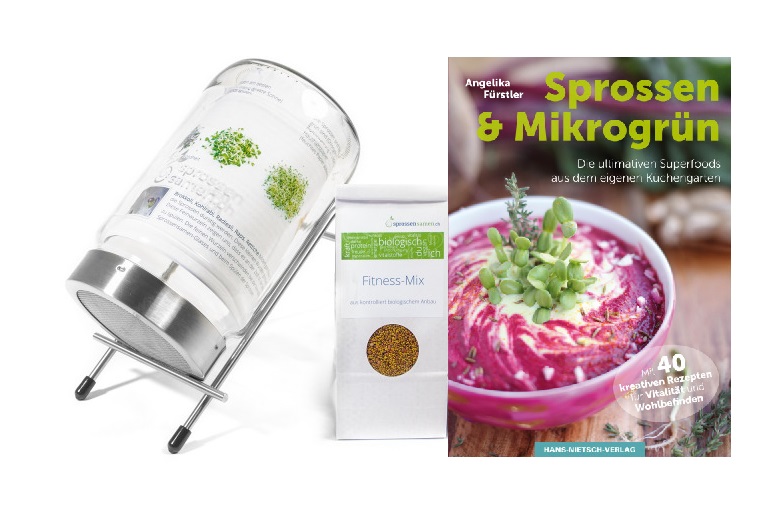
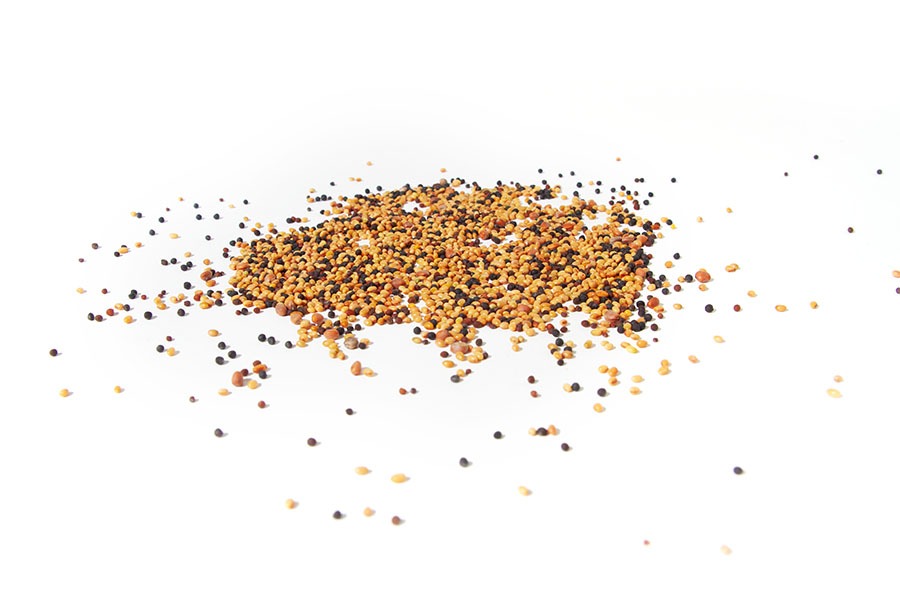
Sprossit-Mix sprout seed This wonderful sprout mix was created by sprout expert Angelika Fürstler. It contains: Brussels clover seeds Broccoli seeds Kohlrabi seeds Radish seeds Rapeseed Why Sprossit sprouts are healthy Sprossit sprouts are characterised by the following ingredients: Vitamin C Bitter and flavouring substances dietary fibre secondary plant substances Usage You can eat Sprossit sprouts on their own or mix them into salads. They are also suitable as a topping for your fitness sandwich and for garnishing main dishes. Germinating Sprossit seeds 3.1 litre sprout jar: Soak 2 heaped tablespoons for 10 hours. 1.7 litre sprout jar: soak 1.5 heaped tablespoons for 10 hours. Then germinate in the sprout jar for 6-7 days. Rinse every morning and evening. The sprouts can then be stored in the fridge for about a week. Further information on Sprossit sprout seeds Bag contents: 250g. Country of origin of sprouts: Italy Storage: Store in a cool, dark and dry place Organic certification: CH-BIO-006
Content: 250 Gramm (CHF 4.75 / 100 Gramm)
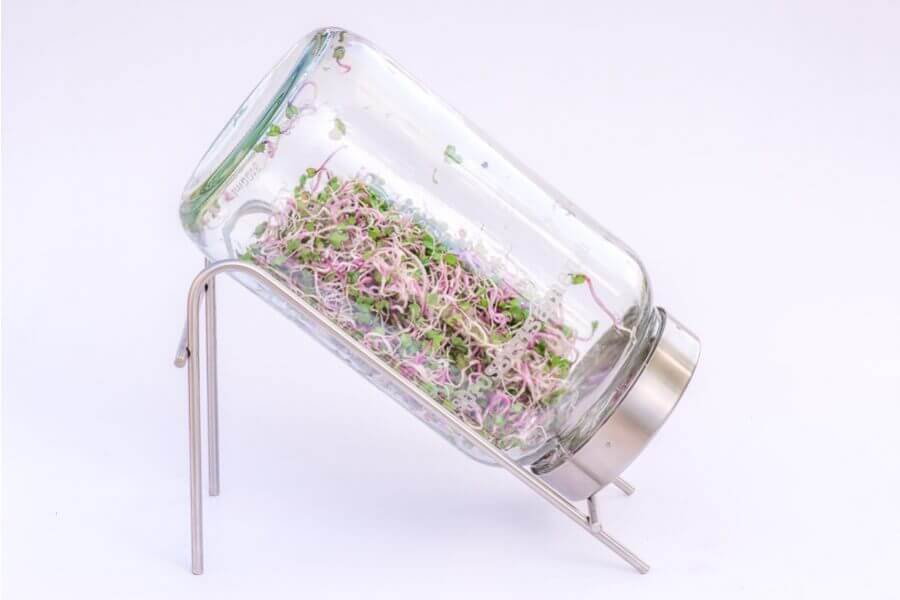
Sprout jar with stand - 1700ml or 3100ml version Start growing sprouts now. All you need is this glass sprouter with lid, sieve and stand including rubber feet, as well as a sprouting seed and very little time. Two different jar sizes: The sprouter is available in two sizes: 1700ml for CHF 69 → suitable for new users 3100ml for CHF 79 → suitable for frequent users and families Sprouter made of glass and stainless steel In contrast to many plastic sprouters, our sprouter is made of glass (with food certification) and all metal materials are made of 1.4301 stainless steel. If you want to expand your sprout farm and organise it in rows, you can also purchase an additional stand connector for CHF 5 to connect the stands. Advantages of glass sprouting units Health and safety: Glass is an inert material that does not release any harmful chemicals or toxins. When sprouting food, it is important that it does not come into contact with harmful substances to ensure the quality and health of the sprouts and sprouted food. Sustainability: Glass is an environmentally friendly material that is recyclable and reusable. Using glass sprouting equipment helps to reduce the ecological footprint and pave the way to a more sustainable future. Durability: Glass is generally more durable and resistant. It retains its original shape and transparency over a longer period of time without discolouring or deforming. This means that glass sterilisers retain their functionality and aesthetics even after frequent use and many sterilisation processes. No odour absorption or discolouration: Glass does not absorb odours or flavours, so it does not cause any undesirable changes in the taste of the sprouted food. In addition, glass does not discolour, so it retains its clear and attractive appearance. Hygiene: Glass is easier to clean and has a smooth, non-porous surface on which fewer bacteria can colonise. This makes it easier to clean glass sterilisers thoroughly and ensure a high level of hygiene, which is particularly important when it comes to food.
Content: 1700 ml (CHF 38.56 / 1000 ml)
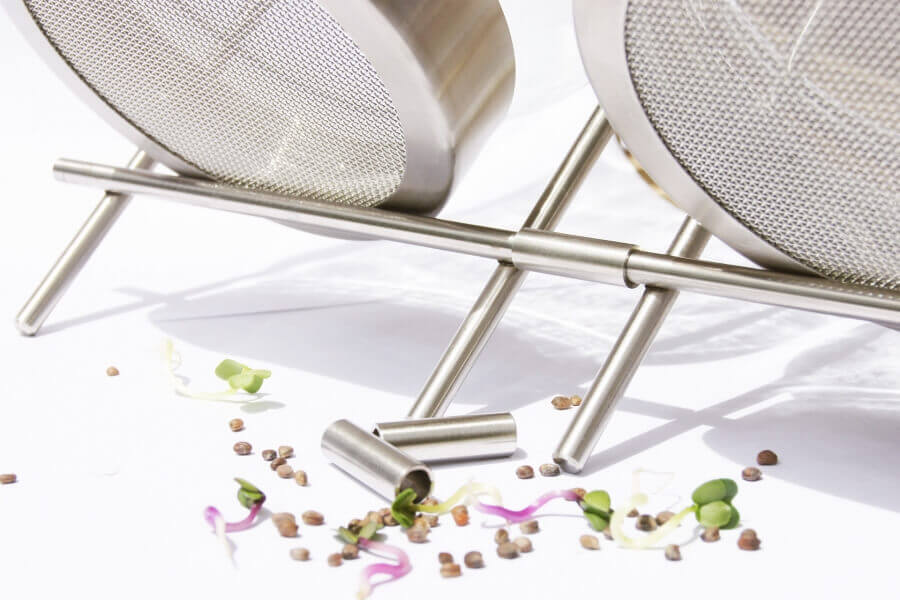
Stand connector for sprout stands Do you have several sprout stands of the "Sprout seeds" brand and don't want them to stand individually in your kitchen? With the matching stainless steel stand connector, you can connect as many sprout stands as you like and create a small production line with different types of sprouts. Contents: 1 pair each, i.e. 2 stand connectors are included to connect the sprout stands at the top and bottom.
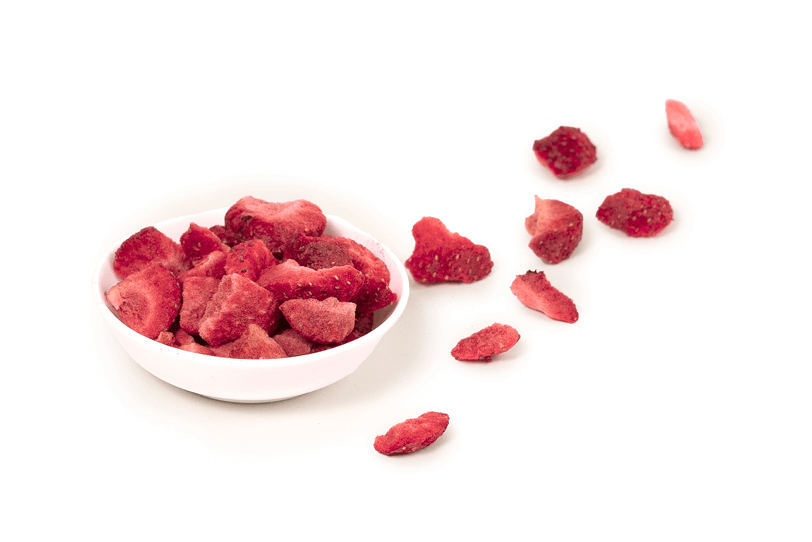
Organic freeze-dried strawberries Crispy, flavoursome, delicious freeze-dried strawberries that give you that summery fruit feeling all year round. What makes our freeze-dried organic strawberries special? The sun-ripened organic strawberries from Serbia are processed on site immediately after harvesting. They are freeze-dried using high-quality technology, whereby the water bound as ice is removed in a vacuum. The strawberries lose 90% of their weight in the process, but retain their natural appearance, intense flavour and most of their nutrients. In addition, the strawberries remain in raw food quality. Contents: Bag with 50g. Recommendations for use With their delicious fruity flavour, these freeze-dried, whole strawberries are perfect in muesli and as a topping for desserts. Also delicious with nuts and other dried fruit as a snack between meals. The freeze-dried strawberries can also be soaked briefly in water to make them juicy again. Nutritional information sprouted freeze-dried strawberries Energy / nutrient per 100gg/mg/μg%*1*1 Reference quantity/daily dose for an average adult (8400kJ/2000kcal) Energy 1608kJ (383kcal) 19% fat 0.4g 1% of which saturated fatty acids 0.04g 0% Carbohydrates 89.3g 34% thereof sugar 63.8g 71% Dietary fibre 14.7g 29% Protein 4.4g 9% salt 0.01g 0% Vitamin C 485mg 606%
Content: 50 Gramm (CHF 22.62 / 100 Gramm)
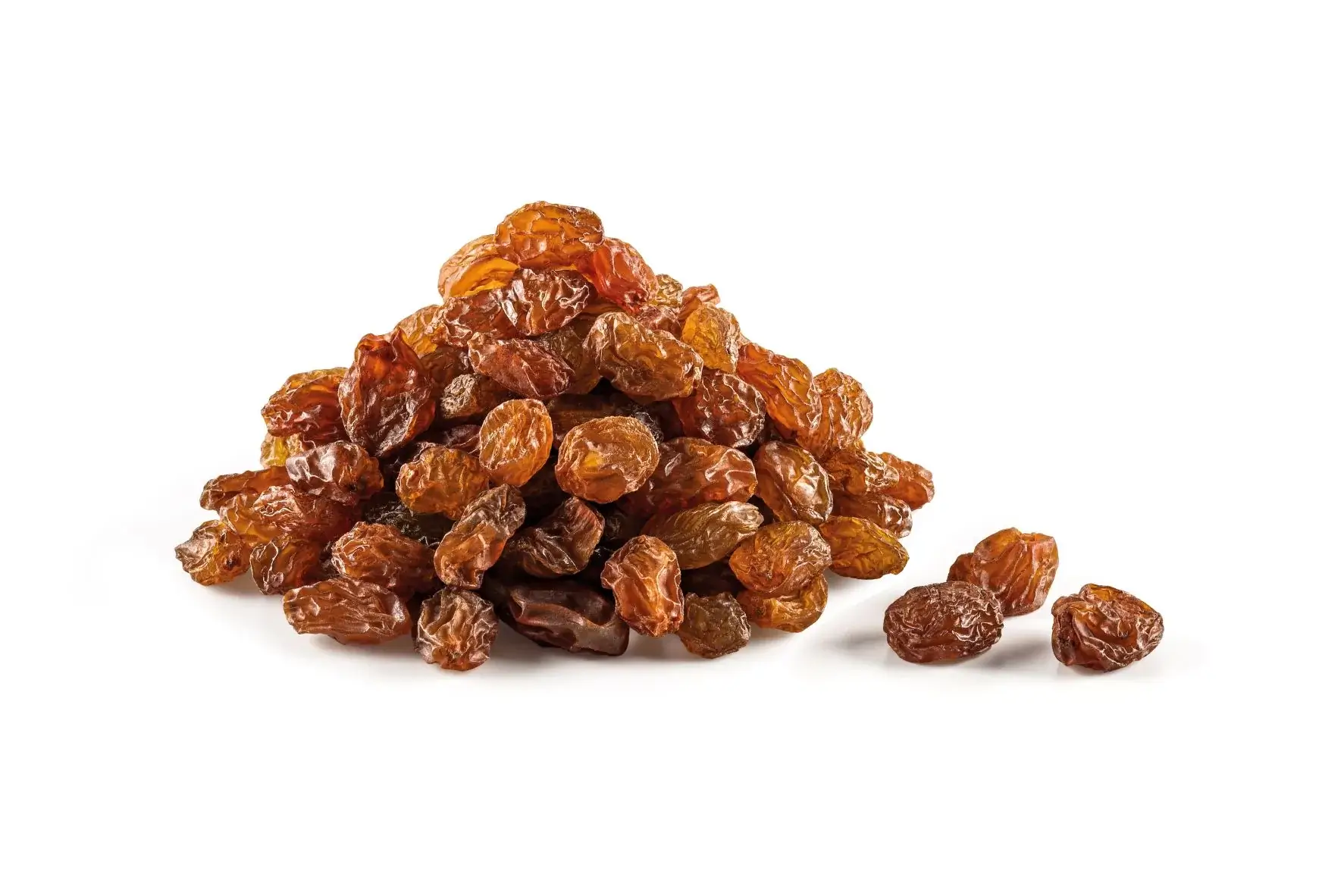
Sultana Organic Raisins The unoiled, unsulphurised organic Sultana sultanas have a sweet taste and are gently dried at below 42°C. They are naturally rich in fibre, phosphorus and iron. They are naturally rich in fibre, phosphorus and iron. Sultanas are seedless, flavourful and have a soft skin. Warnings May contain traces of nuts. Nutritional values of Sultana sultanas per 100g Energy value 1262 kJ / 298 kcal Fat 0.6g - of which saturated fatty acids 0.2g Carbohydrates 68g - of which sugar 67gDietary fibre 5.2g Protein 2.5g Salt 0.05gPhosphorus 110mg (16%)*Iron 2.27mg (16%)* *according to nutrient reference values
Content: 425 Gramm (CHF 2.01 / 100 Gramm)
Average rating of 5 out of 5 stars
Suma - Brazilian ginseng(Pfaffia paniculata) | 100% natural Suma root is also known as "Brazilian ginseng" due to its adaptogenic properties. However, it does not belong to the ginseng family, but to the foxtail family. Why consume suma? Suma contains a range of nutrients, including 19 amino acids, vitamins A, B1, B2, E, K, pantothenic acid, iron, silicon, magnesium, zinc and antioxidant saponins. Its relatively high content of germanium, a powerful antioxidant that can scavenge free radicals and highly reactive oxygen compounds at the cellular level, is important. Antioxidants are important for cell maintenance and function. Suma is known to improve the oxygen supply and energy efficiency of cells and to promote performance and endurance. For example, Russian Olympic athletes take suma to build muscle and increase their stamina without the negative effects of steroids. Known in Brazil as "para tudo" (for everything), suma has been used by the inhabitants of the Amazon for hundreds of years and is traditionally used to boost sexual vigour and increase the body's energy levels. Recommendations for use You can mix suma powder into smoothies, fruit juices and milk drinks or use it as an ingredient in muesli, homemade chocolate and other dishes. We recommend starting with half a teaspoon and increasing to a level teaspoon per day after a week. Due to its special adaptogenic properties, Suma should only be taken when needed and not over a longer period of time. We recommend a maximum of 1 month and then a break of at least 1 month. Note: In case of medical treatment, pregnancy or uncertainty, consult a specialist about the use of this product. Keep out of the reach of children Nutritional values Suma powder per 100g Energy value 263kcal/1091kJFat 3gof which saturated fatty acids 1.6gCarbohydrates 28.5gof which sugar 5gDietary fibre 47.5gProtein 6.8gSalt <0.01g
Average rating of 5 out of 5 stars
Update: Sale of the current batch with expiry date 30.06.2026 with 67% discount for CHF 10 instead of CHF 31. Organic sunflower lecithin powder with total lecithin complex (100% natural) What makes our sunflower lecithin powder special? Our organic sunflower lecithin powder is a versatile natural emulsifier. Due to its unique structure, it effectively combines fat and water. Sunflower lecithin contains the natural lecithin complex (mixture of various phospholipids) from sunflower seeds. Phospholipids are components of cell membranes, among other things, and play an important role in our entire metabolism. The yellow sunflower lecithin has a neutral flavour and is free from gluten and carriers. It is also generally GMO-free, as no genetic engineering is used in sunflower cultivation (in contrast to soya cultivation). Where and how is our sunflower lecithin powder produced? Our sunflower lecithin powder is produced in China, where the world's only CO2 de-oiling plant is located. The organic sunflower seeds are mechanically pressed to extract the oil. The lecithin is then isolated from the oil by CO2 extraction. The result is a powdered, de-oiled pure lecithin. This process completely dispenses with the use of solvents. How to use sunflower lecithin powder? Sunflower lecithin has a pleasant flavour and is suitable as a food additive for smoothies and muesli as well as an emulsifier. Sprinkle 1 heaped tablespoon (approx. 10g) over muesli or add to smoothies and nut milks. Suitable for chocolate production and for making glacé (ice cream). Can also be eaten on its own. Sunflower lecithin should be stored at room temperature, protected from light and moisture (always seal the bag tightly). Labelling 100% EMULSIFIER ORGANIC SUNFLOWER LECITHIN (E322). Allergic reactions Although it is basically allergen-free, we have received information from a customer who is highly allergic to sunflower seeds that he also has allergic reactions to sunflower lecithin. We therefore recommend that consumers who are allergic to sunflower seeds use sunflower lecithin with caution or avoid it altogether. Possible alternatives would be soya lecithin or almond puree, which also contains lecithin. Uses Sunflower lecithin can be used both as a food supplement and as an emulsifier for drinks. We recommend 1 heaped tablespoon (approx. 10g) as a guide for a smoothie or as an addition to muesli.For the production of almond drink, we recommend 25-40 grams of sunflower lecithin per litre. Packaging sizes Bag with 200g powder. Best before date The current batch has best before 30.06.2026. Nutritional values of sunflower lecithin powder per 100g Energy value 3150kJ/750kcalFat 91gof which saturated fatty acids 11gof which monounsaturated fatty acids 9gof which polyunsaturated fatty acids 30gCarbohydrates 8gthereof sugar 3gProtein <0.3gSalt 0.0g
Content: 200 Gramm (CHF 4.75 / 100 Gramm)
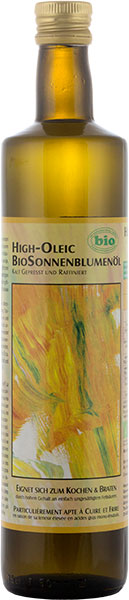
Cold-pressed high-oleic organic sunflower oil from Soyana This certified organic high-oleic sunflower oil comes from specially cultivated sunflowers. It contains approx. 75% monounsaturated fatty acids and is therefore particularly suitable for heating and frying. Normal sunflower oil, on the other hand, contains only approx. 23% monounsaturated (omega-9 fatty acids), but around 60% polyunsaturated fatty acids. Safflower oil, tree nut oil, pumpkin seed oil and linseed oil also have a high proportion (>50%) of polyunsaturated fatty acids, so-called MUFS. These are essential omega-3 and omega-6 fatty acids, which the body needs to produce important endogenous substances. Essential means that our body cannot produce these fatty acids itself, which is why we need to consume 19g per day through our diet. The oils mentioned are basically healthy as long as they are not heated. This is because the MUFAs break down and toxic degradation products and free radicals are formed. Therefore, use high-oleic oils (also known as HO or HOLL), coconut oil (contains many saturated fatty acids) or frying butter for frying. You can find a somewhat older but clear article in the Ktipp of 8 September 2009. Production and origin Sunflower oil is produced in Italy. The pressed sunflower seeds come from the European Union. Nutritional values of High-Oleic Organic Sunflower Oil per 100ml Energy values 3700 kJ / 900 kcalFat 100gof which saturated fatty acids 7gmonounsaturated fatty acids 75gPolyunsaturated fatty acids 13gCarbohydrates 0gSugar 0gProtein 0gSalt 0gVitamin E approx. 50mg
Content: 750 ml (CHF 1.51 / 100 ml)
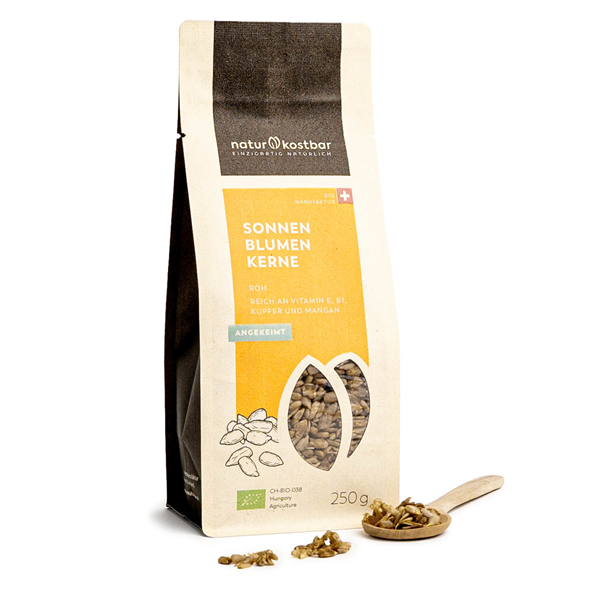
Sunflower seeds sprouted - better digestible These sprouted organic sunflower seeds are easier to digest due to the sprouting process and have more enzymes and a significantly higher nutrient density. The sunflower seeds come from a family farm in Transylvania, Romania. The small farm specialises in sprouted raw food and processes the harvest of numerous organic farmers from Europe. The mindful, natural philosophy is reflected in the excellent quality of the sunflower seeds. Contents: Bag with 250g. Use These sprouted sunflower seeds have a mild, nutty flavour. Thanks to their crunchy consistency, sunflower seeds add flavour to salads, muesli, porridge, dips and are a perfect snack between meals. Nutritional information sprouted sunflower seeds Energy / nutrient per 100gg/mg/μg%*1*1 Reference amount/daily intake for an average adult (8400kJ/2000kcal) Energy 2749kJ (665kcal) 33% fat 61.4g 88% of which saturated fatty acids 6.7g 34% Carbohydrates 5.7g 2% thereof sugar 2.6g 3% Protein 20g 40% salt 0.04g 1%
Content: 250 Gramm (CHF 2.62 / 100 Gramm)
Average rating of 5 out of 5 stars
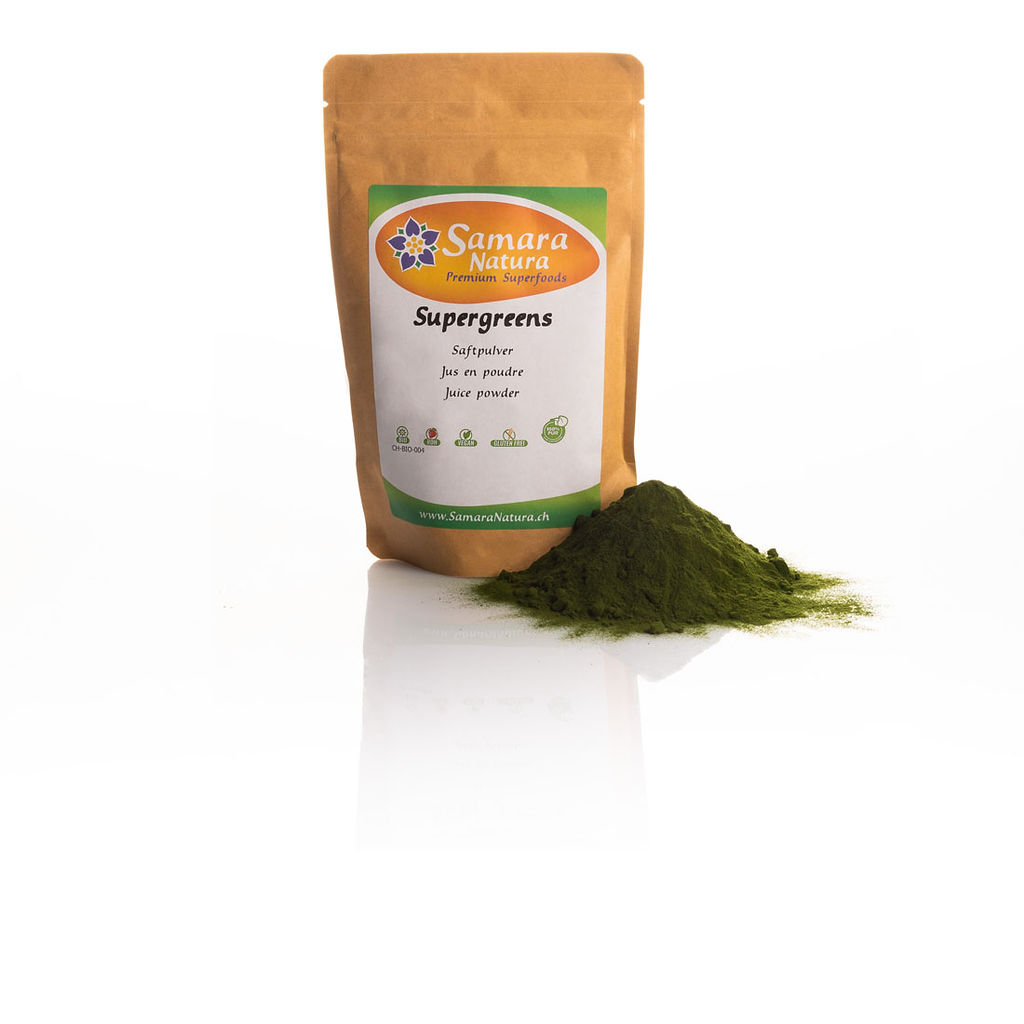
Update: Sale of the old batch (best before 31.10.2026) with 35% discount. Supergreens juice powder (100% natural) For this mix, the juice from alfalfa, barley grass, oat grass, KAMUT® wheatgrass and wheatgrass is pressed and gently processed into powder. This preserves the aroma, colour, taste and nutrients. It is 100% pure juice powder, without any additives. Difference between grass juice powder and grass powder In contrast to normal grass powder, grass juice powder contains almost no dietary fibres/fibre. The nutrients and vital substances (including chlorophyll) are present in concentrated form. Origin & quality Our grass juice powder comes from an unspoilt area in the USA, where it is harvested at the time of highest nutrient density. The controlled processing temperature is below 42°C = raw food quality. Use of Supergreens juice powder 2-3 times daily ½ - 1 tsp mixed with juice, water, rice drink or other drinks. Ideal as an ingredient for smoothies. Nutritional values per 100g (serving 1 tsp = 2g) Energy value 1351kJ/323kcal (27kJ/6kcal) Fat 1g (0.02g) of which healthy fatty acids 0.4g (0.08g) Carbohydrates 35g (0.7g) of which sugar 20g (0.4g) Dietary fibre 5.7g (0.11g) Protein 32.2g (0.64g) Salt 1.6g (0.03g)
Content: 125 Gramm (CHF 12.92 / 100 Gramm)
Average rating of 4.9 out of 5 stars
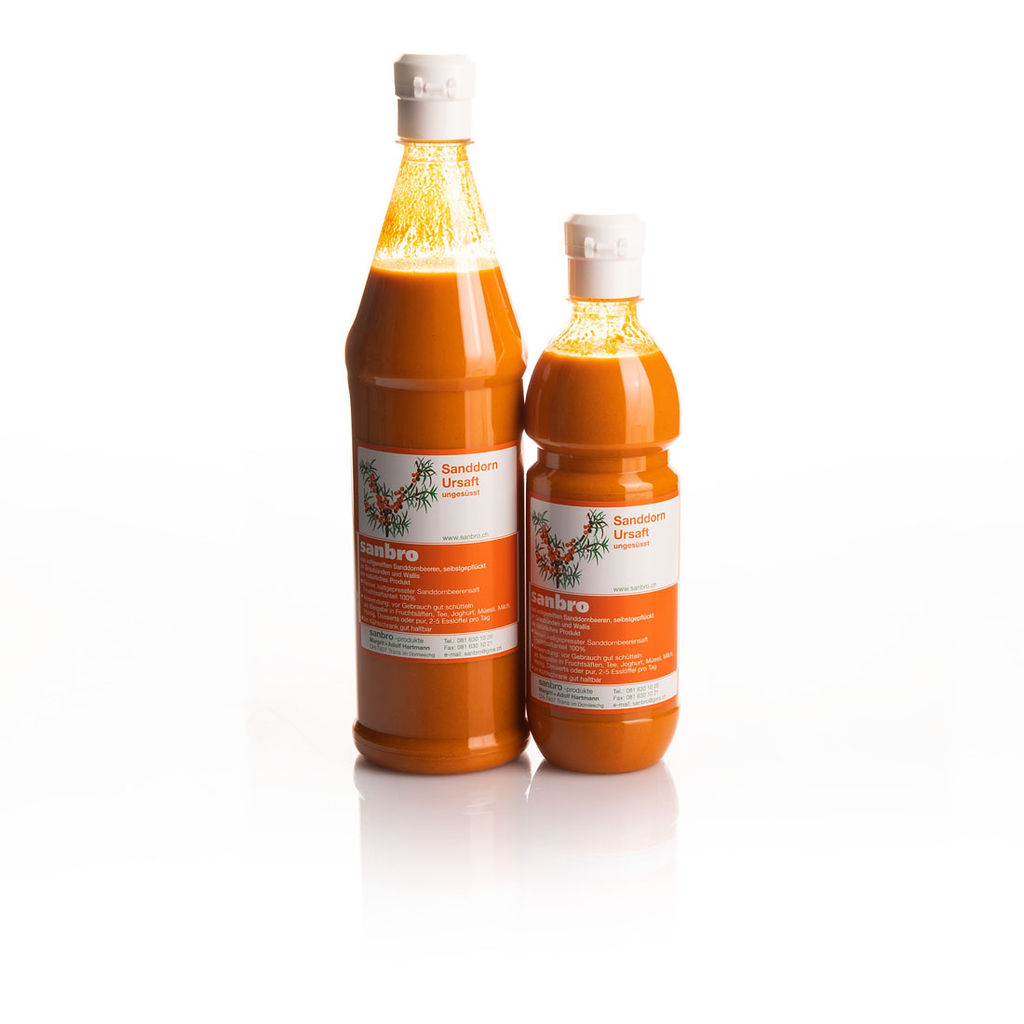
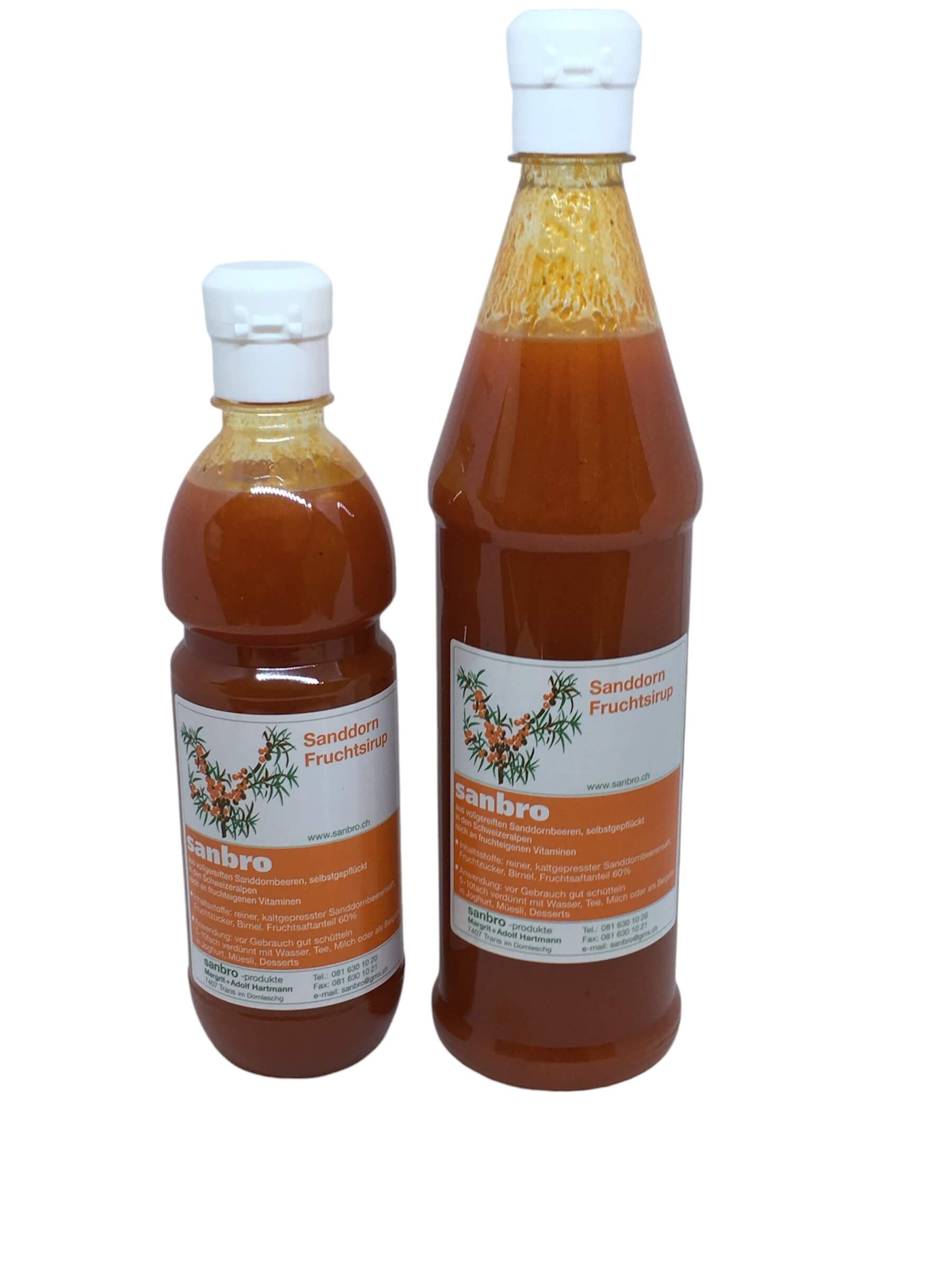
Sea buckthorn - the berries richest in vitamin C in Europe Original juice means that this sea buckthorn juice contains no additives, is gently cold-pressed and is not pasteurised. This is not even necessary due to the naturally high vitamin C content. This makes this sea buckthorn juice one of the few in raw food quality! Further advantages of this unique product: Wild collections: In contrast to sea buckthorn from plantations, these berries from wild collections are significantly smaller and have a thicker skin. The vitamin and vital substance content is unique and incomparably high, approx. five times that of sea buckthorn from plantations. Local: The berries come from hard-to-reach areas in the Grisons Oberland and Valais and are processed by Margrit and Adolf Hartmann in Trans GR. Regular fresh pressings: After harvesting, some of the berries are frozen so that they can be pressed fresh regularly until the following summer. The wild sea buckthorn berries naturally tolerate the cold very well. Family business: The wild berries are harvested by hand by Mr and Mrs Hartmann. The whole bushes are cut off and rolled up in jute sacks. The two donkeys, Fiona and Meli, help with the transport down to the valley. Fair prices: At first glance, the price may seem high compared to other sea buckthorn juices. If you consider the origin and all the manual labour, the price is more than justified. Hartmanns do not maximise profits and have not increased prices for over 20 years. Harvested from wild sea buckthorn bushes in the Swiss Alps The orange berries of the sea buckthorn bush, which are collected in the remote Swiss mountain valleys, are highly regarded by experts. The vital substance content is very high, especially vitamin C. The vitamin C content has been repeatedly tested by the manufacturer in Swiss test laboratories. These revealed vitamin C values of 18000 to 22000 mg/kg juice. Usual values for good plantation varieties are 3000 to 5000 mg/kg juice. This is 36 to 44 times more than that of fresh orange juice. The richness of all its ingredients is unrivalled. More than 12 vitamins: A, B1, B2, B5, B6, B12, C, E, F, H, P, PP, glycosides, flavonoids, saponins, omega-3, -6 and -9 fatty acids, fruit acids and mineral trace elements are contained in ripe sea buckthorn berries. Vitamin C is most effective in natural combination with other vital substances. Sea buckthorn juice also contains sea buckthorn pulp oil. Sea buckthorn juice in raw food quality The whole berries are pressed very gently at low temperatures. The very high acid content - due to the high vitamin C content - and the clean processing mean that the juice does not need to be pasteurised and can be kept for at least 6 months. This preserves all the vital substances. The juice is very refreshing thanks to its vitamin C content and strong sea buckthorn flavour. The high vitamin P content supports the stability and absorption of vitamin C. Harvesting and processing the berries to make sea buckthorn juice The berries, which grow wild at around 1000 metres above sea level, are harvested by Margrit and Adolf Hartmann by hand in rough terrain in the Valais and Grisons Oberland. Compared to cultivated plants, these berries are smaller but richer in vitamins. Harvest time is between August and October. The berries and thorny branches are cut off with electric shears and placed in large jute sacks. The two donkeys "Fiona" and "Meli" help to carry the heavy sacks down into the valley. All the sea buckthorn berries are processed on the Hartmann couple's farm in Trans im Domleschg. In the comprehensive report by nau.ch Sanddorn - Das Alpengold aus Graubünden (nau.ch) and in the 5-minute TeleZüri report "Heimisch exotisch" from 5 August 2020, you can see how the harvest takes place: Heimisch exotisch: Sea buckthorn - TeleZüri (telezueri.ch). Sea buckthorn juice or syrup For people who don't like this completely unsweetened original juice, we recommend sea buckthorn syrup, which is pleasantly sweetened with fructose and birnel. The sea buckthorn fruit content of the syrup is still 60%. Note: The berries are wild fruits and are grown without pesticides or agrochemicals. However, due to the very large harvesting area, organic certification is not financially viable. Use of Swiss sea buckthorn juice Sea buckthorn juice tastes best on its own, slightly sweetened or added to water, fruit juices, tea, yoghurt, muesli and desserts. Take 2 to 5 tablespoons a day, depending on your personal requirements. Storage As the sea buckthorn juice is unpasteurised, we generally recommend storing it in a cool place. This is the best way to preserve the vitamins and fresh flavour. We deliberately only order small batches from the producer every few weeks so that we can offer freshly pressed sea buckthorn juice on a regular basis. Size variations Sea buckthorn juice is available in a 5dl bottle for CHF 28 and in an inexpensive 7.5dl bottle for CHF 39. A quantity discount of 5% is granted for orders of 3 or more.
Content: 500 ml (CHF 5.32 / 100 ml)
Sea buckthorn syrup - from the berry richest in vitamin C in Europe Harvested from wild sea buckthorn bushes in the Swiss Alps The orange berries of the sea buckthorn bush, which are collected in the remote Swiss mountain valleys, are highly regarded by experts. The vital substance content is very high, especially vitamin C. The vitamin C content has been repeatedly tested by the manufacturer in Swiss test laboratories. These revealed vitamin C values of 18000 to 22000 mg/kg juice. Usual values for good plantation varieties are 3000 to 5000 mg/kg juice. This is 36 to 44 times more than that of fresh orange juice. The richness of all its ingredients is unrivalled. More than 12 vitamins: A, B1, B2, B5, B6, B12, C, E, F, H, P, PP, glycosides, flavonoids, saponins, omega-3, -6 and -9 fatty acids, fruit acids and mineral trace elements are contained in ripe sea buckthorn berries. Vitamin C is most effective in natural combination with other vital substances. Sea buckthorn juice also contains sea buckthorn pulp oil. Sea buckthorn syrup in raw food quality The whole berries are pressed very gently at low temperatures. The very high acidity - due to the high vitamin C content - and the clean processing mean that the juice does not need to be pasteurised and can be kept for at least 6 months. This preserves all the vital substances. The juice is very refreshing thanks to its vitamin C content and strong sea buckthorn flavour. The high vitamin P content supports the stability and absorption of vitamin C. Harvesting and processing the berries to make sea buckthorn juice The berries, which grow wild at around 1000 metres above sea level, are harvested by Margrit and Adolf Hartmann by hand in rough terrain in the Valais and Grisons Oberland. Compared to cultivated plants, these berries are smaller but richer in vitamins. Harvest time is between August and October. The berries and thorny branches are cut off with electric shears and placed in large jute sacks. The two donkeys "Fiona" and "Meli" help to carry the heavy sacks down into the valley. All the sea buckthorn berries are processed on the Hartmann couple's farm in Trans im Domleschg. Sea buckthorn syrup or juice In contrast to the original juice, which is completely unsweetened and very sour due to its very high vitamin C content, the sea buckthorn syrup is pleasantly sweetened with fructose and birnel. The sea buckthorn fruit content of the syrup is still 60%. Note: The berries are wild fruits and are grown without pesticides or agrochemicals. However, due to the very large harvesting area, organic certification is not financially viable. Use of Swiss sea buckthorn syrup Sea buckthorn syrup tastes best when added to water, tea, yoghurt, muesli and desserts. Take 1 to 5 tablespoons a day, depending on your personal requirements. Large varieties Sea buckthorn syrup is available in both the 650g (equivalent to approx. 5dl) and the inexpensive 1kg (equivalent to approx. 7.5dl) bottle!
Content: 650 Gramm (CHF 3.07 / 100 Gramm)
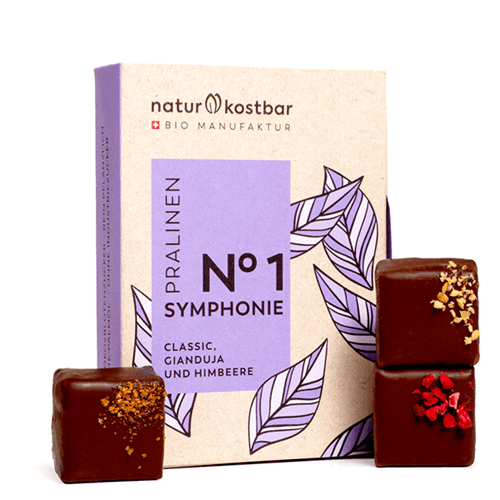
Update: Naturkostbar has renamed the Assortis praline box to Symphonie N°1 and replaced the hazelnut pralines with gianduja pralines. Symphonie N°1 chocolates from Naturkostbar - handmade in Switzerland Enjoy the 3 most popular Naturkostbar chocolates. The box of 6 contains 2 pieces each of Raspberry, Gianduja and Classic. These fine chocolates are handmade in the Naturkostbar manufactory in Uetendorf near Thun. The flavours of the cocoa beans from mixed cultures merge with the coconut blossom sweetness, Madagascan vanilla and a few exclusive ingredients using the stone mill process. The result is deliciously creamy chocolates with a unique flavour. Ingredients Cashew nuts, hazelnuts (I.G.P. Piedmont), coconut blossom sugar, ground cocoa beans, cold-pressed almond oil, cocoa butter, freeze-dried raspberries, maca powder, bourbon vanilla. All ingredients from organic farming.Made in the Naturkostbar manufactory in Uetendorf near Thun. Production of Symphonie N°1 chocolates Naturkostbar lovingly dedicates itself to the skilful production of these plant-based delicacies using raw ingredients such as dried raspberries, Piedmont hazelnuts and unroasted cashews, which are sourced directly and transparently. Quality, genuine flavour and premium ingredients are just as important as the transparent, fair purchasing of raw materials and transparency in production. The chocolates are traditionally made by hand in the Naturkostbar factory in Uetendorf. Wherever possible, the raw materials are sourced directly from the producers in the country of origin. Unrivalled quality is also used in the processing: The cocoa beans are sorted by hand and then carefully processed in the stone mill over several hours to create a tempting filling and smooth chocolate. This is how these fine chocolates are lovingly made by hand. Without any lecithins or industrial sweeteners. Savour the difference! How to use Enjoy the pralines as a fine dessert. Of course, these Symphonie N°1 chocolates also make an excellent special gift. Note: A white coating on the pralines is a natural fat bloom and does not affect the quality. Optimum storage at 18°C. Nutritional information per 100g energy 2296kJ (553kcal) fat 39.6g of which monounsaturated fatty acids 19.3g of which polyunsaturated fatty acids 4.1g of which saturated fatty acids 14.81g Carbohydrates 34.7g of which sugar 25.6g protein 9.7g salt 0.14g
Content: 72 Gramm (CHF 20.99 / 100 Gramm)
Tropical kiss: Gluten-free indulgence with a holiday feeling Why and how to use it? The gluten-free Tropical Kiss transports you to the tropics with every bite. The sweetness of ripe bananas harmonises perfectly with crunchy sunflower seeds, buckwheat and pecan nuts. Hemp seeds, sesame seeds and dried fruit provide a rounded flavour and deliver valuable nutrients. Coconut blossom sugar and dates add a caramel flavour. The granola pieces are ideal as a healthy breakfast or as a sweet snack between meals. Whether you're in the office, hiking, travelling or as a snack at school - the Tropical Kiss is the ideal companion for anyone looking for a healthy and tasty alternative to conventional sweets.What makes this special snack so special? Some of the ingredients are processed in sprouted form to realise their full nutritional potential. Sunflower seeds and buckwheat are then gently dried to give them their crunchy texture - without any roasting.
Average rating of 5 out of 5 stars
Turmeric powder: the Ayurvedic super spice (100% natural) Turmeric contains essential oils, the yellow pigment curcumin, enzymes and gives curry its typical light yellow colour. One of the most important health plants In our part of the world, it is now well known as a spice. As we are not allowed to make any health claims, we refer you to various reports on the Internet, including those from the Zentrum der Gesundheit. The curcumin content of the powder is approx. 5%. However, in order to achieve a noticeable effect, 5 grams (equivalent to approx. one teaspoon) should be taken daily. It is therefore suitable for a variety of uses in the kitchen. What makes our turmeric powder special? High quality and very flavourful 100% pure nature 100% raw food quality Without preservatives or other additives Vegan The turmeric powder comes from 1,400 small farmers and is produced in the MASS co-operative in India. The turmeric roots are harvested by hand. The turmeric roots are then cleaned, dried and finally ground into a very fine powder. How do I use turmeric powder in everyday life? Turmeric powder is not only suitable for flavouring many oriental dishes such as Moroccan vegetable stew or Indian curry. It should also be included in your daily diet and drinks. Possible uses include smoothies, soups, quiche, lasagne, casseroles, spaetzle, pancakes, sauces, spreads and dips. Recipes with turmeric powder Have you ever tried a sweet and spicy turmeric latte? It warms the body from the inside, protects it and is quick to prepare. Ingredients: 2dl cow's or plant milk 1/2 tsp turmeric powder (frequent users can also use 1 tsp) 1/2 tsp grated ginger 1 tsp coconut oil 1 tbsp agave or yacon syrup 1 pinch of pepper 1 pinch of cinnamon Heat all the ingredients in a small pan and leave to infuse for 10 minutes. You can find many recipes on the internet, e.g. at www.chefkoch.de. Nutritional values of turmeric powder per 100g Energy value 390 kcal/1638 kJ fat 9.9g of which saturated fatty acids 2.8g Carbohydrates 48.9g of which sugar 3g Dietary fibre 21g protein 7.8g salt 0.095g
Content: 250 Gramm (CHF 5.32 / 100 Gramm)
Real Bourbon vanilla powder from Madagascar Vanilla is the fruit of a white orchid species that is originally native to Mexico and has spread to many tropical countries over the course of time. Vanilla is now one of the most sought-after spices and is also known as the "queen of spices". The cultivation and processing of vanilla has always been labour-intensive, as much of the work has to be done by hand. In addition, the available areas are limited and demand is constantly increasing. As a result, vanilla is now one of the most expensive spices in the world. Genuine bourbon vanilla powder from Madagascar has unfortunately become a rarity due to severe flooding in Madagascar in 2016 and 2017, which resulted in major crop failures and long-term damage to crops. You can find more information on this in the NZZ online article. While the much cheaper synthetically produced vanillin consists of just one substance, the special flavour of real vanilla is a harmonious composition of almost 200 individual substances! Real vanilla therefore not only has a unique flavour and seductive aroma, it is also healthy. It has been regarded and cultivated by the peoples of Central America for centuries as a remarkable gift of nature, and the pharmacies of the 18th century stocked it as a health remedy in the form of powder, infusion and tincture. Uses With its unique spectrum of flavours, it can be used in a variety of ways for all sweet dishes, such as dessert sauces, ice cream, smoothies, pastries, compotes, jams, homemade chocolate and fruit bars. Also delicious in drinks such as cocoa, nut milk and herbal teas. Origin Grown and processed in Madagascar. Nutritional values of vanilla powder bourbon per 100g Reference quantity for an average adult (8400kJ/2000kcal) energy 1339kJ (322kcal) 16% fat 11.2g 16% of which saturated fatty acids 1.76g 9% Carbohydrates 33g 13% thereof sugar 20.4g 23% protein 5.2g 10% salt 0.28g 5%
Content: 25 Gramm (CHF 113.64 / 100 Gramm)
Vita Biosa Probiotic Berries (sweet-fruity) | 100% naturalVita Biosa Probiotic is a controlled organic herbal ferment drink from Denmark, developed to harmonise the intestinal flora. Vita Biosa Probiotic therefore supports the regular activity of your intestines and gives you a good gut feeling. 19 carefully selected herbs are fermented with 7 lactic acid cultures and probiotics. The probiotic bacteria contained can survive in the stomach, attach themselves to the intestinal wall and multiply there. This produces acids which, together with the probiotic bacteria and a wholesome diet, contribute to a balanced environment in the gastrointestinal tract. Vita Biosa Probiotic is available in three other flavours: Original Herbs, Rosehip and Ginger. However, we recommend this sweeter berry flavour for beginners and children. What makes Vita Biosa special? Vita Biosa Probiotic is not a dietary supplement, but a food. It does not add any additional chemical substances to the body, but is purely natural. Due to the special fermentation process at temperatures below 40°C, Vita Biosa Probiotic Original Herbs is free from lactose, gluten, sugar, alcohol or preservatives. Why consume Vita Biosa Probiotic? Supporting the intestinal flora: The lactic acid bacteria in Vita Biosa can help to restore and maintain the balance of the intestinal flora. A healthy intestinal flora is important for digestion, the immune system and general well-being. Improving digestion: Vita Biosa can help to alleviate digestive complaints such as flatulence, constipation and diarrhoea Strengthening the immune system: A large part of the immune system is located in the gut. A healthy intestinal flora can help to strengthen the immune system and increase the body's defences. Detoxification: Vita Biosa can support the body in detoxification by promoting the elimination of harmful substances. Improving nutrient absorption: A healthy intestinal flora can improve the absorption of nutrients from food. Who is it suitable for? For people who want to improve their intestinal health and general well-being Vita Biosa Probiotic is suitable for the whole family, i.e. for all ages Vita Biosa is particularly suitable after taking antibiotics to support the impaired intestinal flora Not suitable for people with histamine intolerance, as the probiotics contain both Lactococcus lactis and Lactobacillus casei Simple (daily) use To start with, take 2-3 teaspoons with meals (pure in water or in juice). In the build-up phase of one week, increase the daily intake to 30-50 ml (equivalent to 6-10 teaspoons). If you are not yet used to the sour taste of Vita Biosa Probiotik, we recommend mixing it with water or juice as a Biosa spritzer. However, our favourite use is as a probiotic smoothie with fresh berries: 50ml Vita Biosa Probiotic 100g blueberries100g raspberries (can also be frozen if not in season)1 apple1 handful of almonds150ml orange juice IMPORTANT: Please do not mix it with hot drinks, as these could kill the lactic acid bacteria. Other flavours Vita Biosa Probiotic is available in three other flavours: Original Herbs, Rosehip and Ginger. However, we recommend this sweeter berry flavour for beginners and children. Size variants Available as a 5dl bottle or 3 litre bag-in-box The 3 litre box is particularly suitable for families and people who regularly consume Vita Biosa Manufactured in Denmark Vita Biosa Probiotic herbal fermented drinks are foods that are fermented and constantly optimised in Denmark with a great deal of love, care and expertise under strict government controls and with the aid of state-of-the-art technology. Herbs contained in Vita Biosa Pimpinella anisum (aniseed) 9%, Glycyrrhiza glabra (liquorice root) 9%, Foeniculum vulgare (fennel) 9%, Ocimum basilicum (basil) 4.5%, Matricaria recutita (Roman chamomile) 4,5%, Anthriscus cerefolium (chervil) 4.5%, Anethum graveolens (dill) 4.5%, Sambucus nigra (black elderberry) 4.5%, Trigonella foenum-graecum (fenugreek seeds) 4.5%, Zingiber officinale (ginger) 4.5%, Angelica archangelica (angelica) 4.5%, Juniperus communis (juniper) 4.5%, Urtica dioica (nettle) 4.5%, Origanum vulgare (oregano) 4.5%, Petroselium crispum (parsley) 4.5%, Mentha piperita (peppermint) 4.5%, Rosmarinus officinalis (rosemary) 4.5%, Salvia officinalis (sage) 4.5%, Thymus vulgaris (thyme) 4.5%. Herbal content max. 0.4% of the total product. Information on the fermentation and production process Fermentation with the seven vegan lactic acid bacteria and probiotics produces a unique herbal extract with a fresh, tart flavour. The herbs, carefully selected for their flavour and quality, were handled with care between sowing and harvesting. Purely organic herbal fermented drink with active lactic acid cultures and probiotics. Lactic and acetic acid are produced during fermentation, giving the drink a pH value of approx. 3.5. This low pH value prevents the growth of harmful bacteria in the end product, which contains millions of microorganisms that occur naturally in a healthy intestinal environment. During fermentation, the seven lactic acid cultures and probiotics consume all the sugar and convert it into lactic and acetic acid. When all the sugar has been consumed, the fermentation process is complete and the product is sugar-free. Thanks to the special fermentation process at temperatures below 40°C, Vita Biosa Probiotic is free from lactose, gluten, sugar, histamine, alcohol or preservatives. It is unpasteurised and can be kept in the refrigerator for 2 months after first opening. However, it does not need to be cooled beforehand. Nutritional values of Vita Biosa Probiotic per 100 ml Energy value 36 kJ / 8 kcal Fat 0.0g of which saturated fatty acids 0.0g Carbohydrates 1.8g of which sugar 0.0g Protein 0.3g Dietary fibre 0.0g Salt 0.02g
Content: 500 ml (CHF 3.76 / 100 ml)
Vita Biosa Probiotic Ginger (lemony-fresh) | 100% natural Vita Biosa Probiotic is a controlled organic herbal ferment drink from Denmark, developed to harmonise the intestinal flora. Vita Biosa Probiotic therefore supports the regular activity of your intestines and gives you a good gut feeling. 19 carefully selected herbs are fermented with 7 lactic acid cultures and probiotics. The probiotic bacteria contained can survive in the stomach, attach themselves to the intestinal wall and multiply there. This produces acids which, together with the probiotic bacteria and a wholesome diet, contribute to a balanced environment in the gastrointestinal tract. Vita Biosa Probiotic is available in three other flavours: Original Herbs, Rosehip and Berries (Aronia). We recommend the sweeter berry flavour for beginners and children. What makes Vita Biosa special? Vita Biosa Probiotic is not a dietary supplement, but a food. It does not add any additional chemical substances to the body, but is purely natural. Due to the special fermentation process at temperatures below 40°C, Vita Biosa Probiotic Original Herbs is free from lactose, gluten, sugar, alcohol or preservatives. Why consume Vita Biosa Probiotic? Supporting the intestinal flora: The lactic acid bacteria in Vita Biosa can help to restore and maintain the balance of the intestinal flora. A healthy intestinal flora is important for digestion, the immune system and general well-being. Improving digestion: Vita Biosa can help to alleviate digestive complaints such as flatulence, constipation and diarrhoea Strengthening the immune system: A large part of the immune system is located in the gut. A healthy intestinal flora can help to strengthen the immune system and increase the body's defences. Detoxification: Vita Biosa can support the body in detoxification by promoting the elimination of harmful substances. Improving nutrient absorption: A healthy intestinal flora can improve the absorption of nutrients from food. Who is it suitable for? For people who want to improve their intestinal health and general well-being Vita Biosa Probiotic is suitable for the whole family, i.e. for all ages Vita Biosa is particularly suitable after taking antibiotics to support the impaired intestinal flora Not suitable for people with histamine intolerance, as the probiotics contain both Lactococcus lactis and Lactobacillus casei Simple (daily) use To start with, take 2-3 teaspoons with meals (pure in water or in juice). In the build-up phase of one week, increase the daily intake to 30-50 ml (equivalent to 6-10 teaspoons). If you are not yet used to the sour taste of Vita Biosa Probiotik, we recommend mixing it with water or juice as a Biosa spritzer. However, our favourite use is as a probiotic smoothie with fresh berries: 50ml Vita Biosa Probiotic 100g blueberries100g raspberries (can also be frozen if not in season)1 apple1 handful of almonds150ml orange juice IMPORTANT: Please do not mix it with hot drinks, as these could kill the lactic acid bacteria. Other flavours Vita Biosa Probiotic is available in three other flavours: Original Herbs, Rosehip and Berries (Aronia). We recommend the sweeter berry flavour for beginners and children. Size variants Standard: 5dl bottle available On pre-order (delivery time approx. 1 month) 3 litre bag-in-box. This is particularly suitable for families and people who regularly consume Vita Biosa. Manufactured in Denmark Vita Biosa Probiotic herbal fermented drinks are foods that are fermented and constantly optimised in Denmark with a great deal of love, care and expertise under strict government controls and with the aid of state-of-the-art technology. Herbs contained in Vita Biosa Pimpinella anisum (aniseed) 9%, Glycyrrhiza glabra (liquorice root) 9%, Foeniculum vulgare (fennel) 9%, Ocimum basilicum (basil) 4.5%, Matricaria recutita (Roman chamomile) 4,5%, Anthriscus cerefolium (chervil) 4.5%, Anethum graveolens (dill) 4.5%, Sambucus nigra (black elderberry) 4.5%, Trigonella foenum-graecum (fenugreek seeds) 4.5%, Zingiber officinale (ginger) 4.5%, Angelica archangelica (angelica) 4.5%, Juniperus communis (juniper) 4.5%, Urtica dioica (nettle) 4.5%, Origanum vulgare (oregano) 4.5%, Petroselium crispum (parsley) 4.5%, Mentha piperita (peppermint) 4.5%, Rosmarinus officinalis (rosemary) 4.5%, Salvia officinalis (sage) 4.5%, Thymus vulgaris (thyme) 4.5%. Herbal content max. 0.4% of the total product. Information on the fermentation and production process Fermentation with the seven vegan lactic acid bacteria and probiotics produces a unique herbal extract with a fresh, tart flavour. The herbs, carefully selected for their flavour and quality, were handled with care between sowing and harvesting. Purely organic herbal fermented drink with active lactic acid cultures and probiotics. Lactic and acetic acid are produced during fermentation, giving the drink a pH value of approx. 3.5. This low pH value prevents the growth of harmful bacteria in the end product, which contains millions of microorganisms that occur naturally in a healthy intestinal environment. During fermentation, the seven lactic acid cultures and probiotics consume all the sugar and convert it into lactic and acetic acid. When all the sugar has been consumed, the fermentation process is complete and the product is sugar-free. Thanks to the special fermentation process at temperatures below 40°C, Vita Biosa Probiotic is free from lactose, gluten, sugar, histamine, alcohol or preservatives. It is unpasteurised and can be kept in the refrigerator for 2 months after first opening. However, it does not need to be cooled beforehand. Nutritional values of Vita Biosa Probiotic per 100 ml Energy value 36 kJ / 8 kcal Fat 0.0g of which saturated fatty acids 0.0g Carbohydrates 1.8g of which sugar 0.0g Protein 0.3g Dietary fibre 0.0g Salt 0.02g
Content: 500 ml (CHF 3.76 / 100 ml)
Average rating of 3.75 out of 5 stars
Vita Biosa Probiotic to harmonise the intestinal flora | 100% natural Vita Biosa Probiotic is a controlled organic herbal ferment drink from Denmark, developed to harmonise the intestinal flora. Vita Biosa Probiotic therefore supports the regular activity of your intestines and gives you a good gut feeling. 19 carefully selected herbs are fermented with 7 lactic acid cultures and probiotics. The probiotic bacteria contained can survive in the stomach, attach themselves to the intestinal wall and multiply there. This produces acids which, together with the probiotic bacteria and a wholesome diet, contribute to a balanced environment in the gastrointestinal tract. Vita Biosa Probiotic is available in three other flavours: ginger, rose hip and berries (chokeberry). We recommend the sweeter berry flavour for beginners and children. What makes Vita Biosa special? Vita Biosa Probiotic is not a dietary supplement, but a food. It does not add any additional chemical substances to the body, but is purely natural. Due to the special fermentation process at temperatures below 40°C, Vita Biosa Probiotic Original Herbs is free from lactose, gluten, sugar, alcohol or preservatives. Why consume Vita Biosa Probiotic? Supporting the intestinal flora: The lactic acid bacteria in Vita Biosa can help to restore and maintain the balance of the intestinal flora. A healthy intestinal flora is important for digestion, the immune system and general well-being. Improving digestion: Vita Biosa can help to alleviate digestive complaints such as flatulence, constipation and diarrhoea Strengthening the immune system: A large part of the immune system is located in the gut. A healthy intestinal flora can help to strengthen the immune system and increase the body's defences. Detoxification: Vita Biosa can support the body in detoxification by promoting the elimination of harmful substances. Improving nutrient absorption: A healthy intestinal flora can improve the absorption of nutrients from food. Who is it suitable for? For people who want to improve their intestinal health and general well-being Vita Biosa Probiotic is suitable for the whole family, i.e. for all ages Vita Biosa is particularly suitable after taking antibiotics to support the impaired intestinal flora Not suitable for people with histamine intolerance, as the probiotics contain both Lactococcus lactis and Lactobacillus casei Simple (daily) use To start with, take 2-3 teaspoons with meals (pure in water or in juice). In the build-up phase of one week, increase the daily intake to 30-50 ml (equivalent to 6-10 teaspoons). If you are not yet used to the sour taste of Vita Biosa Probiotik, we recommend mixing it with water or juice as a Biosa spritzer. However, our favourite use is as a probiotic smoothie with fresh berries: 50ml Vita Biosa Probiotic 100g blueberries100g raspberries (can also be frozen if not in season)1 apple1 handful of almonds150ml orange juice IMPORTANT: Please do not mix it with hot drinks, as these could kill the lactic acid bacteria. Other flavours Vita Biosa Probiotic is available in three other flavours: ginger, rose hip and berries (chokeberry). We recommend the sweeter berry flavour for beginners and children. Size variants Available as a 5dl, 1 litre bottle or 3 litre bag-in-box The 3 litre box is particularly suitable for families and people who regularly consume Vita Biosa Manufactured in Denmark Vita Biosa Probiotic herbal fermented drinks are foods that are fermented and constantly optimised in Denmark with a great deal of love, care and expertise under strict government controls and with the aid of state-of-the-art technology. Herbs contained in Vita Biosa Pimpinella anisum (aniseed) 9%, Glycyrrhiza glabra (liquorice root) 9%, Foeniculum vulgare (fennel) 9%, Ocimum basilicum (basil) 4.5%, Matricaria recutita (Roman chamomile) 4,5%, Anthriscus cerefolium (chervil) 4.5%, Anethum graveolens (dill) 4.5%, Sambucus nigra (black elderberry) 4.5%, Trigonella foenum-graecum (fenugreek seeds) 4.5%, Zingiber officinale (ginger) 4.5%, Angelica archangelica (angelica) 4.5%, Juniperus communis (juniper) 4.5%, Urtica dioica (nettle) 4.5%, Origanum vulgare (oregano) 4.5%, Petroselium crispum (parsley) 4.5%, Mentha piperita (peppermint) 4.5%, Rosmarinus officinalis (rosemary) 4.5%, Salvia officinalis (sage) 4.5%, Thymus vulgaris (thyme) 4.5%. Herbal content max. 0.4% of the total product. Information on the fermentation and production process Fermentation with the seven vegan lactic acid bacteria and probiotics produces a unique herbal extract with a fresh, tart flavour. The herbs, carefully selected for their flavour and quality, were handled with care between sowing and harvesting. Purely organic herbal fermented drink with active lactic acid cultures and probiotics. Lactic and acetic acid are produced during fermentation, giving the drink a pH value of approx. 3.5. This low pH value prevents the growth of harmful bacteria in the end product, which contains millions of microorganisms that occur naturally in a healthy intestinal environment. During fermentation, the seven lactic acid cultures and probiotics consume all the sugar and convert it into lactic and acetic acid. When all the sugar has been consumed, the fermentation process is complete and the product is sugar-free. Thanks to the special fermentation process at temperatures below 40°C, Vita Biosa Probiotic is free from lactose, gluten, sugar, histamine, alcohol or preservatives. It is unpasteurised and can be kept in the refrigerator for 2 months after first opening. However, it does not need to be cooled beforehand. Nutritional values of Vita Biosa Probiotic per 100 ml Energy value 36 kJ / 8 kcal Fat 0.0g of which saturated fatty acids 0.0g Carbohydrates 1.8g of which sugar 0.0g Protein 0.3g Dietary fibre 0.0g Salt 0.02g
Content: 500 ml (CHF 3.76 / 100 ml)
Average rating of 5 out of 5 stars
Vita Biosa Probiotic Rosehip (spicy-sour) | 100% natural Update: Due to low demand, we now only offer the 3-litre bag-in-box on pre-order -> info@samaranatura.ch or 044 586 27 27. The 500ml bottles are normally available. Vita Biosa Probiotic is a controlled organic herbal ferment drink from Denmark, developed to harmonise the intestinal flora. Vita Biosa Probiotic therefore supports the regular activity of your intestines and gives you a good gut feeling. 19 carefully selected herbs are fermented with 7 lactic acid cultures and probiotics. The probiotic bacteria contained can survive in the stomach, attach themselves to the intestinal wall and multiply there. This produces acids which, together with the probiotic bacteria and a wholesome diet, contribute to a balanced environment in the gastrointestinal tract. Vita Biosa Probiotic is available in three other flavours: original herbs, ginger and berries (aronia). We recommend the sweeter berry flavour for beginners and children. What makes Vita Biosa special? Vita Biosa Probiotic is not a dietary supplement, but a food. It does not add any additional chemical substances to the body, but is purely natural. Due to the special fermentation process at temperatures below 40°C, Vita Biosa Probiotic Original Herbs is free from lactose, gluten, sugar, alcohol or preservatives. Why consume Vita Biosa Probiotic? Supporting the intestinal flora: The lactic acid bacteria in Vita Biosa can help to restore and maintain the balance of the intestinal flora. A healthy intestinal flora is important for digestion, the immune system and general well-being. Improving digestion: Vita Biosa can help to alleviate digestive complaints such as flatulence, constipation and diarrhoea Strengthening the immune system: A large part of the immune system is located in the gut. A healthy intestinal flora can help to strengthen the immune system and increase the body's defences. Detoxification: Vita Biosa can support the body in detoxification by promoting the elimination of harmful substances. Improving nutrient absorption: A healthy intestinal flora can improve the absorption of nutrients from food. Who is it suitable for? For people who want to improve their intestinal health and general well-being Vita Biosa Probiotic is suitable for the whole family, i.e. for all ages Vita Biosa is particularly suitable after taking antibiotics to support the impaired intestinal flora Not suitable for people with histamine intolerance, as the probiotics contain both Lactococcus lactis and Lactobacillus casei Simple (daily) use To start with, take 2-3 teaspoons with meals (pure in water or in juice). In the build-up phase of one week, increase the daily intake to 30-50 ml (equivalent to 6-10 teaspoons). If you are not yet used to the sour taste of Vita Biosa Probiotik, we recommend mixing it with water or juice as a Biosa spritzer. However, our favourite use is as a probiotic smoothie with fresh berries: 50ml Vita Biosa Probiotic 100g blueberries100g raspberries (can also be frozen if not in season)1 apple1 handful of almonds150ml orange juice IMPORTANT: Please do not mix it with hot drinks, as these could kill the lactic acid bacteria. Other flavours Vita Biosa Probiotic is available in three other flavours: Original Herbs, Rosehip and Berries (Aronia). We recommend the sweeter berry flavour for beginners and children. Size variants Available as a 5dl bottle or 3 litre bag-in-box The 3 litre box is particularly suitable for families and people who regularly consume Vita Biosa Manufactured in Denmark Vita Biosa Probiotic herbal fermented drinks are foods that are fermented and constantly optimised in Denmark with a great deal of love, care and expertise under strict government controls and with the aid of state-of-the-art technology. Herbs contained in Vita Biosa Pimpinella anisum (aniseed) 9%, Glycyrrhiza glabra (liquorice root) 9%, Foeniculum vulgare (fennel) 9%, Ocimum basilicum (basil) 4.5%, Matricaria recutita (Roman chamomile) 4,5%, Anthriscus cerefolium (chervil) 4.5%, Anethum graveolens (dill) 4.5%, Sambucus nigra (black elderberry) 4.5%, Trigonella foenum-graecum (fenugreek seeds) 4.5%, Zingiber officinale (ginger) 4.5%, Angelica archangelica (angelica) 4.5%, Juniperus communis (juniper) 4.5%, Urtica dioica (nettle) 4.5%, Origanum vulgare (oregano) 4.5%, Petroselium crispum (parsley) 4.5%, Mentha piperita (peppermint) 4.5%, Rosmarinus officinalis (rosemary) 4.5%, Salvia officinalis (sage) 4.5%, Thymus vulgaris (thyme) 4.5%. Herbal content max. 0.4% of the total product. Information on the fermentation and production process Fermentation with the seven vegan lactic acid bacteria and probiotics produces a unique herbal extract with a fresh, tart flavour. The herbs, carefully selected for their flavour and quality, were handled with care between sowing and harvesting. Purely organic herbal fermented drink with active lactic acid cultures and probiotics. Lactic and acetic acid are produced during fermentation, giving the drink a pH value of approx. 3.5. This low pH value prevents the growth of harmful bacteria in the end product, which contains millions of microorganisms that occur naturally in a healthy intestinal environment. During fermentation, the seven lactic acid cultures and probiotics consume all the sugar and convert it into lactic and acetic acid. When all the sugar has been consumed, the fermentation process is complete and the product is sugar-free. Thanks to the special fermentation process at temperatures below 40°C, Vita Biosa Probiotic is free from lactose, gluten, sugar, histamine, alcohol or preservatives. It is unpasteurised and can be kept in the refrigerator for 2 months after first opening. However, it does not need to be cooled beforehand. Nutritional values of Vita Biosa Probiotic per 100 ml Energy value 36 kJ / 8 kcal Fat 0.0g of which saturated fatty acids 0.0g Carbohydrates 1.8g of which sugar 0.0g Protein 0.3g Dietary fibre 0.0g Salt 0.02g
Content: 500 ml (CHF 3.76 / 100 ml)
Wakame - wild collections from Galicia These brown algae grow like large oak leaves on the Galician coast and can grow up to 1.5 metres in size. They are very rich in calcium, iodine, protein and fibre.They are well suited for newcomers to seaweed cuisine because they can be used in many different ways: raw or in salads, in soups, rice dishes, combined with other vegetables and as a filling for pies, baked in the oven or simply cooked. Use of Irish wakame Raw: in salads (chop and soak for 15 minutes) Cooked: approx. 20 mins with soups, vegetables, potatoes, rice, avena, millet, polenta, semolina etc. Fried: Together with onions: for pasta, pies, pizzas, quiche etc. Steamed: Together with vegetables Wakame ingredients 100% dried wakame seaweed (Undaria pinnatifida), from certified organic wild harvesting. Bag size One bag contains 25g of wakame. Nutritional values of wakame per 100g Fat 1-2gCarbohydrates 46-51gProtein 9-20gVitamin C 10-50mgCalcium 1.167-1.29gIodine 16.5-27.5µgIron 5-12.6mgMagnesium 0.896mg.
Content: 25 Gramm (CHF 25.80 / 100 Gramm)
Info: We only stock the small 180g jar of Naturkostbar as standard. The large 550g jar for CHF 34 can be pre-ordered at any time -> info@samaranatura.ch or 044 586 27 27.Organic tree nut puree from Naturkostbar Creamy, smooth puree made from sprouted Swiss wild-grown tree nuts Production: The wild-grown tree nuts come from trees in the Swiss Seeland. After the tree nuts have been cracked, they are processed in the Naturkostbar factory in Uetendorf. The nuts are sprouted, i.e. soaked in water for a few hours and then gently dried, in order to fully develop their mineral and vitamin density. The nuts are then gently and slowly transformed into a creamy puree using a traditional stone mill. Grinding with granite stone is a particularly gentle process: the flavours are released and the puree develops a unique, delicate consistency. Use: The delicious tree nut puree tastes great as a spread and refines crackers soups smoothies sauces Salad dressings Muesli Yoghurt Tree nut milk tip: Mix 1 tablespoon of tree nut butter with 2 litres of water. To sweeten, add 2 dates and, if desired, seasonal berries or superfood powder. Quality: Raw food, from certified organic farming Ingredients: 100% Swiss organic tree nuts Origin of raw materials: Switzerland Organic certification: CH-BIO-086 Nutritional values per 100g Energy 3060kJ (742kcal) fat 70.8g of which saturated fatty acids 6.3g Carbohydrates 7g of which sugar 2g protein 15.9g salt 0g
Content: 180 Gramm (CHF 8.18 / 100 Gramm)
Cold-pressed organic tree nut oil from Swiss tree nuts Strong, majestic tree nut trees spoil us with tree nuts every autumn in the Swiss Seeland. Local farmers collect the wild-grown nuts by hand and bring them to our nutcracker. We process the raw, cracked tree nuts in our factory in Uetendorf. Our water-cooled oil mill ensures that there is no heat build-up during the pressing process and that the temperature of the oil always remains below 37°C. We then allow the unfiltered oil to sediment. This produces our particularly high-quality, cold-pressed tree nut oil with an excellent nutrient content. It provides you with polyunsaturated fatty acids and vitamins. And the aromatic oil enriches every dish with its mild, nutty, delicate flavour; from starters to main courses and desserts. Use Tree nut oil tastes wonderfully aromatic with a mild, nutty, delicate flavour. This oil is a delicious culinary enrichment. It adds flavour to salads, vegetables and desserts, for example, and also enhances hot dishes. Add the oil after cooking to preserve the flavour and valuable ingredients. With a drop or two of the tree nut oil, your dishes will turn into. Note: Store in the refrigerator. Tree nut oil is also suitable for skin care. It has a regenerating effect and smoothes the skin. Why is tree nut oil healthy? With its 72% linolenic acid content, our tree nut oil is particularly rich in polyunsaturated fatty acids. These essential unsaturated fatty acids are particularly important for our organism and are part of a healthy, balanced diet. Thanks to its high content of omega-3 fatty acids, our tree nut oil can also help to maintain a normal blood cholesterol level. Tree nuts also contain lecithin, choline, vitamins B1, B2, B6 and vitamin E, which can help protect our cells from oxidative stress. Why not heat tree nut oil? Cold-pressed oils (except coconut oil) are sensitive to heat and are therefore mainly suitable for cold cooking. Toxic compounds can be formed when heated to high temperatures, e.g. frying. Additional information Ingredients: 100% organic tree nut oil Organic certificate: CH-BIO-086 Allergens: Tree nuts Nutritional values of tree nut oil per 100g energy 3400kJ (830kcal) fat 92g of which monounsaturated fatty acids 16g of which polyunsaturated fatty acids 63g of which saturated fatty acids 7g Carbohydrates - of which sugar - protein - salt - Vitamin E 3.3mg Vitamin K 15µg
Organic Fairtrade tree nuts Update: The organic Fairtrade tree nuts are sold out and will be discontinued. As an alternative, we recommend the sprouted Swiss tree nuts from Naturkostbar. The untreated organic Fairtrade tree nuts are crunchy, complex in flavour and very nutritious. They ripen on wild walnut trees in the mountains of Samarkand (Uzbekistan), close to the ancient Silk Road. They are harvested by small farmers. Harvesting and careful processing are carried out using traditional methods. After shelling, sorting and drying in the sun, the beautiful nuts are ready to eat. They are 100% natural. Even the ancient Romans and Greeks were great fans of the delicious tree nuts and wrote extensively about their health benefits and uses. Even today, tree nuts are recognised as a source of omega-3 fatty acids. Store in a dry and cool place (normal room temperature). Best before date 30.04.2025. Origin (grown and processed) in Uzbekistan. Usage Due to their size, our delicious walnut halves are the perfect addition to muesli, salads, for baking (e.g. banana bread) or as a snack or trail mix when travelling. Warnings Small children can choke on nuts. May contain pieces of shell despite careful processing. May contain traces of other nuts. Nutritional values tree nuts per 100g Energy value 2786 kJ / 675 kcalFat 63g - of which saturated fatty acids 6.7gCarbohydrates 11g - of which sugar 6.9gFibre 6.1gProtein 14gSalt 0.01gOmega-3 fatty acids 7.5mg
Content: 250 Gramm (CHF 5.60 / 100 Gramm)
Average rating of 5 out of 5 stars
Update: Our wheatgrass powder is now available from Germany (Lake Constance region). The quality is also very good and thanks to better purchasing conditions we were able to reduce the final price by 30%. Wheatgrass powder from Germany - mineralising and cleansing (100% natural) Why consume wheatgrass powder? Wheatgrass contains a variety of vitamins, minerals, enzymes, amino acids, phytochemicals and antioxidants - in an easily digestible form. Regular use of wheatgrass powder can help the body maintain its optimum level of all necessary nutrients. Its rich green colour is a testament to the abundance of chlorophyll, which is beneficial. They are also cheaper than most multivitamin and multimineral products. What makes our wheatgrass powder special? The wheatgrass powder is 100% pure, grown without pesticides or agrochemicals and is made from young shoots. The grasses grow outdoors in the sun-drenched, mineral-rich and fertile soils of New Zealand. They are harvested before the stalks develop and immediately dehydrated at body temperature. This ensures that the naturally pure, "living" organic ingredients of this superfood, including the heat-sensitive enzymes and nutrients, are preserved. Grasses vary in their nutrient content depending on where, when and how they grow. Our grass is grown in very fertile soils in New Zealand. Use wheatgrass powder in a variety of ways Add the wheatgrass powder to water, water kefir, fresh fruit and vegetable juices, smoothies, food or other drinks. Start with ½ teaspoon daily, increase to 1-2 teaspoons or more as required. It is best to drink ½ hour before meals. The amount of powder should only be increased gradually so that the body can get used to it. Due to its antioxidant properties, grass powders are also suitable for external use. They are ideal for skin and hair care. In powder form, the grasses are a good mouthwash and an excellent dental cleanser. What should I bear in mind when using wheatgrass powder? Wheatgrass powder can have a high vitamin K content. Careful use is advisable for people who are hypersensitive. In this case, we recommend starting with 1/4 to 1/2 teaspoon with meals and increasing the amount slowly. Also useful for dogs and cats The grasses are also ideal for dogs and cats. You can mix the powder into their food, both in dry and moist form. Nutritional values of wheatgrass powder per 100g Energy value 1113kJ/268kcalFat 3.3g (0.1g)-of which saturated fatty acids 0.4gCarbohydrates 16.3g-of which sugar 3.3gDietary fibre 42gProtein 22.3gSalt <0.01gChlorophyll approx. 1g
Content: 250 Gramm (CHF 9.50 / 100 Gramm)
White mulberries - traditional oriental delicacy Our organic white mulberries from Turkey are honey-like sweet, juicy and crunchy at the same time. Just a handful of the natural sweetness provides an amazing package of vitamins, minerals and proteins. Mulberries are rich in resveratrol, a plant defence substance that has strong antioxidant properties in humans. A delicious alternative to sultanas, mulberries can be eaten straight from the bag. Why eat white mulberries? White mulberries(Morus alba) are rich in vitamins B and C, iron, calcium, magnesium, protein and fibre. Together with goji berries and Inca berries, they are one of the few fruits in the world that are considered a good source of protein. The most important antioxidant in mulberries is resveratrol, which is a polyphenol and is also found in grapes. Soft in consistency with a fig-like crunchiness, white mulberries are an excellent natural sweet. An ideal and healthy snack for on the go. What makes our white mulberries special? The white mulberries are shaken from the tree and gently dried at low temperatures to optimise their natural sweetness. Our mulberries are 100% pesticide- and agrochemical-free, raw food quality, preservative-free and sustainably harvested. How to use white mulberries? Simply as a snack or in muesli, yoghurt and smoothies. Mulberries are a delicious snack when mixed with nuts and other dried fruit. They go well with homemade chocolates, pastries and jams. For a nutritious raw muesli, for example, you can mix dried buckwheat sprouts with the mulberries and some fresh fruit and serve with nut milk. Nutritional values of white mulberries per 100g Energy value 1435 kJ/339 kcal, Fat 2.6g, of which saturated fatty acids 1.2g,Carbohydrates/glucides 93g, of which sugar 42.3g,Dietary fibre 11g, protein 10.6g.All information is subject to the usual fluctuations of natural products.
Content: 250 Gramm (CHF 5.13 / 100 Gramm)
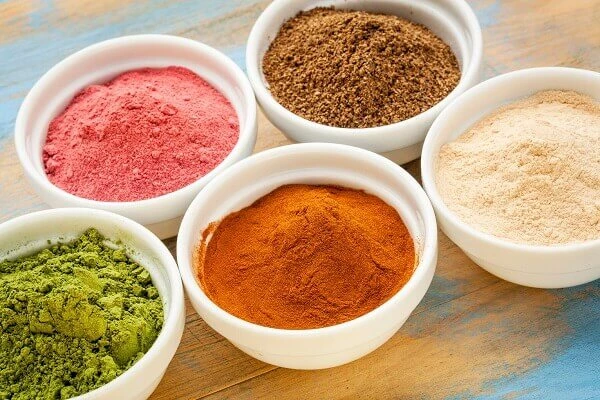
Wild dried plum halves organic bag The raw, unoiled and unsulphured organic prune halves without stones have a delicious, sweet and sour flavour. They grow wild on the mountain slopes along the old Silk Road from Samarkand (Uzbekistan). The wild plums are gently dried in the sun at below 42°C to preserve their natural flavour and nutrients. They are slightly less soft than most plums, but in terms of flavour and nutritional value, they are the best in the world - if you ask us. To make them softer again, you can simply soak the prunes overnight. Why prunes are healthy? We've never understood why "prune" is a dirty word. Because prunes are a valuable food. Prunes are rich in fibre, which can also help with constipation. They also contain sorbitol, which gives them a mild laxative effect. We therefore recommend not snacking on more than a handful. They also contain potassium, niacin, manganese, iron and the mineral boron, which strengthens bones and muscles. Uses The dried fruit can be used in a variety of ways - as a snack between meals, as an exciting addition to muesli, for making your own nut and fruit bars or as an ingredient with a tangy flavour for savoury dishes. Warnings May contain traces of nuts. Nutritional values of dried wild prune halves per 100g Energy value 1000 kJ / 237 kcal Fat 0.6g - of which saturated fatty acids 0.2g Carbohydrates 51g - of which sugar 42gDietary fibre 9g Protein 2.3g Salt 0.02g
Content: 250 Gramm (CHF 5.60 / 100 Gramm)
Spice mix sprout seeds - superfood from the jar Growing your own sprouts is very easy with the right equipment and is great fun! Sprouts are also very healthy because they contain lots of vitamins and minerals. The spice mix with three different sprouting seeds offers you a harmonious and flavourful blend. They are included in the ideal ratio: Alfalfa sprouts rocket sprouts Cress sprouts Country of origin of sprouts: Italy How to use sprout spice mix? You can simply eat the sprouts on their own or mix them into salads. They are also suitable as a topping for your fitness sandwich and for garnishing main courses. How to grow Würz-Mix sprouts? Soak for 10 hours Rinse in the morning and evening Leave to germinate for 5-6 days
Content: 250 Gramm (CHF 4.37 / 100 Gramm)
Xylitol birch sugar from Finland 100% pure Update: Our SamaraNatura birch sugar is sold out. As an interim solution, we have a few bags of Tautona available. The price is the same and the quality is also very good (made in Finland from local birch and beech wood). Why buy xylitol birch sugar? Xylitol is a sugar substitute and has the same sweetening power as white sugar. For baking, sweetening drinks (tea, coffee & co) and desserts as well as for refining sauces and dressings Has no unpleasant flavour of its own Low in calories: 40% fewer calories and 75% fewer carbohydrates Low glycaemic index (approx. 11 | compared to sugar of approx. 70) Dental care effect: to prevent plaque and tooth decay Xylitol looks and tastes like sugar and can therefore be used 1:1 like normal sugar, in hot and cold drinks, cakes and desserts. What makes our xylitol birch sugar special? We have tried a number of natural sweeteners over the years and after discovering xylitol, it has become one of our favourite sweeteners. Our xylitol comes from Finland Extracted exclusively from European birch and beech wood Maximum processing temperature is 25°C = raw food quality 100% pure, white, granular product (looks like granulated sugar) Originally, xylitol only came from birch bark. However, scientists in China found a way to extract xylitol from maize glucose. The problem here is that large quantities of pesticides are often used in the cultivation of maize and the soil is damaged. How is birch sugar produced? Xylitol is produced by the hydrogenation of xylose, which converts the sugar into a primary alcohol. This sugar alcohol, however, has nothing to do with ordinary alcohol. Xylitol occurs naturally in tree bark, but also in some types of fruit and vegetables. As birch bark is traditionally used for this purpose in Finland, the name birch sugar has also become established. Size variants Xylitol birch sugar is available in two sizes. In the practical 500g bag for CHF 11 and in the 1kg economy price bag for CHF 17.50. As is usual with all SamaraNatura products, we grant a 5% discount on quantities of 3 or more bags. Consumption recommendations As birch sugar has practically no flavour of its own, it is very suitable for sweetening tea and coffee. Other sweeteners such as agave syrup or yacon syrup often have a caramel flavour, which makes them more suitable for creams and desserts. However, birch sugar is not suitable for yeast baked goods, as yeast cannot metabolise xylitol. Xylitol belongs to the class of sugar alcohols that can have a laxative effect if consumed in excess. It is best to start with a small amount of 1 tablespoon per day so that the body can adjust to the new food and then slowly increase this amount. Warning: Xylitol is toxic to dogs as it causes rapid drops in blood sugar levels and seizures. Baking with xylitol For homemade chocolate and raw cakes, we recommend grinding the crystals into a fine powder (powdered sugar) (using a blender or coffee grinder). This prevents sugar lumps from forming. Coconut blossom sugar: the alternative or supplement to xylitol Coconut blossom sugar tastes similar to brown sugar, but even better! It has a rich, sugary-sweet caramel flavour and many chefs appreciate how coconut sugar refines their culinary dishes and makes them tastier. Ingredients Xylitol (E967) Nutritional values of xylitol - birch sugar per 100g Energy: kcal 240/kj 1000Fat: 0gSaturated fatty acids: 0gCarbohydrates: 100gof which sugar 0.2gand polyols 99.8gProtein: 0gSalt: 0g
Content: 500 Gramm (CHF 2.38 / 100 Gramm)
Average rating of 5 out of 5 stars
Organic Yacon Syrup - Delicious, prebiotic sweetener Yacon is grown in the high mountain valleys of the Andes and has a dense root system that is bursting with minerals, vitamins and complex vital substances. The freshly squeezed juice of the root is a gift of nature and has been savoured by the Andean peoples for centuries. Why consume yacon syrup? An ideal sweetener for the health-conscious, diet-conscious and diabetics. The special thing about yacon is the quality of its sugar, which is predominantly in the form of oligofructose (or fructooligosaccharides). Oligofructose cannot be utilised by the digestive enzymes and therefore causes hardly any calories and is gentle on the blood sugar level. Yacon tastes delicious and has half the calories of honey, for example. Yacon syrup is also significantly less glycaemic than honey, agave syrup or maple syrup. The oligofructose in yacon also supports the beneficial bacteria in the large intestine and thus improves the digestion and absorption of nutrients. The indigestible sugar thus serves as prebiotic food for the beneficial bacteria. What makes our yacon syrup special? Our yacon syrup comes from traditional varieties from the Peruvian Andes and is 100% natural, grown without pesticides or agrochemicals. It is produced at low temperatures, which guarantees that the syrup retains a very high quality of nutrients and enzymes. This yacon syrup is thickened from yacon juice in a special low-pressure process at low temperatures of 45°C. As yacon syrup can only be kept for a relatively short time without pasteurisation and additives, it is pasteurised at 70°C for 3 minutes. Our yacon syrup is therefore not raw, but is processed very gently, which means that the valuable nutrients and enzymes of the root are largely preserved. How to use yacon syrup? Yacon syrup is a versatile sweetener. It can be used to sweeten desserts, drinks and smoothies. For salad dressings, we like to mix the syrup with vinegar as a substitute for balsamic vinegar, which usually contains a lot of sugar. The sweetening power of the syrup is less than that of sugar, honey or agave syrup. To support a healthy intestinal flora, 1 teaspoon a day is sufficient. For a longer shelf life, we recommend storing the yacon syrup in the fridge. Nutritional values of SamaraNatura Organic Yacon Syrup per 100g Energy value 1227 kJ/293kcalFat 0g- of which unsaturated fatty acids 0gCarbohydrates 71g- of which sugar 25g,dietary fibre 7gProtein 0gSalt 0g
Content: 250 ml (CHF 8.74 / 100 ml)
Average rating of 5 out of 5 stars
Yellow maca powder - the superfood from the Andes (100% natural) Wide range of maca Our raw maca powder from the Junin region in Peru is one of the best maca powders on the market. In addition to the yellow maca described here, our range currently also includes red and black maca, naturally also in organic and raw food quality. Our red maca powder fulfils the highest quality requirements ✓ from organic cultivation ✓ Raw food quality due to special air-drying process with the help of the sun ✓ pure variety from 100% red maca roots ✓ Grown at altitudes of over 4000 metres above sea level in the Junín region of Peru ✓ 4:1 concentration, i.e. 4kg of maca tubers yield 1kg of maca powder Why consume yellow maca powder? Maca increases our energy levels. Maca makes us feel energised, grounded and happy. Maca also has a pleasant, malty flavour and can be used in many different ways. The root vegetable has been a staple food of the indigenous peoples of the Andes for thousands of years and is an excellent source of energy and stamina. Its content of biologically utilisable protein is approx. 11% in the dried root. For legal reasons (Swiss Foodstuffs Ordinance), as a food retailer we are not permitted to make any statements about possible effects. Do your own research on maca on the Internet. We find Dr Schweikart 's website very informative. The different varieties are also described there. What makes our yellow maca powder special and where is it produced? Our pure yellow maca powder is made from 100% natural maca roots from controlled organic cultivation, produced under strict production standards and quality controls. They all come from altitudes of over 4000 metres above sea level in the Junín region of Peru. Our suppliers work together with small farmers. In doing so, they create jobs for the local population and advise small entrepreneurs by offering training and financial support. This is a means of raising the standard of living of small farmers and at the same time increasing their crop yields. How to use yellow maca powder in everyday life? Maca has a unique flavour and can be added to many different dishes. Some people find the flavour of maca powder somewhat reminiscent of caramel with a peppery note. Maca powder can be stirred into rice, nut or hemp milk, for example, or simply mixed into muesli. Mix maca powder with water, milk of your choice or add it to juice, smoothies, muesli or raw desserts. Maca is also a good binding agent for soups and therefore a tasty addition. We particularly like maca together with oatmeal and as an ingredient in our raw chocolate recipes. More recipes... It is advisable to start with a small amount of ½ tsp per day and increase up to 1-2 tbsp per day. Unlike soya products, Mexican yam and linseed, maca does not contain hormones. Note: A common misconception about superfoods and herbs is that there is a standard amount to consume. In general, the usual recommended daily intake for most superfoods, including maca, is between 1 tsp and 3 tbsp per day, divided into two or three doses. It is best to start with 1 tsp per day and adjust the amount to your personal needs. Nutritional values of Maca powder yellow per 100g Energy value 1380kJ/327kcalFat 2gCarbohydrates 61g, of which sugar/dont sucres 32gDietary fibre 18gProtein 12g.All information is subject to the usual fluctuations of natural products.
Content: 250 Gramm (CHF 6.84 / 100 Gramm)