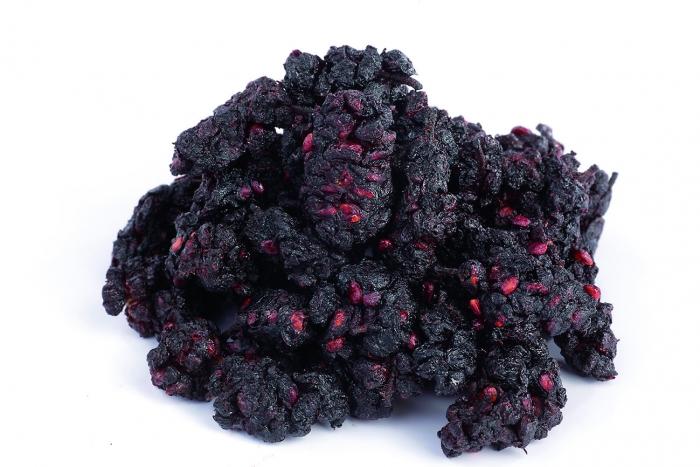
Update: Black mulberries are only comparable to white mulberries to a limited extent. They are less sweet, but more flavoursome, fruity and juicier/stickier. Organic black mulberries black - fruity and delicious Black mulberries have a beautiful and unusually intense purple-black colour. They have been known throughout southern Europe since earliest times and are thought to have been introduced from Persia. It is mentioned by most of the early Greek and Roman writers. In the past, dried black mulberries - known as the king of mulberries - were served at court as a highly exquisite speciality reserved only for the king, queen and esteemed guests. Why consume black mulberries?Delicious and nutritious, natural dried black mulberries are a great snack. They have a wide range of important nutrients, including vitamin C, iron, calcium, fibre, protein and organic compounds, including phytonutrients, zea-xanthin, resveratrol, anthocyanins, lutein and various other polyphenolic compounds. Its high protein and iron content is special for a fruit. The protein content in these super berries makes them particularly nourishing and satisfying, while iron boosts energy levels by producing oxygen-rich blood cells throughout the body. Mulberries are said to be particularly high in antioxidants, which is why they have a reputation as a perfect anti-ageing fruit. Antioxidants neutralise free radicals that can damage the genetic information of our cells.What makes our black mulberries special?Our organic mulberries are 100% natural, carefully processed and dried and contain no preservatives, colourings, sweeteners or other unnatural additives. They come exclusively from Uzbekistan and are grown by the farmers living there, who belong to a large community of 1000 farmers and their families. Our mulberries are harvested by hand when the berries are fully ripe. This ensures the highest nutritional value and freshness. After harvesting, they are carefully washed and gently dried using solar energy. The drying process is very environmentally friendly, with a solar drying method that has a minimal impact on the product. Most berries on the market have added sugar and preservatives. We prefer ours 100% pure, with their wonderful natural flavour. Our black mulberries have a beautiful dark colour, which indicates the quality and purity of the product. Blue and purple foods are very rarely found in modern diets and are so important - black mulberries make eating blue foods a real pleasure. Our organic black mulberries are dark and sticky, but pleasantly soft and large (depending on the harvest). Their flavour is sweet and sour, fruity and very aromatic. How to use black mulberries? Thanks to their intense sweet and sour flavour, they are a delicacy in their own right. They are also perfect as an addition to muesli, smoothies and as a dessert topping. They are a good alternative to dates or sultanas or other dried fruit suitable for sweetening. They go really well in yoghurt (including vegan coconut yoghurt) and honey. A real treat! Nutritional values of black mulberries per 100g Energy value 1310kJ/310kcalFat 3.4 gof which saturated fatty acids 1.1 gCarbohydrates 59 gof which sugar 52 gDietary fibre 7.2gProtein 6.6 gAll information is subject to the usual fluctuations of natural products. Storage: Store in a cool, dry and dark place.
Content: 250 Gramm (CHF 7.41 / 100 Gramm)
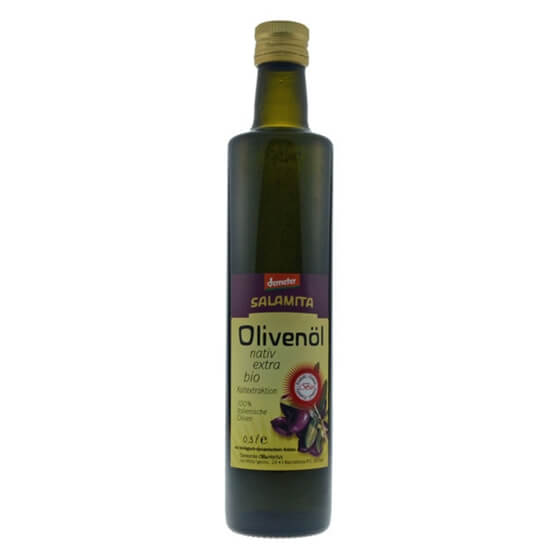
Salamita extra virgin olive oil from Sicily The cold-pressed organic Demeter olive oil of the highest quality grade "extra virgin" comes from 100% Italian olives. It is gently produced by mechanical pressing and fulfils the highest requirements in terms of flavour and composition. The Sicilian olives owe their tart and intense flavour to the fertile soils and benefit from the Mediterranean climate and the heat-retaining lava rock during the ripening process. Producer Founded in 1972 by the Salamita brothers, the co-operative has been practising organic farming since the beginning. As early as 1974, they switched to biodynamic farming in accordance with Rudolf Steiner's antroposophical philosophy. Their ongoing commitment was an important contribution to the development of the biodynamic movement in Sicily. Use This olive oil is perfect for flavoursome salad dressings and dips, but of course also for enhancing starters and main courses such as mashed potatoes, soups or vegetables. Certification Demeter, organic code: IT-BIO-007. Nutritional values of Salamita olive oil per 100g Energy value 3758 kj (899 kcal) fat 72g - of which saturated fatty acids 16.5g Carbohydrates 0g - thereof sugar 0g protein 0g salt 0g
Content: 500 ml (CHF 3.91 / 100 ml)
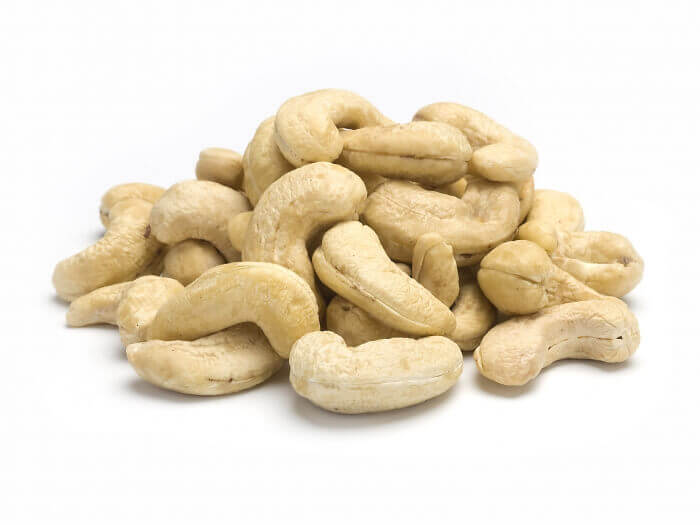
Organic cashews Jumbo - hand-cracked and Fairtrade The popular Jumbo cashews (240 size) are available again in 500g and 1kg bags. Jumbo cashews from Kerala (India) are among the best cashews in the world. They come from small farmers in Kerala (India) where they are carefully harvested, shelled and sorted by hand. They are gently dried in the sun to protect the nutrients and flavours as well as possible. Unlike most other cashews, they are truly raw food quality, i.e. hand-cracked, unsteamed and unheated. This not only preserves the nutrients much better, but also results in exceptional quality! The cashews are extra large, incredibly tasty and crunchy. They impress with their mild, sweet and nutty flavour. The cashews are very light to beige in colour.We have tried countless cashews over the years, but these cashews are among the best we have ever had. The grading size is 240, which means that there are 240 cashews of this size in a pound bag (1 pound equals 454g). The larger the value (e.g. 320), the smaller the cashew nuts. Origin Our organic Fairtrade cashew nuts come from small farmers in Kerala (India) where they are carefully harvested, shelled and sorted by hand. They are gently dried in the sun to protect the nutrients and flavours as much as possible. The farmers belong to the Elements & Fairtrade Alliance Kerala (FTAK). By buying these Fairtrade jumbo cashews, you are supporting these Fairtrade smallholder groups in improving their living conditions through hard and honest labour. Use We love these cashews as a snack on their own or mixed with fresh or dried fruit. Sprinkle cashews on salads, in muesli or use them for cashew milk, cashew puree and many vegan desserts such as pudding and cheesecake. Tip: The combination of cashew nuts with goji berries and/or cocoa nibs creates a very special flavour experience. Caution : Keep out of the reach of children. May contain traces of other nuts. Nutritional values organic cashew nuts jumbo per 100g Energy value 2310kJ/ 553 kcal fat 43.8g of which saturated fatty acids 7.8g Carbohydrates 30.2g of which sugar 5.9g protein 18.2g salt 0.03g
Content: 1000 Gramm (CHF 3.60 / 100 Gramm)
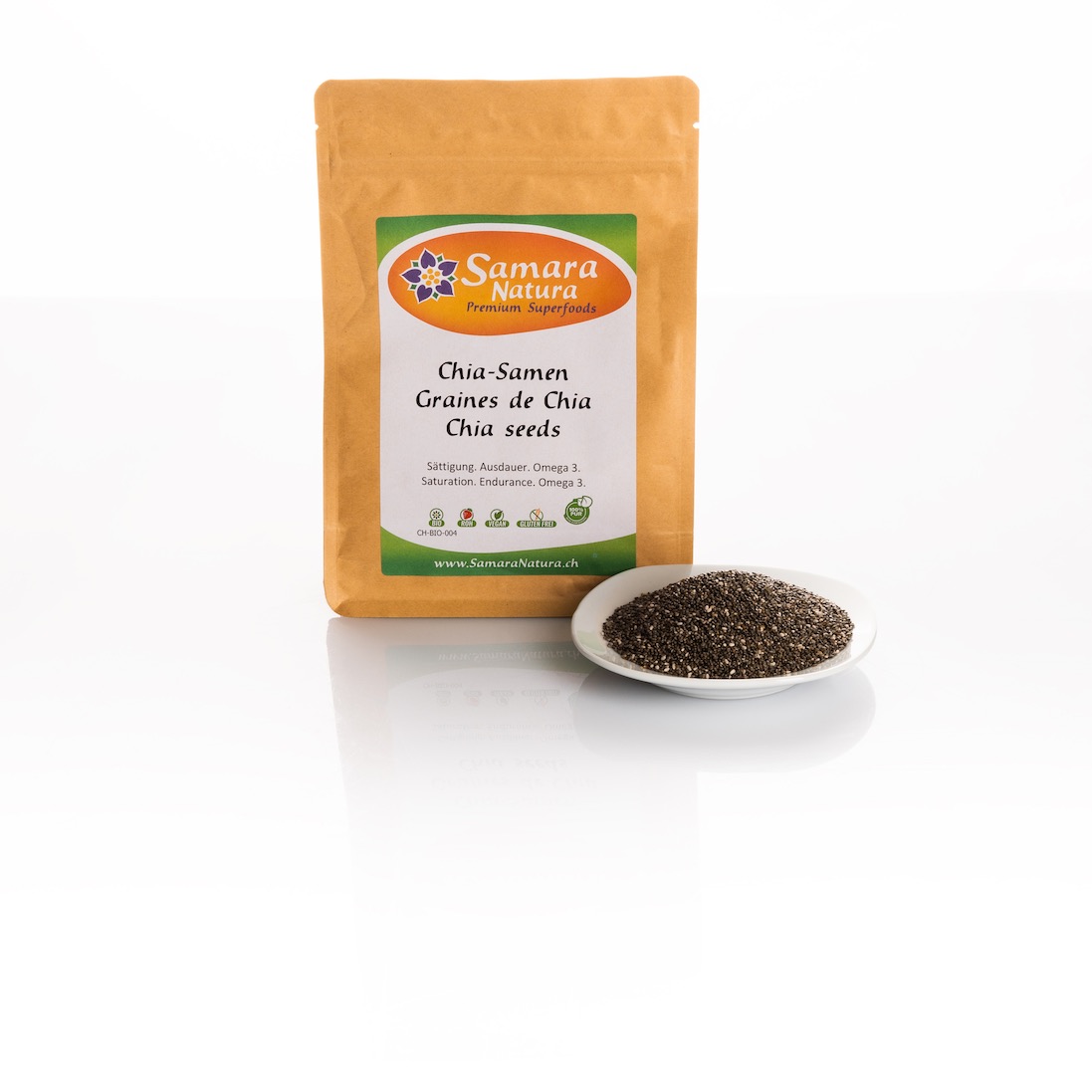
Organic chia seeds (100% natural) - the little power seeds Chia seeds are an ancient superfood that was used by the Mayas, Aztecs and Incas as early as 3500 BC. They come from the desert plant Salvia hispanica, which grows in southern Mexico. Chia means starch in the Mayan language and was considered "running food" because messengers could run all day long with the help of these tiny seeds. Why consume organic chia seeds? Easy to use: Almost unnoticed, the body gets an extra dose of nutrients and can absorb food much better. At the same time, it gets an extra dose of energy and more well-being for mind and soul. Chia seeds contain many antioxidants that not only scavenge free radicals and highly reactive oxygen compounds. They are important for cell maintenance and function. They help to maintain cell function. The antioxidants also prevent the seeds from spoiling quickly. The seeds are very filling as they absorb ten times their weight in water and form a gel. Athletes all over the world now include chia as part of their diet during training sessions. Chia seeds are rich in high-quality proteins, calcium and omega-3 and have an optimal ratio of omega-3 to omega-6 fatty acids. Last but not least, chia is a very inexpensive, concentrated food. 1/3 cup of dry chia seeds makes 500g of chia gel. Depending on how much gel you use, this 500g will probably last you an average of four days. You really don't need more than 1-2 tablespoons of chia gel per day. What makes our organic chia seeds special? Highest quality Cultivation without pesticides and agrochemicals Processed without the use of heat Purification only via a "shaking process" Use in the daily diet The most common way to eat chia is to soak the seeds first, which then turns into a jelly-like mass. The seeds can absorb a large amount of liquid very quickly, ten times their volume in less than 10 minutes. Chia gel Add 1/3 cup of seeds to 2 cups of water. Stir the mixture and place it in the fridge, tightly covered. A gel (approx. 500g) will form within 10 minutes and can be consumed immediately. A longer soaking time of several hours is advisable, as this makes the nutrients easier to utilise. Chia gel will keep for several days in the fridge and you can use some of it whenever you like. You can add it to smoothies, salad dressings, desserts and mueslis or simply eat it on its own. Whole seeds Sprinkle the dry seeds on salads or add to muesli mixes. You can also try grinding the seeds in a coffee grinder and adding the resulting chia flour to smoothies, soups, bread, etc. Chia sprouts are used similarly to alfalfa sprouts in salads, sandwiches and other dishes. As chia seeds absorb a lot of water, they can lead to dehydration in the body. It is therefore important to drink enough water or - even better - to use seeds that have already been soaked. How much to eat Based on the Food and Commodities Ordinance LGV - Novel Food, the maximum daily intake of chia seeds is 15g (or a maximum of 5% for use in bread products). This amount must not be exceeded. Nutritional values of chia seeds per daily portion (15g) Energy value 275kJ/67kcal fat 4.7g of which saturated fatty acids 0.6g of which polyunsaturated fatty acids 3.6g Omega-3 fatty acids 2.8g Carbohydrates 0.7g thereof sugar 0.1g Dietary fibre 4.7g protein 3.2g salt 0.005g
Content: 250 Gramm (CHF 3.04 / 100 Gramm)
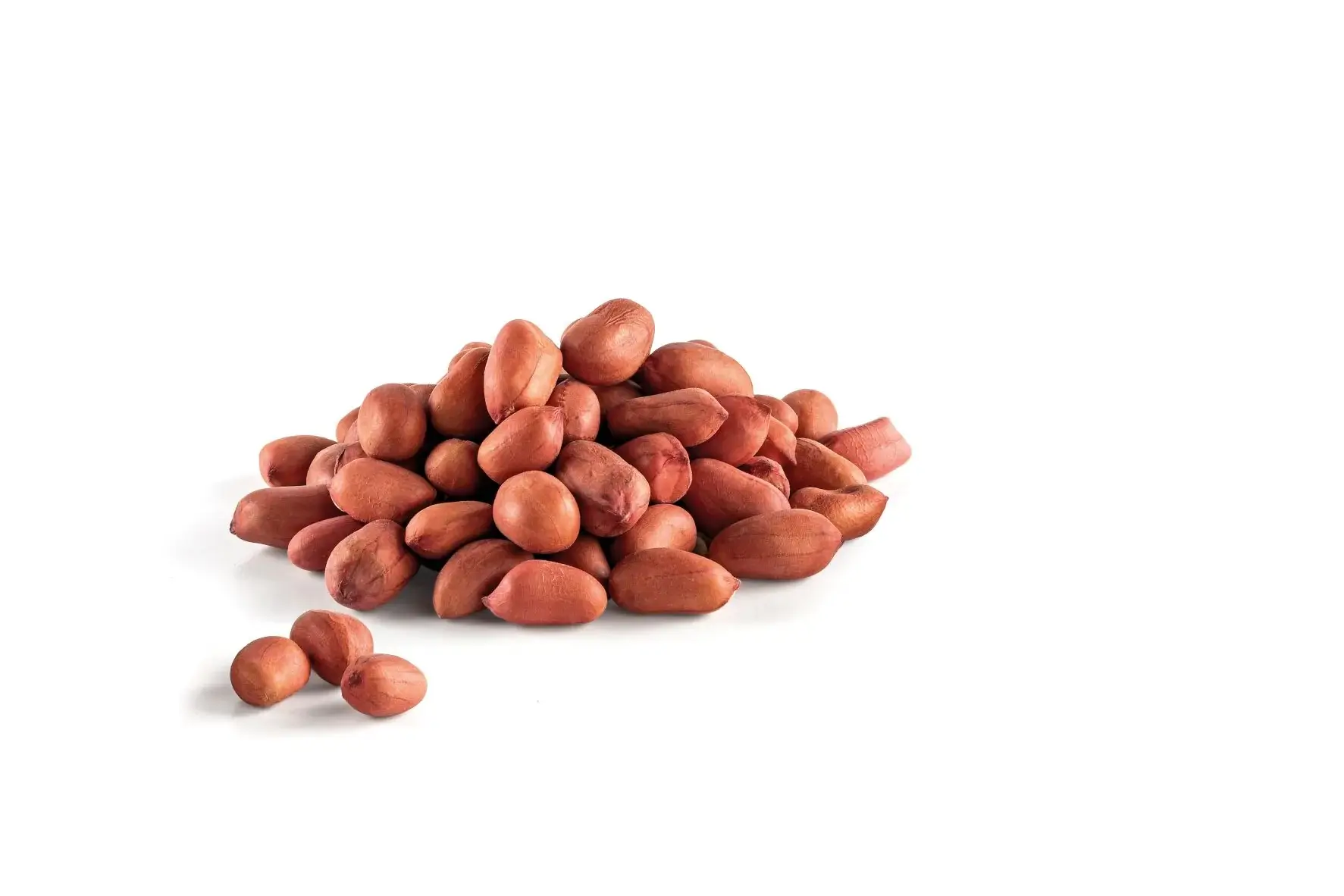
Redskin Organic Peanuts The red-skinned, unsalted and unroasted peanuts are different from the typical nuts at the bar, even at first glance. They can be recognised by their incredibly rich colour and unmistakable taste. The peanuts come from remote mountain regions along the old Silk Road in Uzbekistan, where they have been grown sustainably and organically for decades. To preserve their pure, natural flavour, they are gently dried using solar drying. When you open a pack of these high-quality nuts, you are sure to get curious looks. Everyone immediately recognises that these peanuts are different from all the others. Peanuts are a good source of vitamin B1, E, phosphorus, magnesium and potassium. Store in a dry place away from heat. See bottom of pack for best before date. Use Their delicate flavour and the absence of salt and sugar make peanuts the ideal snack. They are also suitable as a topping for salads and for preparing meals and homemade peanut butter. Warnings Small children can choke on nuts. May contain pieces of shell. May contain traces of other nuts. Nutritional values of Redskin Organic Peanuts per 100g Energy value 2431 kJ / 588 kcal Fat 48g - of which saturated fatty acids 6.4g Carbohydrates 7.5g - of which sugar 2gDietary fibre 12g Protein 25g Salt 0.05g Vitamin B1 0.9mg (82%)*Vitamin E 10.3mg (86%)* Phosphorus 341mg (86%)*Magnesium 163mg (43%)* Potassium 661mg (33%)* *according to nutrient reference values
Content: 250 Gramm (CHF 4.80 / 100 Gramm)
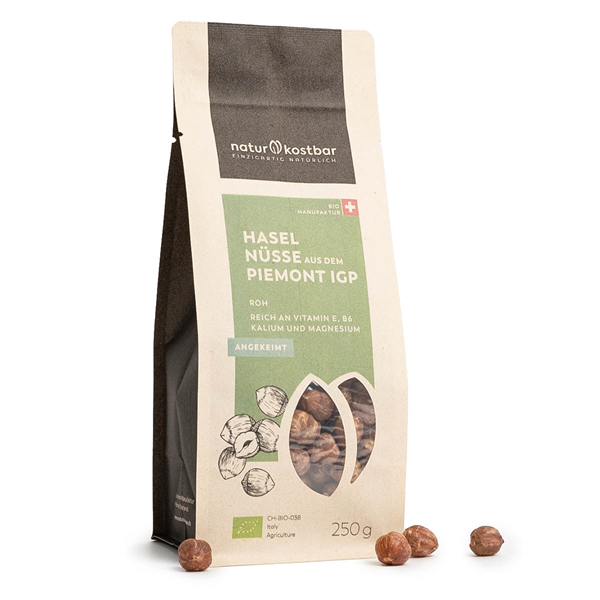
Organic sprouted hazelnuts - double the magnesium and calcium content The organic hazelnuts from Piedmont are soaked and sprouted in the Naturkostbar factory for several hours. They are then dried for 24 hours at a maximum temperature of 42° C. Germination neutralises the phytic acid present in the hazelnuts and significantly increases the nutrient density. In addition, the hazelnuts can be digested better, which also improves nutrient absorption. Use of sprouted hazelnuts Like normal hazelnuts, sprouted hazelnuts are suitable as a snack on their own or mixed with dried fruit and cocoa beans to make a delicious trail mix. Additional information Contents: Bag with 250g. Caution: May contain pieces of shell. Origin and production: Organic hazelnuts from Piedmont (Italy), sprouted in the Naturkostbar Manufaktur in Uetendorf near Thun. Organic certificate: CH-BIO-086 Nutritional values of sprouted hazelnuts Nutritional values Øper 100g/100ml%11 Reference quantity for an average adult (8400kJ/2000kcal) Energy 2650kJ (643kcal) 32% fat 59.5g 85% of which saturated fatty acids 4.2g 21% of which monounsaturated fatty acids 46.6g 311% of which polyunsaturated fatty acids 6.5g - Carbohydrates 6.9g 3% thereof sugar 4.3g 5% Dietary fibre 9.7g 19% Protein 15.2g 30% salt 0.01g 0% B-carotene (provitamin A) - - Vitamin A - - Vitamin B1 0.27mg 25% Vitamin B2 0.1mg 7% Vitamin B3 1.3mg 8% Vitamin B6 0.5mg 36% Vitamin B12 - - Vitamin C - - Vitamin D - - Vitamin E 27mg 225% Vitamin K - - biotin - - calcium 160mg 20% chloride 11mg 1% chromium - - iron 3.6mg 26% fluoride - - Folic acid/folacin 41µg 21% iodine 6.5µg 4% Potassium 720mg 36% Copper - - magnesium 160mg 43% manganese - - molybdenum - - Pantothenic acid 1.2mg 20% phosphorus 320mg 46% selenium - - Zinc 2.9mg 29%
Content: 250 Gramm (CHF 7.56 / 100 Gramm)
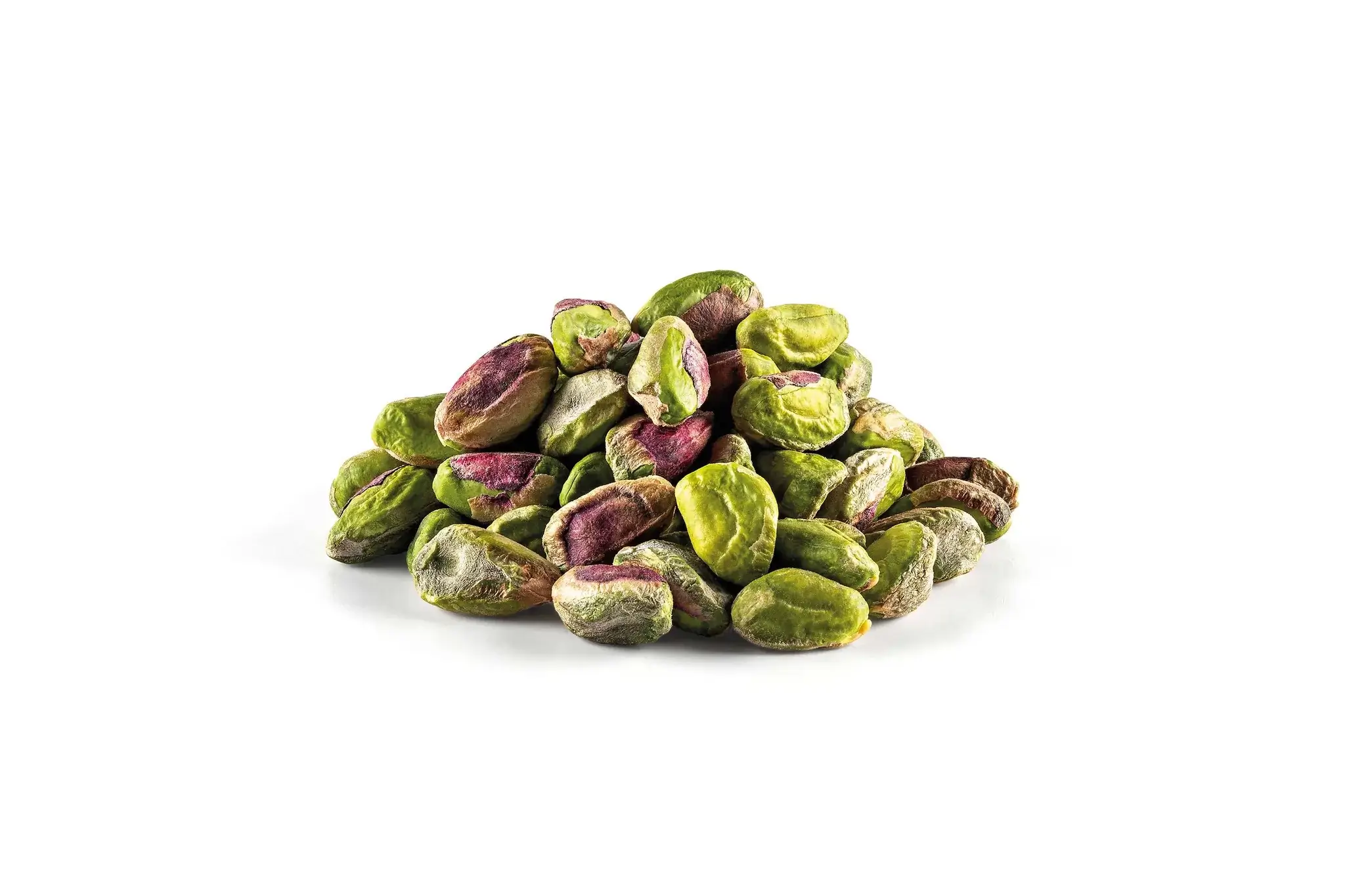
Organic Pistachio Kernels 250g Update: Unfortunately, the new batch of organic pistachios from Spain has been delayed, but will be packed and available on 24 July 26. Our shelled, raw pistachios have an intense and delicious flavour. They come from Spain. The pistachios are carefully harvested and processed, ensuring that their nutrients are preserved as much as possible. They are unroasted, unsalted and contain no additives whatsoever.Pistachios are sometimes referred to as ‘green gold’ because of their colour. Theybelong to the cashew family and are very popular due to their unique flavour and versatility. Our pistachios are raw, organic and of high quality. They are a source of protein, fibre, vitamin E and other minerals. Natural pistachios also contain natural melatonin. Store in a dry place away from heat. The best-before date is usually 1 year. Uses They are ideal as a high-quality snack, as a topping for salads, or for cooking and garnishing (e.g. grated over chocolate desserts). Warnings Small children may choke on nuts. May contain small pieces of shell. May contain traces of other nuts. Nutritional values for pistachios per 100g Energy 2543 kJ / 615 kcal Fat 52g - of which saturated fatty acids 6.8g Carbohydrates 12g - of which sugars 2.3gFibre 11g Protein 21g Salt 0.02gVitamin E 5.2mg (43%)*Magnesium 160mg (43%)* Iron 7.3mg (52%)* *according to nutrient reference values
Content: 250 Gramm (CHF 8.55 / 100 Gramm)
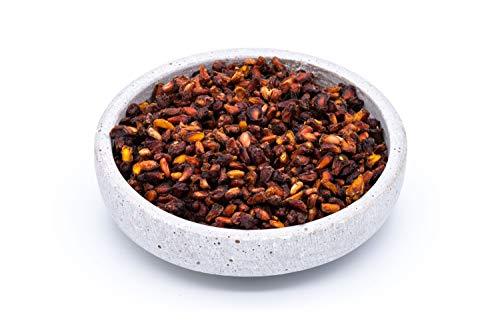
Why consume pomegranate seeds? Not so long ago, Japanese researchers discovered that pomegranates are rich in phyto-oestrogens, especially oestrone. Oestrone is a mildly effective oestrogen that is similar to the female sex hormones. The pomegranate also contains a lot of vitamin C, potassium, antioxidants and fibre. The pomegranate also has a stimulating effect, which is particularly beneficial for chronic fatigue, lack of energy, infections and inflammation. Pomegranates contain large quantities of antioxidant secondary plant substances such as polyphenols (flavonoids, tannins). What makes our pomegranate seeds special? These premium organic pomegranate seeds are particularly dark purple, almost purple in colour and very rich in antioxidants. The pomegranate seeds are characterised by a red to dark purple colour. When they are dried, the moisture in the segments is lost and the kernel with the fruity skin remains. The stone is crispy and edible. The surrounding flesh and skin give the kernels an aromatic, characteristic fruity flavour. Origin and exceptional production The pomegranates are harvested by hand when fully ripe, piece by piece, and are peeled by hand and sun-dried on the same day by the Silk Road Organik Foods processing company. The drying process used is a very environmentally friendly solar drying method, which is also extremely gentle on the product. Around 1 kg of fresh organic fruit is needed to produce 100 g of pomegranate seeds, i.e. a ratio of 1:10! These organic Fairtrade pomegranate seeds come from a remote mountain village in the Varganza Valley in the south of Uzbekistan. They ripen there on trees in the mountainous regions around Samarkand. The area is extensively certified organic and Fairtrade and is farmed by the FAIRTRADE farmers living there. The farmers belong to a large Fairtrade community, which is made up of 3 groups, Dustkul Bogi, Turkiston Gulba and Turob Bobo. They include around 1000 individual farmers and their families. Thanks to the co-operation with Fairtrade, the farmers can offer their families a secure income and their children a new perspective. In Austria, the pomegranate seeds are de-pressurised. The combination of pressure and time ensures that the pomegranates are absolutely pest-free. The history of the pomegranate The pomegranate has been cultivated for over 5000 years, making it one of the oldest plants known to mankind. The name pomegranate goes back to the Romans (lat. granae = seeds, grains; lat. granatus = granular, rich in seeds). The pomegranate has always been a symbol of life and fertility. The pomegranate has a history steeped in legend: it probably helped to trigger the Trojan War, in Christian culture the pomegranate is the symbol of Mary's fertility, it is also regarded as a symbol of life and the Egyptians added it to mummies. To this day, it is considered an aphrodisiac and is an ingredient in countless love drinks. Tips for use Refine your muesli, salads or use the pomegranate seeds for baking. Pomegranate seeds are also suitable as a snack and create an incredible explosion of flavour, especially when combined with nuts and cocoa beans. Nutritional values of organic pomegranate seeds per 100g Energy 308 kcal / 1289 kJFat 2.4gof which saturated fatty acids 0.6gCarbohydrates 64.4gof which sugar 64.4gProtein 2.8gDietary fibre 8.8gSalt <0.01g
Content: 150 Gramm (CHF 10.00 / 100 Gramm)
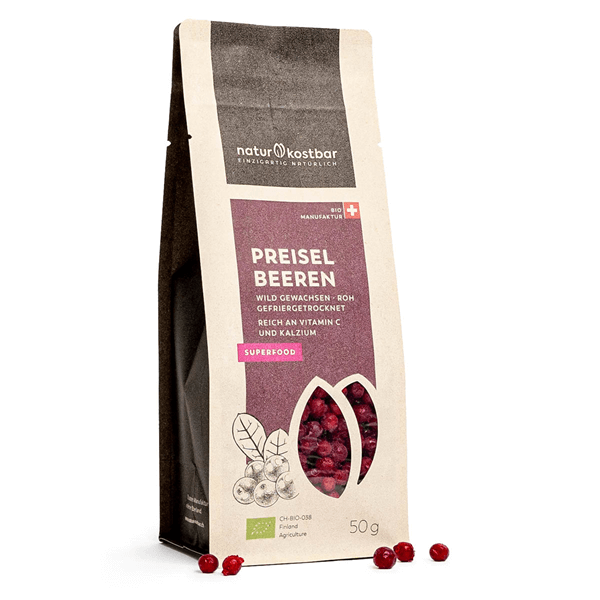
Packung à 50g.
Content: 50 Gramm (CHF 30.22 / 100 Gramm)
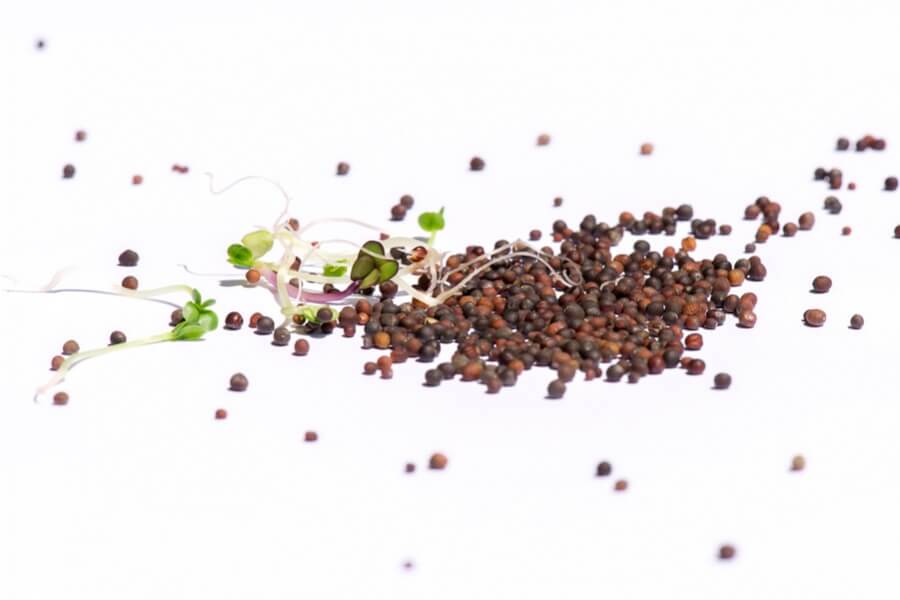
Protection-Mix organic sprouts The 250g Protection-Mix contains Broccoli sprouts Kohlrabi sprouts Rapeseed sprouts Country of origin sprouts: Italy How to use Protection-Mix sprouts? You can simply eat the sprouts on their own or mix them into salads. They are also suitable as a topping for your fitness sandwich and for garnishing main courses. How to grow Protection-Mix sprouts? Soak 3 heaped tablespoons of Protection-Mix sprouted seeds in a small (1700ml) or 4 heaped tablespoons in a large (3100ml) sprouting jar for 10 hours. Then pour off the water, rinse twice and turn the jar slightly so that the seeds stick to the glass wall. Place the germination jar in a bright place in the appropriate stand, but not in direct sunlight. Rinse with cold water every 12 hours. Repeat the process for several days until the sprouts have reached a size of approx. 2-3 centimetres. Germination usually takes 4 to 5 days. Use afterwards. The Protection-Mix sprouts can be kept chilled in the fridge for several days.
Content: 250 Gramm (CHF 4.37 / 100 Gramm)
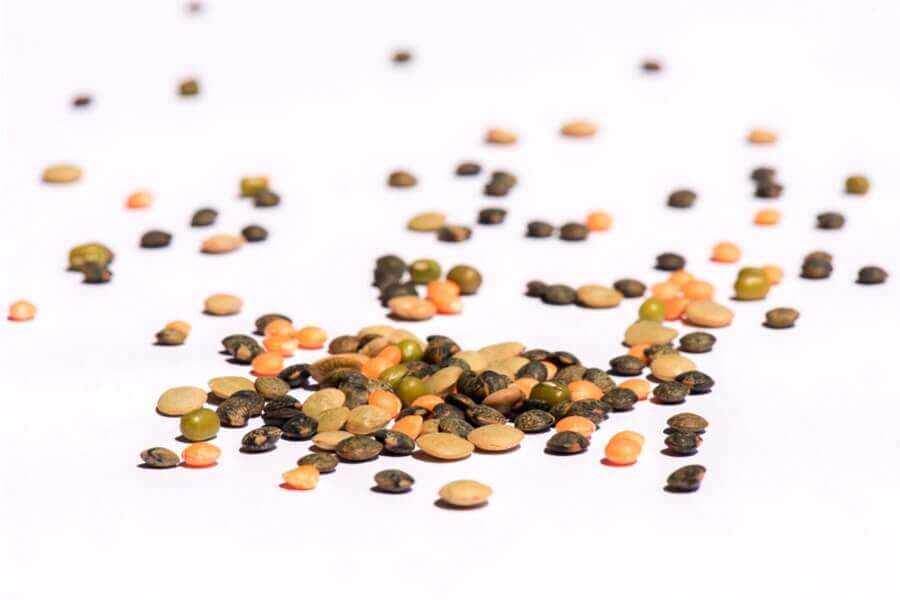
Protein-Mix 2 Sprouts Organic The 500g protein mix 2 (germinable) contains an optimum ratio of Buckwheat Mountain lentils Green lentils Beluga lentils Why the protein mix is healthy This mix provides your body with an optimum supply of high-quality energy fuel: easily digestible, plant-based protein and carbohydrates. Both the buckwheat and the lentils are very filling. Use You can simply eat the sprouts on their own or mix them into salads. They are also suitable as a topping for your fitness sandwich and for garnishing main courses. How to germinate protein mix sprouts 3.1 litre sprout jar: soak 8 heaped tablespoons for 10 hours.1.7 litre sprout jar: soak 8 heaped tablespoons for 10 hours. Then pour off the water, rinse twice and turn the jar slightly so that the seeds stick to the glass wall. Place the germination jar in a bright place in the appropriate stand, but not in direct sunlight. Rinse every morning and evening. Repeat the process for 2-3 days until the sprouts are as big as the seeds themselves. Then use. The protein mix sprouts can be stored in the fridge for approx. one week. Further information on Protein-Mix Sprouts sprouted seeds Bag contents: 500g. Country of origin of sprouts: Buckwheat from Austria, mountain lentils from Italy, green lentils from Italy, beluga lentils from Italy. Storage: Store in a cool, dark and dry place Organic certification: CH-BIO-006
Content: 500 Gramm (CHF 1.43 / 100 Gramm)
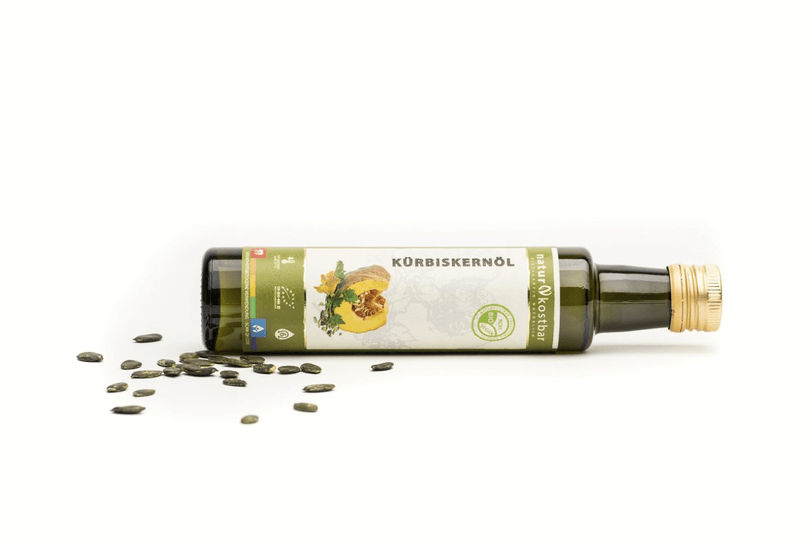
Cold-pressed organic pumpkin seed oil from Naturkostbar The organically grown apricot kernels come from Turkey. The apricot kernels are gently cold-pressed in the Naturkostbar factory in Uetendorf. The water-cooled oil press ensures that the temperature remains below 37°C. This preserves the valuable ingredients in the oil and makes it a special treat. This apricot kernel oil is 100% pure and contains no other oils. What is the best way to use apricot kernel oil? The high-quality apricot kernel oil refines salad dressings and dips with its sweet flavour and typical persipan note. We recommend storing it in the fridge after first opening. Apricot kernel oil is also ideal for skin care, whether as a fragrant massage oil or as a soothing aftersun oil. It is slowly absorbed into the skin and strengthens the skin's elasticity. Why not heat apricot kernel oil? Cold-pressed oils (except coconut oil) are sensitive to heat and are therefore mainly suitable for cold cooking. Toxic compounds can form when heated to high temperatures, e.g. frying. Does apricot kernel oil contain hydrocyanic acid? Apricot kernel oil contains hardly any hydrocyanic acid. The acid from the kernels volatilises during pressing. Apricot kernel oil is safe to consume and enriches your diet. Additional information Ingredients: 100% organic apricot kernel oil Organic certificate: CH-BIO-086 Allergens: Apricot kernels Nutritional values of apricot kernel oil per 100g Apricot kernel oil is a high-quality source of energy with a high proportion of unsaturated fatty acids. The oil contains plenty of vitamin B1, which protects our cells from oxidative stress. It also contains the green colouring agent chlorophyll. Nutritional values Øper 100g/100ml%11 Reference quantity for an average adult (8400kJ/2000kcal) Energy 3400kJ (830kcal) 40% fat 92g 131% of which saturated fatty acids 17g 85% of which monounsaturated fatty acids 28g 187% of which polyunsaturated fatty acids 47g - Carbohydrates - - thereof sugar - - dietary fibre - - protein - - salt - - B-carotene (provitamin A) - - Vitamin A - - Vitamin B1 - - vitamin B2 - - Vitamin B3 - - Vitamin B6 - - Vitamin B12 - - Vitamin C - - Vitamin D - - Vitamin E 4mg 33% Vitamin K - - biotin - - calcium - - chloride - - chromium - - iron - - fluoride - - Folic acid/folacin - - iodine - - potassium - - copper - - magnesium - - manganese - - molybdenum - - pantothenic acid - - phosphorus - - selenium - - zinc - -
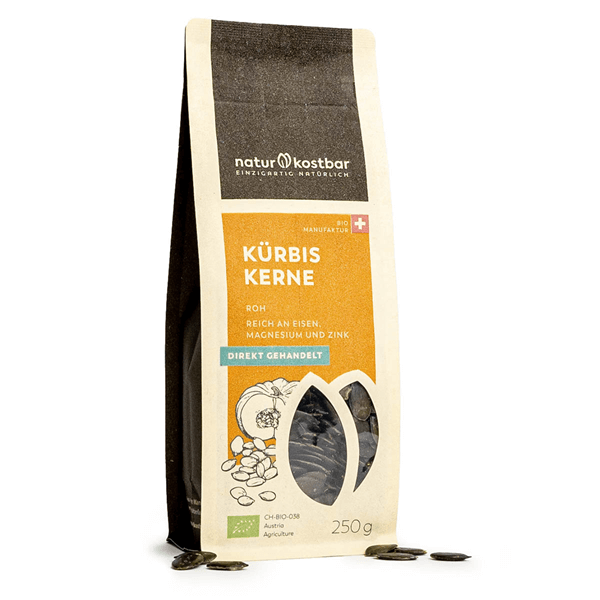
Pumpkin seeds: crunchy seeds full of energy Why and how to use them? Inside the large autumn fruits, the pumpkin seeds develop their fine flavour and are enriched with important vitamins, minerals, polyunsaturated fatty acids and protein. Enjoy the organic pumpkin seeds on their own as a snack, combine them with nuts and fruit or use them to flavour your dishes. They go perfectly with salads, muesli and savoury dishes. They also cut a fine figure in bread dough or as a decoration on vegetable dishes. The pumpkin seeds even release their delicious flavour when made into pesto. What makes these pumpkin seeds special? These pumpkin seeds are organically grown on an Austrian family farm. After harvesting, they are gently and slowly dried to preserve all their valuable nutrients. The raw seeds are then sent directly to the factory in Uetendorf. Ingredients Organic pumpkin seeds from Austria. Nutritional information Nutritional values Øper 100g/100ml%1 Energy: 2364kJ/565kcal 28,25% Fat: 44.00g 62,86% of which saturated fatty acids: 9.37g 46,85% of which monounsaturated fatty acids: 10.60g 70,67% of which polyunsaturated fatty acids: 23.60g 157,33% Carbohydrates: 4.70g 1,81% of which sugar: 2.10g 2,33% Dietary fibre: 8.80g 17,60% Protein: 35.00g 70,00% salt: 0.10g 1,67% Vitamin E: 4.00mg 33,33% Vitamin B1 (thiamine): 0.22mg 20,00% Vitamin B2 (riboflavin): 0.30mg 21,43% Vitamin B6: 0.10mg 7,14% Calcium: 41.00mg 5,13% Phosphorus: 830.00mg 118,57% Iron: 12.50mg 89,29% Magnesium: 402.00mg 107,20% Zinc: 7.00mg 70,00% Iodine: 12.00µg 8,00% Manganese: 1.00mg 50,00% Fluoride: 0.10mg 2,86% Potassium: 814.00mg 40,70% Chloride: 80.00mg 10,00% 1 Reference amount for an average adult (8400kJ/2000kcal)
Content: 250 Gramm (CHF 3.38 / 100 Gramm)
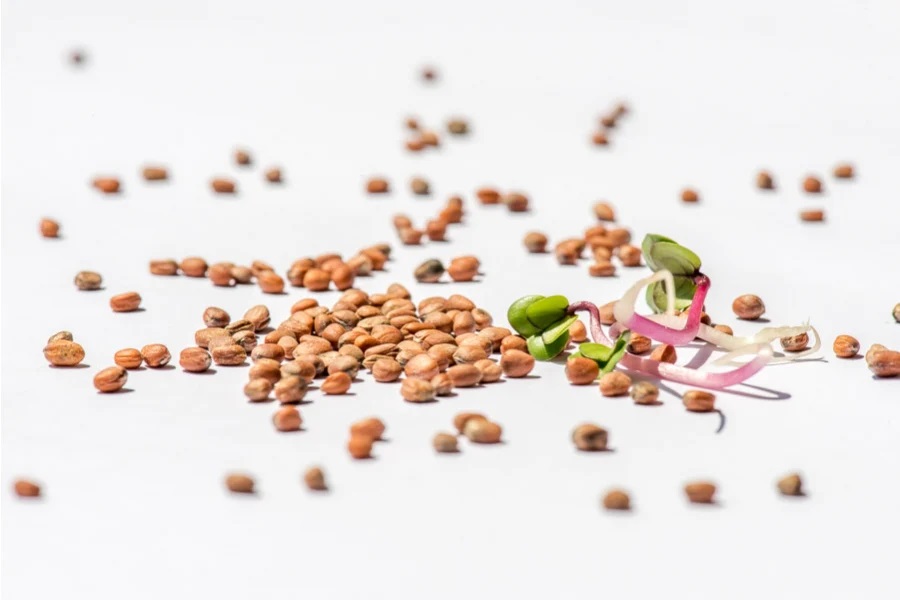
Radiesli Sprossensamen BioDie Radiesli Sprossen sind aromatisch und pikant. Sie passen sowohl zu Salaten und Sandwiches, aber vor allem zu Käsegerichte wie Fondue oder Raclette. Nährwerte Radiesli Sprossen (ausgewachsen) 100 g verzehrbarer Anteil enthalten etwa (ausgewachsene Knolle):Energie14 kcal bzw. 57–61 kJEiweiss1,1 gFett0,1 gKohlenhydrate, verwertbar2,0 gBallaststoffe1,6 gWasser94 gNatrium17 mgKalium225–255 mgCalcium34–35 mgPhosphor28 mgMagnesium8 mgEisen1,2 mgFluor0,10 mgVitamin A4 µgVitamin Ekeine DatenVitamin B10,04 mgVitamin B20,04 mgNiacin0,2 mgVitamin B60,06 mgVitamin C27–29 mgSalicylsäure1,24 mgHerkunftsland Keimsprossen: Italien
Content: 250 Gramm (CHF 4.18 / 100 Gramm)
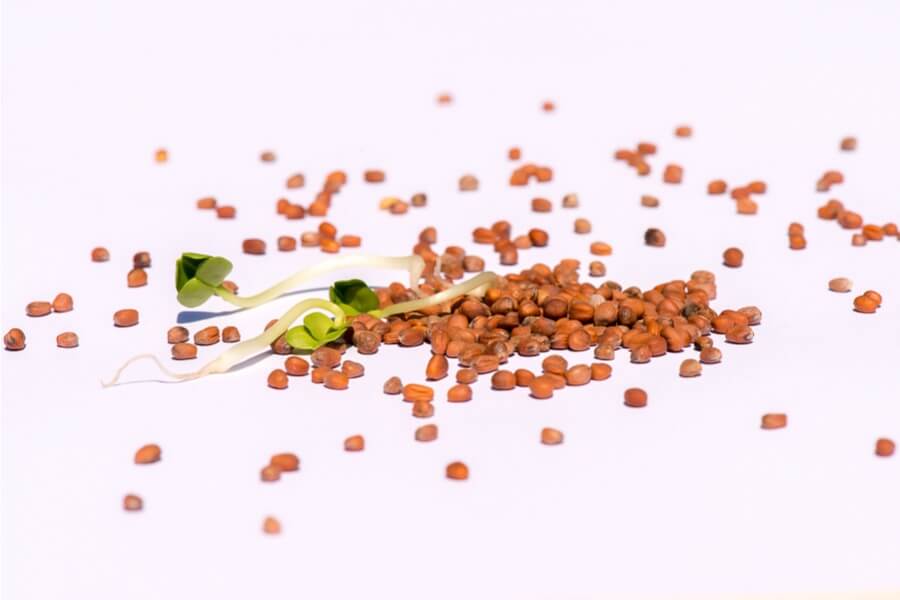
Radish green sprout seed For all those who like things a little more savoury or just for a change.A normal radish covers an adult's daily requirement of The radish green sprouts contain Vitamin C, protein, carotene, some B vitamins, plenty of potassium, sodium, magnesium, calcium, phosphorus, iron and enzymes. Radish sprouts also contain a sulphur-containing oil, raphanol, as well as several mustard oil glycosides and bitter substances, which have an antibiotic effect, are choleretic and dissolve mucus in the respiratory tract. Country of origin of sprouts: Italy Growing green radish sprouts Soak 4 heaped tablespoons (3100ml jar) or 3 heaped tablespoons (1700ml jar) of radish seeds for 10 hours. Then rinse in the morning and evening.The radish sprouts take 4-5 days to germinate. Consume directly afterwards. To keep the sprouts fresh for longer, we recommend storing them in the fridge. Tip: Place kitchen paper between the sprouts and the Tupperware. Use The radish green sprouts go particularly well with fondue or raclette, as they help to digest the greasy meal. You can also simply eat the sprouts on their own, mix them into salads or use them as a topping for sandwiches.
Content: 250 Gramm (CHF 4.18 / 100 Gramm)
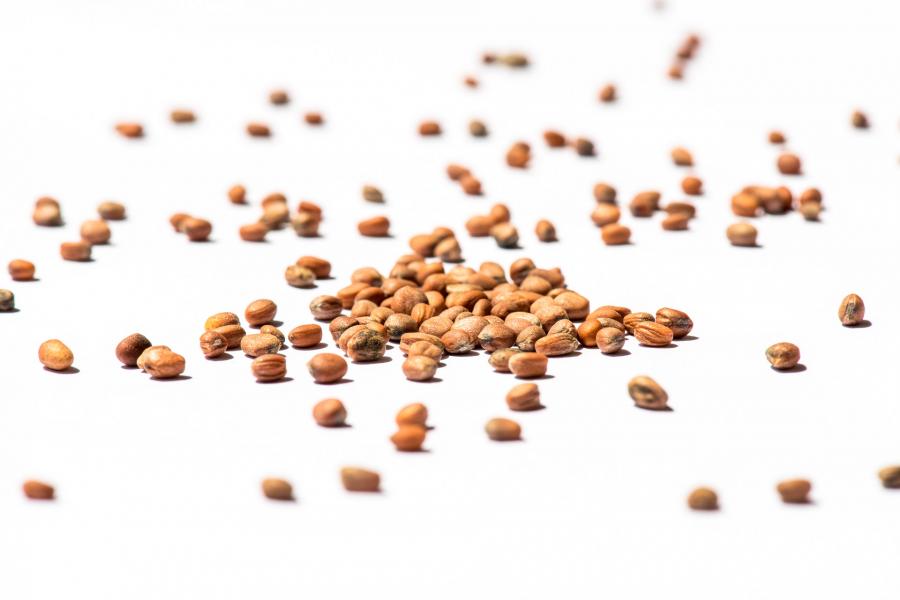
Radish mix sprout seeds The radish mix contains radish, radish green and radish purple sprout seeds. This mix is full of antioxidants and provides plenty of energy. The radish mix sprouts contain: Vitamin C, antioxidants, iron, phosphorus, magnesium. Calcium, B vitamins Country of origin of sprouts: Italy Use The radish mix sprouts go particularly well with fondue or raclette, as they help to digest the fatty meal. However, you can also simply eat the sprouts on their own, mix them into salads or use them as a topping for sandwiches.
Content: 250 Gramm (CHF 4.37 / 100 Gramm)
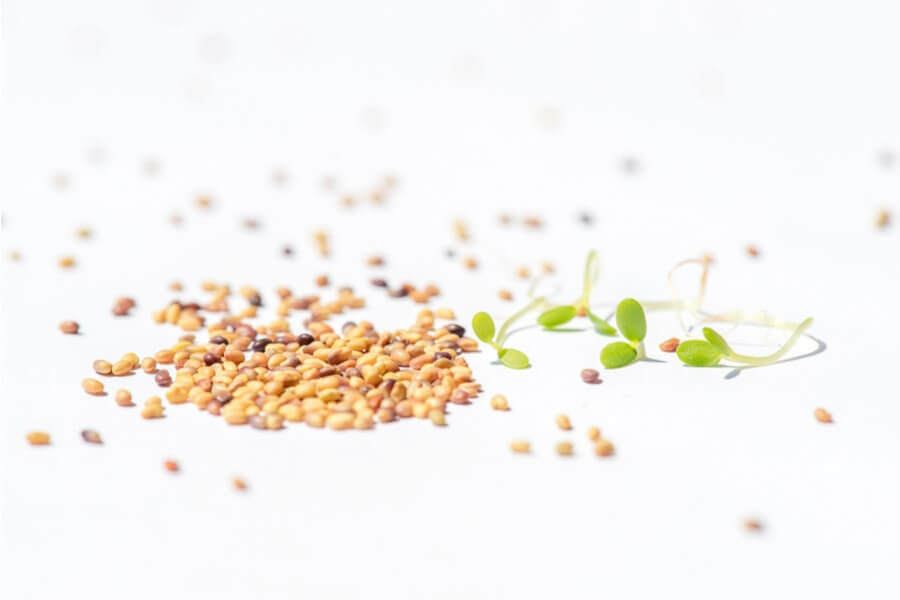
Red clover sprouts - superfood from the jar Red clover is rich in proteins, vitamins A, B, C and E and minerals such as calcium, magnesium, phosphorus and potassium.Red clover also contains isoflavones, which are phytoestrogens and have a weak oestrogenic effect. Red clover flowers are used in folk medicine as a food supplement for the treatment and prevention of menopausal symptoms. Country of origin of sprouts: Italy How to use You can simply eat the sprouts on their own or mix them into salads. They are also suitable as a topping for your fitness sandwich and for garnishing main dishes.
Content: 250 Gramm (CHF 3.61 / 100 Gramm)

Rocket sprouts germination seed Rocket seeds cannot be grown on their own, which is why they must be grown together with red clover or alfalfa (our recommendation). The following ratio is excellent for growing sprouts: 1 level tsp rocket and 2 heaped tbsp alfalfa, whereby the seed quantity refers to the germination glass of sprout seeds. However, growing them together is by no means a disadvantage; the tasty rocket sprouts provide a savoury addition to the alfalfa sprouts. Why does rocket need to be grown with alfalfa? The rocket seeds (just like cress) stick together strongly at the start of the germination process. Growing them alone would not work. We therefore recommend always growing rocket seeds with alfalfa seeds, as the germination period is optimally matched. Red clover seeds can also be used as an alternative to alfalfa. Why rocket is healthy Rocket is characterised by the following ingredients: Vitamin C Bitter and flavouring substances Mustard oils dietary fibre secondary plant substances Use You can eat rocket and alfalfa sprouts on their own or mix them into salads. They are also suitable as a topping for your fitness sandwich and for garnishing main courses. Germinating rocket 3.1 litre sprout jar: Soak 1 level teaspoon of rocket seeds and 2 heaped tablespoons of alfalfa seeds for 10 hours. 1.7 litre sprouting jar: soak 1 level teaspoon of rocket seeds and 1.5 heaped tablespoons of alfalfa seeds for 10 hours. Then germinate in the sprout jar for 5-7 days. Rinse every morning and evening. The sprouts can then be stored in the fridge for about a week. Further information on rocket sprouts sprouting seeds Bag contents: 250g. Country of origin of sprouts: Italy Storage: Store in a cool, dark and dry place Organic certification: CH-BIO-006
Content: 250 Gramm (CHF 4.18 / 100 Gramm)
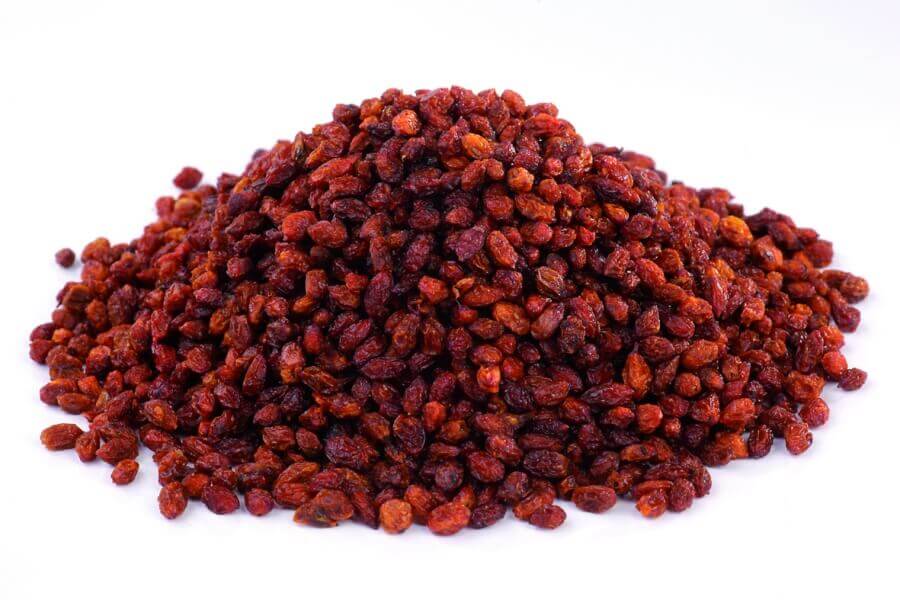
Dried organic sea buckthorn berries - unsweetened & wild harvested Why buy sea buckthorn berries? An analysis carried out by the retailer provided proof of the sensational amounts of vital substances in sea buckthorn. The berries have a very high omega 7 fatty acid and B12 content. This high content is probably only found in Uzbek wild-collected organic sea buckthorn. Cultivated sea buckthorn generally has much lower levels and vitamin B12 in plant foods is very rare! Dried sea buckthorn contains most of the same vital substances and nutrients as fresh sea buckthorn, only in a more concentrated form because the water has been removed. These wild sea buckthorn berries have an intense, spicy and very tart flavour. They have a strong, intense light to dark orange colour. The flesh surrounds a stone, which is also dried. This results in a crispy consistency. What makes our wild organic sea buckthorn berries special? When fully ripe, the wild sea buckthorn berries are picked by hand, washed and gently dried in the sun. The drying process used is a very environmentally friendly solar drying method that is extremely gentle on the product. The organic sea buckthorn berries are - unsulphurised (in accordance with the EU Organic Regulation)- without artificial additives- without preservatives- without colourings Where do our organic sea buckthorn berries come from? Organic sea buckthorn berries from wild collection are very difficult to obtain. We were able to buy a batch from Ukraine. These wild sea buckthorn berries come from the Lviv region in western Ukraine, close to the Polish border. They are packed in 125g bags. How to integrate them into your daily diet? The dried organic sea buckthorn berries are suitable as a small, refreshing snack or as a varied ingredient in your power muesli. To round off the tart flavour, you can combine the sea buckthorn with nuts and sweet dried fruits such as sultanas. Or you can use a healthy sweetener such as agave, yacon or apple syrup. Origin Collected wild and processed in Ukraine. Nutritional values of sea buckthorn berries per 100g Energy value 1116kJ/270kcalFat 21.5gof which saturated fatty acids 1.2gCarbohydrates 8.9gof which sugar 8.8gProtein 5.5gSalt 0.037g All information is subject to the usual fluctuations of natural products. Storage: Store in a cool, dry and dark place.
Content: 125 Gramm (CHF 13.68 / 100 Gramm)
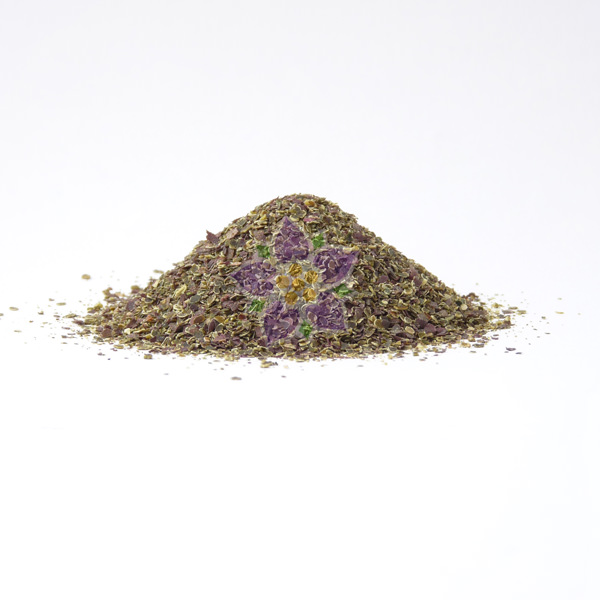
Organic seaweed spice mix - 5-algae mix powder Update: The 40g tin is unfortunately no longer offered by the producer. As an alternative we can offer 100g refill bags. This highly nutritious sea spice mix makes it very easy to incorporate healthy sea vegetables into your daily diet. The sea spice mix contains Atlantic wakame, Atlantic nori, Atlantic kombu, Atlantic dulse and Atlantic spirulina. Sea vegetables are enjoyed daily as a staple and healing food on many coasts of the world. Small amounts add rich flavour and enhance the nutritional value of most dishes. They are a perfect substitute for salt in the diet. Our sea vegetables grow wild in the clean waters off north-west Donegal in Ireland and are harvested by hand. They are carefully monitored and gently dried using a cold air process. We work closely with our supplier Algaran for our organic seaweed seasoning mix and are the general importer of the Algaran brand for Switzerland. Use of organic seaweed spice mix As a raw food, add approx. ½ teaspoon of seaweed seasoning to salads and other dishes. In soups and stews, ideal with pulses and cereal dishes. Add towards the end of the cooking time as desired. Ingredients Irish wakame (Alaria esculenta)*, dulse/lap kelp (Palmaria palmata)*, Irish moss (Chondrus crispus)*, finger kelp (Irish kombu, Laminaria digitata)*, Irish spirulina (Ulva spiralis)*.* from certified organic originNote: These seaweeds may contain parts of crustaceans and grains of sand. Nutritional values Organic seaweed spice mix - 5-algae mix per 100g per 5g (portion) Energy Kcal (KJ) 148 (618) 7.4 (30.9) Proteins 11.3g 0.6g Carbohydrates 9.9g 0.5g thereof sugar 0g 0g fat 1.4g 0.1g of which saturated 0g 0g Dietary fibre 39g 1.9g salt 0.65g 0.03g Vitamin B12 4.4µg 0.2µg (9%*) Iodine 16.9mg 0.8mg (563%*)
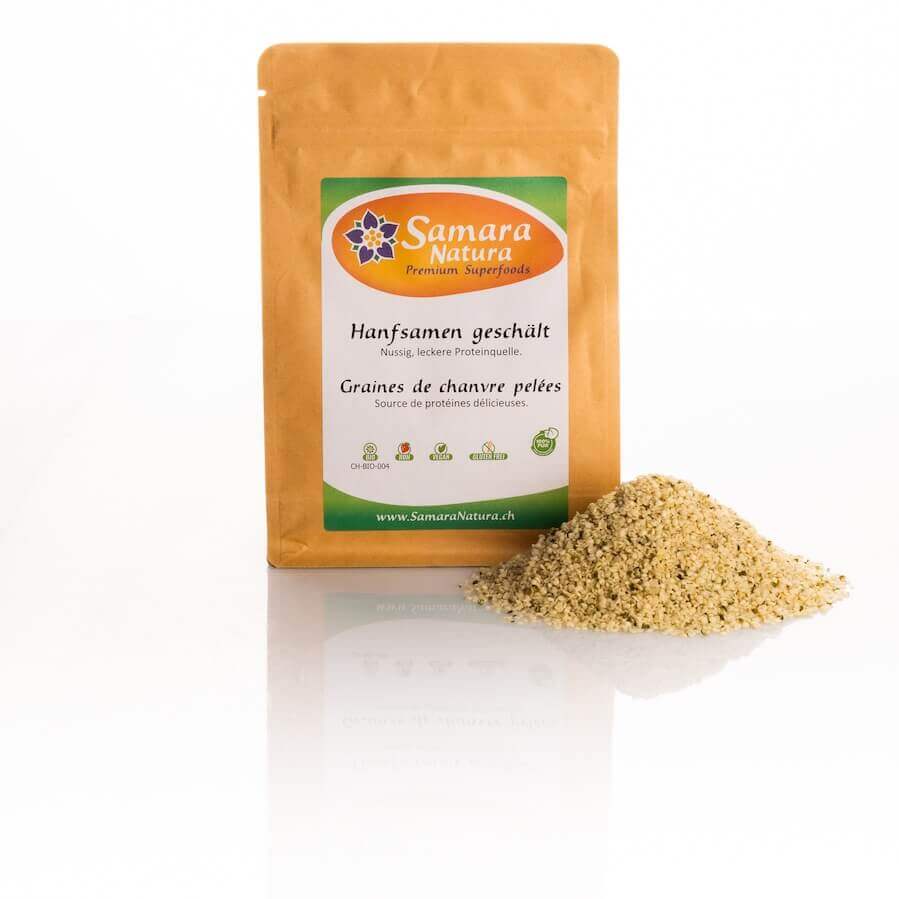
Hulled hemp seeds - protein-rich power food Hemp seeds are characterised by an unusually high nutrient density. Rich in easily digestible protein, essential fatty acids, vitamins, minerals, antioxidants, fibre and lecithin in perfect balance for our bodies. Hemp has an optimal functional ratio of omega-3 to omega-6 fatty acids for humans, which is generally considered to be 4:1. Hemp seeds are therefore an excellent brain food, beautify the skin and promote the oxygen supply to the cells. Hemp seeds are a good food for the supply of EFS, linoleic acid, alpha-linolenic acid and the rare gamma-linolenic acid. These fatty acids are required for the production of numerous hormones and for cell renewal. They support the functions of the human body to maintain health and contribute to the normal development and growth of the organism. Omega-3 fatty acids are incorporated into the cell membrane and are necessary for its structure and function. Omega-3 fatty acids have an influence on blood lipid regulation. They contribute to health as part of a balanced diet. An ideal food for athletes, as edible hemp builds muscle and increases endurance. Vegetarians also benefit from this rich and high-quality source of protein. In contrast to whole seeds, hulled hemp seeds have a low fibre content. Why we love hulled hemp seeds Hemp seeds are a wonderful gift from nature. Not only are they one of the most nutritious foods on the planet, they are also the most environmentally friendly food ever! Hemp grows easily everywhere, requires no pesticides or herbicides and is suitable for the production of almost everything we need in our modern society: Clothes, paper, biodegradable plastic, fuel, cars, building insulation, just to name a few. In addition, hemp seeds offer outstanding health benefits. They contain all the essential amino acids and essential fatty acids (including the rare gamma-linolenic acid!) that the body cannot produce itself and that are necessary for maintaining healthy human life. Hardly any other plant source contains essential amino acids in such an easily digestible form or essential fatty acids in such an optimal ratio for humans. Because shelled hemp seeds are so rich in important nutrients, we consume plenty of them every day. A feat that is easy to accomplish, as hulled hemp seeds are a delicious and versatile food. SamaraNatura hulled hemp seeds Our hulled hemp seeds are obtained from legal, officially authorised cultivars that are grown in Austria without pesticides or agrochemicals. The omega-3 content in hemp seeds is higher when the plant grows in cooler climates, such as in Germany and Austria. Use of hulled hemp seeds Delicious on their own or sprinkled over salads, soups and other dishes; as an ingredient in smoothies, muesli and desserts. Beginner or child (2-9 years): 15-30 grams per day Teenager (10-18 years): 30-50 grams Adults: 50-75 grams per day Competitive athletes: up to 140 grams per day Hemp seeds should only be eaten raw and should not be cooked with food. As hemp seeds do not contain the enzyme inhibitors typical of many seeds, they can be eaten raw without having to soak them in water first. You can also drink hemp fresh in the form of milk by pureeing the peeled seeds in water and straining them if necessary (see recipe). Weight variants As we have constantly received requests for larger packaging units, we now offer the following bag sizes: 250g, 500g, 1kg and 12.5kg. To change the size, simply click on "Weight variants" at the top right. Nutritional values of hulled hemp seeds per 100g Energy value 2627kJ/635kcalFat 55gof which saturated fatty acids 4.8gOmega-3 fatty acids 10gCarbohydrates 2.8gof which sugar 1.9gDietary fibre 4.1gProtein 29gSalt 0.03g
Content: 250 Gramm (CHF 5.13 / 100 Gramm)
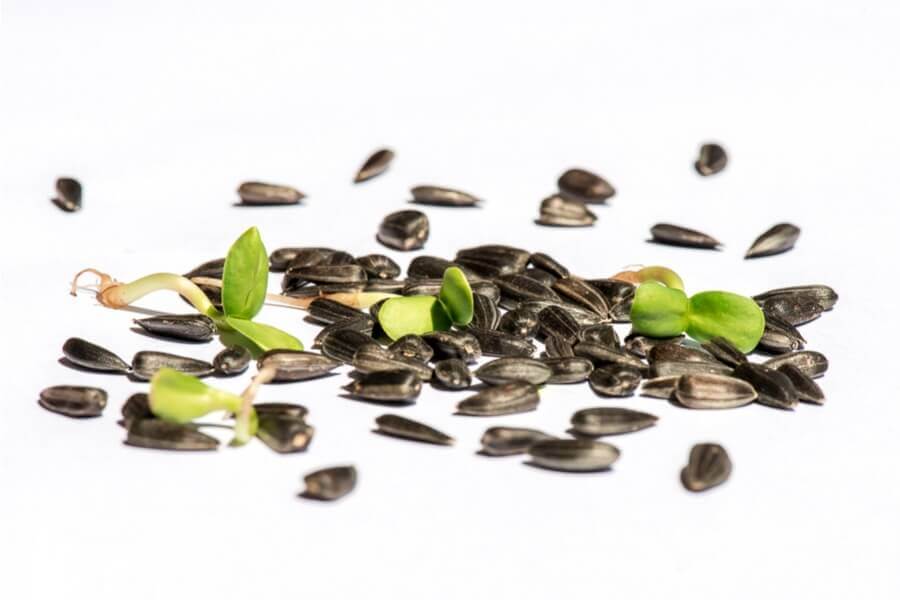
Sunflower sprout seeds: delicious variety for your raw food kitchen Sunflower sprouts are sprouted sunflower seeds. They are high in protein and contain many minerals such as iron, calcium and magnesium, which are essential for our health. They offer a unique combination of flavour and nutrients. Why eat sunflower sprouts? Excellent nutritional content: Sunflower sprout seeds are packed with essential nutrients such as vitamin C, vitamin E, folic acid, iron and protein. This superfood offers a wealth of nutrients that naturally strengthen you and support your well-being. Easy to digest: The sprouts are easy to digest, which means that your body can absorb the nutrients efficiently. This makes them an ideal addition to a balanced diet. Delicious flavour: The mild, nutty flavours of sunflower sprouts add a delicious touch to your salads, sandwiches, wraps and smoothies. They also add a pleasant texture to soups and hot dishes. Raw food quality: Our sunflower sprout seeds are carefully cultivated and processed to ensure that they retain their valuable enzymes and nutrients in their raw food quality. How to use sunflower sprouts? Salads and wraps: Sprinkle a handful of fresh sunflower sprouts on your salads or stuff them into wraps for a crunchy and nutritious touch. Smoothies: Add a handful of sprouts to your favourite smoothie to enrich it with a healthy boost of nutrients. Bread topping: Use the sprouts as a healthy topping for your breakfast bread or sandwich. Soups and stews: Add just before serving to add fresh flavour and valuable nutrients to soups. How to grow sunflower sprouts? Soak for 10 hours Rinse in the morning and evening Leave to germinate for 7 days Vitamins per 100g: IngredientValueUnitVitamin E Active. 38.84 mg Folic acid 121 µg Vitamin B1 1.9 mg Vitamin B2 0.26 mg Vitamin B6 1.27 mg Vitamin C 0 mg a-tocopherol 37.2 mg Vitamin K 0 µg Biotin 56 µg Retinol equivalent 3 µg ß-carotene 15 µg free folic acid 50 µg Country of origin: Italy
Content: 350 Gramm (CHF 2.43 / 100 Gramm)
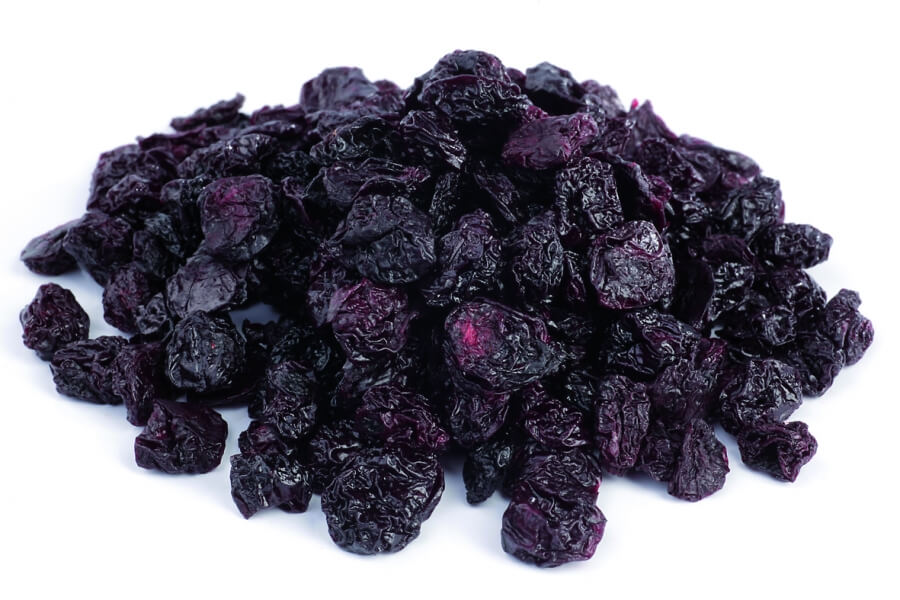
Sour cherries: Organic, raw food & Fairtrade Our wild-collected organic sour cherries from Uzbekistan are very fruity and very tart in flavour. The bright dark colour is created during the gentle drying process. Why SamaraNatura sour cherries From wild collection and therefore particularly rich in nutrients compared to plantation products 100% pure nature, i.e. unoiled, without sweeteners, without preservatives, without colourings in organic & raw food quality Fairtrade certified Gently sun/solar dried De-pressurised and laser-cleaned Origin and production The organic Fairtrade sour cherries come exclusively from Uzbekistan. The area is extensively certified organic and FAIRTRADE and is farmed by the FAIRTRADE farmers living there. The farmers belong to a large Fairtrade community, which is made up of 3 groups, Dustkul Bogi, Turkiston Gulba and Turob Bobo. They include around 1000 individual farmers and their families. Thanks to the co-operation with Fairtrade, the farmers can offer their families a secure income and their children a new perspective. After harvesting, the sour cherries are washed, pitted and gently dried with the help of the sun. The solar drying method is very environmentally friendly and gentle on the produce. Sour cherries (Prunus cerasus) belong to the rose family (Rosaceae). They have less flesh than sweet cherries. Sour cherries originally come from south-west Asia and, unlike sweet cherries, only became known in Europe in the Middle Ages. Average nutritional values per 100g Energy value 1042kJ / 246 kcalFat 0.6gof which saturated fatty acids 0.2gCarbohydrates 50.8gof which sugar 35gFibre 8.3gProtein 5.3gSalt 0.01g Salt 0.05g
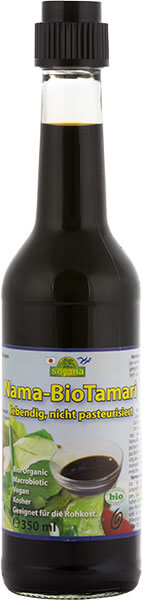
Soyana Nama Organic Tamari - the best soy sauce in Switzerland Unpasteurised organic tamari from Soyana. In the production of this tamari, the soya beans are cooked and then fermented for 2 years in wooden barrels. Nama means highest quality according to traditional Japanese production methods. During fermentation, nutrients are released and probiotic bacteria beneficial to the intestinal flora are formed; each gram contains several million bacteria. The usual pasteurisation process is not used. Use of Nama Organic Tamari Soya Sauce For sauces, salads, soups, sushi, dips. Storage Keep cool or store opened bottle in the refrigerator. Nutritional values Nama Organic Tamari Soy Sauce Soyana per 100g Energy 337kJ / 79kcalFat 0gCarbohydrates 5.6g- of which sugar 0.1gDietary fibre 1.1gProtein 13.7gSalt 11.2g Additional information ✓ Macrobiotic ✓ Organic ✓ Raw food ✓ vegan ✓ Kosher ✓ lactose-free ✓ gluten free ✓ cholesterol-free ✓ free from onions, garlic, leek Allergens: soya
Content: 350 ml (CHF 2.69 / 100 ml)
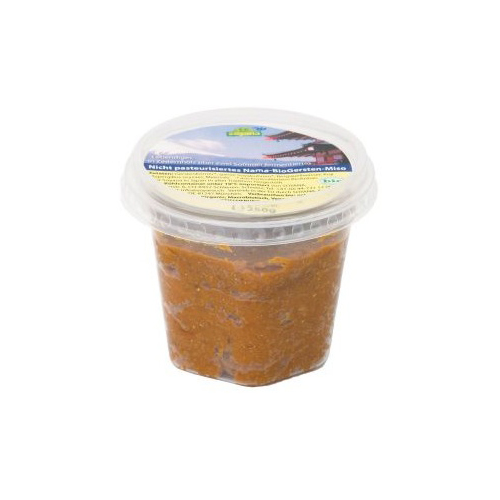
Soyana Nama organic barley miso 250g - unpasteurised Unpasteurised organic barley miso from Soyana. Nama means highest quality according to traditional Japanese production methods. In the production of this miso, the soya beans are cooked and then fermented in wooden barrels for 2 years. During fermentation, nutrients are released and probiotic bacteria beneficial to the intestinal flora are formed; each gram contains several million bacteria. It also contains many enzymes that are beneficial for digestion. The usual preservation by pasteurisation is not used. 250 g are sufficient for approx. 41 portions of 6 g/1 teaspoon each. Ingredients Barley grains*, whole soya beans*, mountain spring water, koji (Aspergillus oryzae), sea salt. *From controlled organic cultivation. Use Nama Organic Barley Miso For sauces, salads, soups, green shakes, sushi, dips and spreads. Tip: Roll an espresso spoon of miso into a green lettuce leaf and enjoy the flavour unfolding in your mouth. Nutritional values of organic barley miso per 100g Energy: 598kj / 143kcalFat: 5g,of which saturated fatty acids 1gCarbohydrates 9.1g,of which sugar 4.8gDietary fibre 6.7gProtein 12.7gSalt 10.37g. Contains gluten. Cholesterol free. Allergens: soya, barley.
Content: 250 Gramm (CHF 3.31 / 100 Gramm)
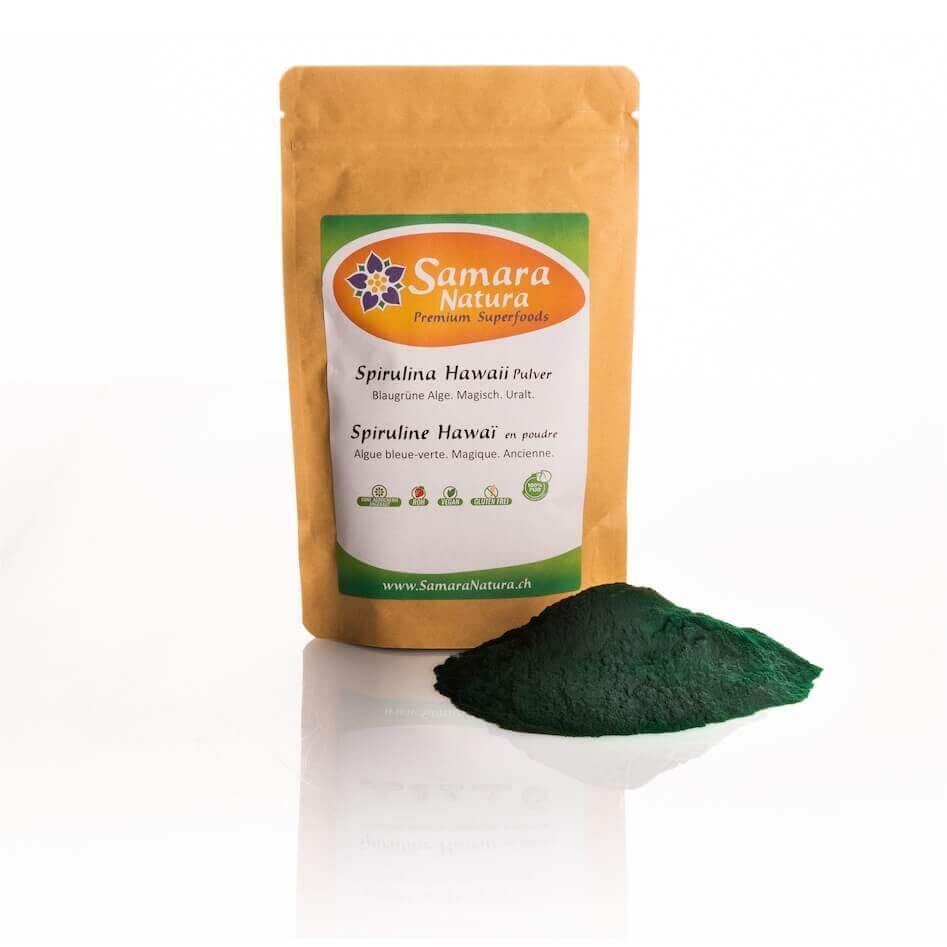
Spirulina powder - the high-quality original from Hawaii (100% natural) What is spirulina? Spirulina is a single-celled, filamentous blue-green algae and one of the first life forms on this planet. Richer in high-quality protein (contains 18 amino acids) than any other food, the microalgae also contains a wealth of vitamins, minerals, important antioxidants such as SOD and phycocyanin, polysaccharides and the rare gamma-linolenic acid. Spirulina is at the forefront of the nutritional revolution. With its rich composition and ability to grow even under unfavourable conditions, the microalgae has great potential to become a food source that will help feed the world's population. By integrating spirulina into our diet, we are making a contribution to solving the food crisis. The effect of spirulina? Spirulina is a valuable food. The algae is incredibly rich, a "wholefood". It is believed to contain all the vital substances that the human body needs. The high density of vital substances brings vitality and well-being. The antioxidants can scavenge free radicals and highly reactive oxygen compounds and are therefore important for the maintenance and function of cells. The detailed nutritional values are listed below. What makes our spirulina powder special? Our Spirulina Pacifica has been cultivated in Hawaii for over 25 years(video with flight over the plantation) and is regarded as one of the highest quality spirulina in the world. In a special, oxygen-free drying system, the spirulina is dried very gently so that more nutrients and enzymes are retained - e.g. over 40% more ß-carotene and over 75% more zeaxanthin - than is possible with conventional drying systems. Spirulina Pacifica is grown in open ponds 20 cm deep, a few hundred metres from the Pacific Ocean. To fill the ponds, fresh water is mixed with seawater from a depth of 600 metres, which is rich in minerals and trace elements. The other most important substances for cultivation in terms of quantity are food-grade baking powder (sodium bicarbonate) and carbon dioxide. Food-grade fertilisers are also used. Paddle wheels move the water to provide the algae with uniform sunlight for optimal growth conditions and nutrient uptake. Spirulina from Hawaii is grown without pesticides or herbicides and does not contain any genetically modified organisms. Our spirulina is called Spirulina Pacifica and is a selected strain of Spirulina platensis that has developed over many years of cultivation in Hawaii. Spirulina Pacifica was intensively analysed by molecular biologists at the University of Hawaii. They identified new enzymes that were not found in other Spirulina platensis strains. Tips for use in everyday nutrition The powder is most often mixed with fruit and vegetable juices. Spring water is also very good and promotes maximum absorption. Spirulina can also be added to food like a spice to avoid loss of nutrients, but it should only be heated a little. Spirulina has a unique flavour that blends well with almost anything. If you are not used to the flavour of green foods, it may take some getting used to at first. If you find that your energy is running low during the day, take some spirulina with water and observe how your body feels 1-2 hours later. You will be amazed. Recommended intake Beginners and children: 1-2 g per day Adults: up to 3g per day It is recommended to start with 1 teaspoon (5 g) or slightly less and gradually increase the intake up to 10 g (1 heaped tablespoon) to avoid indigestion. Taking 1 tsp one hour before meals can help to reduce appetite. The dry powder absorbs water from the air, so the packaging should be tightly sealed and stored in a cool, dry and dark place Complementary product recommendations We recommend taking spirulina together with chlorella in a ratio of 2:1. Similar products Spirulina Hawaii Tablets | Spirulina Algae Powder from Taiwan | Spirulina Algae Tablets from Taiwan Recipes with spirulina Example: Heavy Metal Detox Smoothie 2 bananas 250g wild blueberries (frozen) or 2 tbsp wild blueberry powder 1 large bunch of fresh coriander Juice of 2 oranges 1 tsp spirulina Hawaii powder 1 tsp barley grass juice powder 1 small handful of dulse flakes Water as required More recipes here. Spirulina platensis: Nutritional values per daily portion (3g) Energy value 42kJ/10kcal Protein 2g Carbohydrates <1g Provitamin A (β-carotene) 2,715mg (57%*) Iron 5mg (36%*) Magnesium 15mg (5%*) Vitamin K (K1, K2) 40µg (40%*) Manganese 0.2mg (10%*) Sodium 50mg (3%*) Chlorophyll 19mg Phycocyanin 270mg Gamma-linolenic acid 32mg Carotenoids 13mg Zeaxanthin 3mg *of the recommended daily dose/Apport journ. recommandé Vitamin A and iron contribute to the normal function of the immune system and to normal cell division, vitamin K maintains the normal coagulation capacity of the blood. All information is subject to the usual fluctuations of natural products. The product is not intended as a substitute for a balanced and varied diet and a healthy lifestyle. Keep out of reach of children. The recommended daily dose must not be exceeded.
Content: 125 Gramm (CHF 19.99 / 100 Gramm)
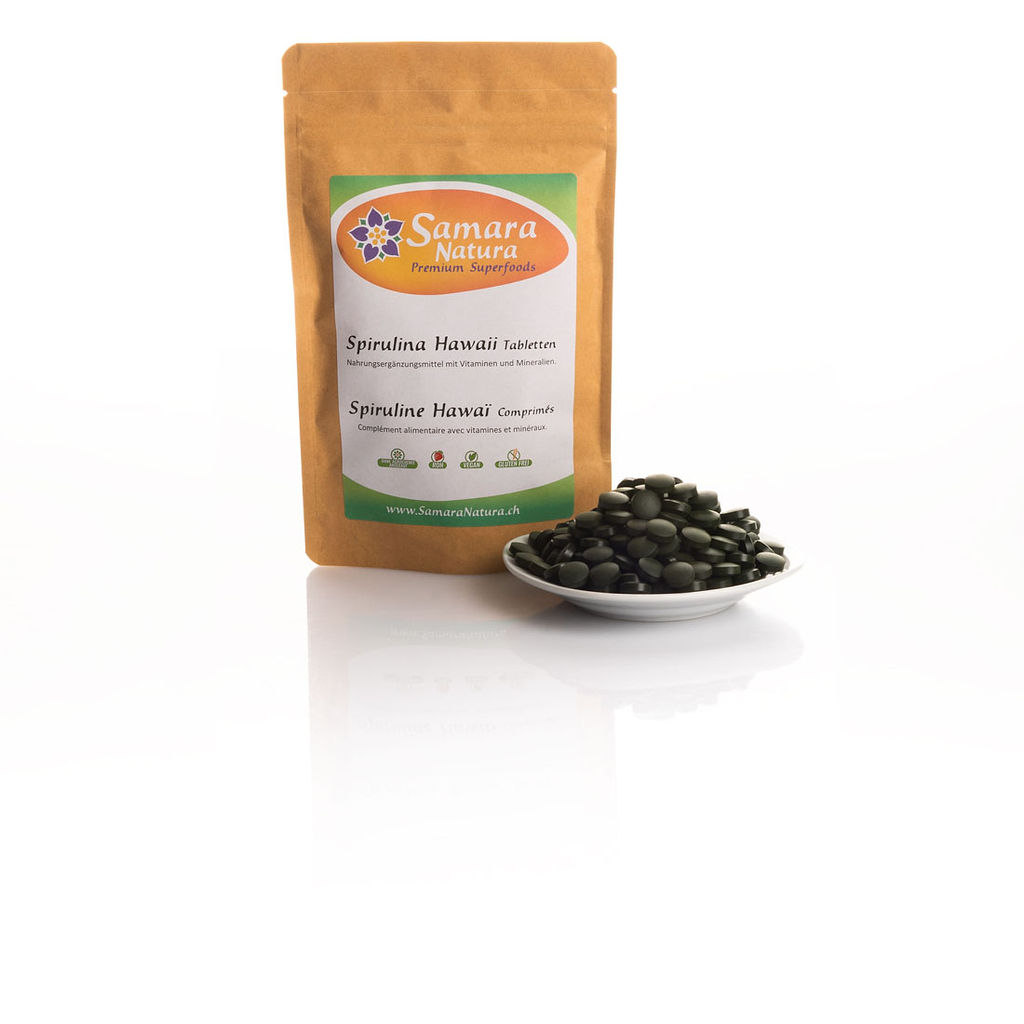
Why consume spirulina tablets (100% natural)? Spirulina is a single-celled, filamentous blue-green algae and one of the first life forms on this planet. Richer in high-quality protein (contains 18 amino acids) than any other food, the microalgae also contains a wealth of vitamins, minerals, important antioxidants such as SOD and phycocyanin, polysaccharides and the rare gamma-linolenic acid. The high density of vital substances brings vitality and well-being. The antioxidants can scavenge free radicals and highly reactive oxygen compounds and are therefore important for cell maintenance and function. The algae is incredibly rich, a "wholefood". It is believed to contain all the vital substances the human body needs and, in combination with chlorella, can provide almost perfect ratios of the most important nutrients! What makes our spirulina tablets special? Spirulina from Hawaii is grown without pesticides or herbicides and does not contain any genetically modified organisms. Our Spirulina Pacifica has been cultivated in Hawaii for over 25 years(video of a flight over the cultivation ponds in Kona, Hawaii) and is regarded as one of the highest quality spirulina in the world. Thanks to a special, oxygen-free drying system, nutrients and enzymes are largely preserved, unlike in other processes. Our spirulina is called Spirulina Pacifica and is a selected strain of Spirulina platensis that has developed over many years of cultivation in Hawaii. Spirulina Pacifica was intensively analysed by molecular biologists at the University of Hawaii. They identified new enzymes that were not found in other Spirulina platensis strains. Spirulina Pacifica is grown in open ponds 20 cm deep, a few hundred metres from the Pacific Ocean. To fill the ponds, fresh water is mixed with seawater from a depth of 600 metres, which is rich in minerals and trace elements. The other most important substances for cultivation in terms of quantity are food-grade baking powder (sodium bicarbonate) and carbon dioxide. Food-grade fertilisers are also used. Paddle wheels move the water to provide the algae with uniform sunlight for optimum growth conditions and nutrient uptake. In a special oxygen-free drying system, the spirulina is dried very gently so that more nutrients and enzymes are retained - e.g. over 40% more ß-carotene and over 75% more zeaxanthin - than is possible with conventional drying systems. Fluctuating green colour According to information from the producer in Hawaii, the colour can vary from batch to batch. Depending on the time of harvest (season) and other factors. The current batch is dark green in colour. Earlier batches were often blue-green in colour. Tips for use Take 1-2 tablets 3 times a day, ideally half an hour before eating. If you find that your energy is running low during the day, take some spirulina with water and observe how your body feels 1-2 hours later. You will be amazed. Recommended amounts: Beginners and children: 1-2g per day Adults: 3g per day If taken in combination with chlorella, we recommend a ratio of 2:1 (spirulina:chlorella). Composition Spirulina Hawaii tablets Spirulina platensis (98.5%), silica (1%), chicory inulin (0.4%), magnesium stearate (0.1%). Important: Silica, chicory inulin and magnesium stearate are used by the producer as a pressing aid. If you are looking for 100% pure powder, we recommend Spirulina Hawaii Powder or Spirulina Taiwan Tablets, which do not contain any pressing aids. Nährwerte Spirulina platensis pro Tagesportion / Valeurs nutritives de Spiruline par portion journalière (3g/6tablets) Energy value 42kJ/10kcalFat 0.2gCarbohydrates 0.3gof which sugar 0.02gProtein 2gProvitamin A (β-carotene) 2.7mg (57%*)Iron 5 mg (36%*)Magnesium 15mg (5%*)Vitamin K (K1, K2) 40 µg (40%*)Chlorophyll 19 mgPhycocyanin 270mg *the recommended daily dose/Apport journ. recommandé Contents Packet 125 g contains approx. 250 tablets of 500mg. Pack 250 g contains approx. 500 tablets of 500mg. Nutritional supplement info The product is not intended as a substitute for a balanced and varied diet and a healthy lifestyle. The recommended daily dose must not be exceeded. Vitamin A and iron contribute to the normal function of the immune system and normal cell division. Vitamin K contributes to normal blood clotting. Note: In case of medical treatment, pregnancy or uncertainty, consult a specialist about the use of this product. Keep out of the reach of children.
Content: 125 Gramm (CHF 26.60 / 100 Gramm)
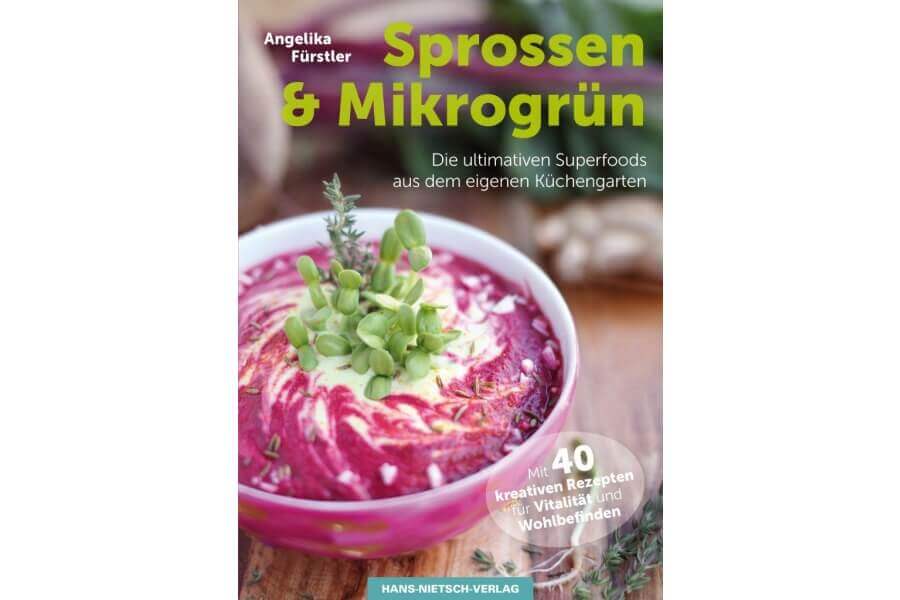
Sprouts & microgreens - reference book by Angelika Fürstler In her reference book Sprouts and Microgreens, Angelika Fürstler provides comprehensive information about the ultimate superfood from your own kitchen garden. Book contents: Ingredients of the individual sprouts Effects on our body 40 creative and purely plant-based recipes for vitality and well-being, including a raw kohlrabi kiss cream soup Hans-Nietsch-Verlag
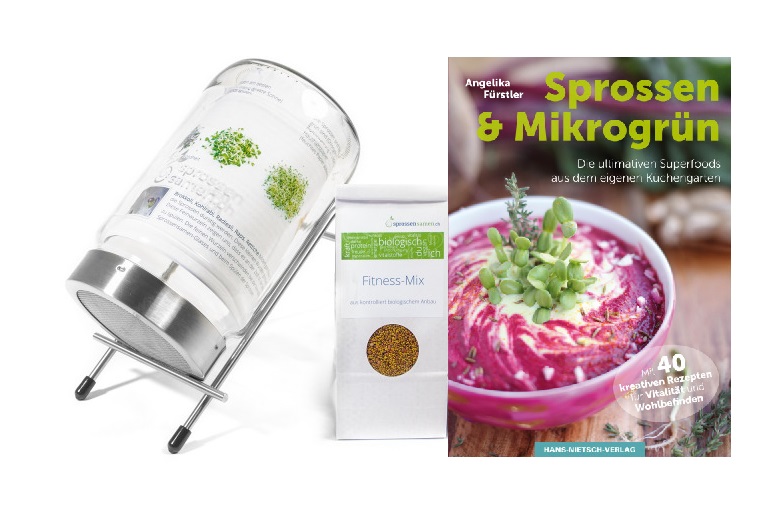
Sprout starter set - everything you need To make it easier for you to start growing sprouts, we have put together a practical starter set. Take advantage of the special starter set price of CHF 92 (instead of the regular CHF 102.50). Starter set contents Biosprosser (sprouter) 1700ml with sieve & lid, incl. stainless steel stand Fitness-Mix Sprouts Organic 250g Sprouts & microgreens - reference book by Angelika Fürstler
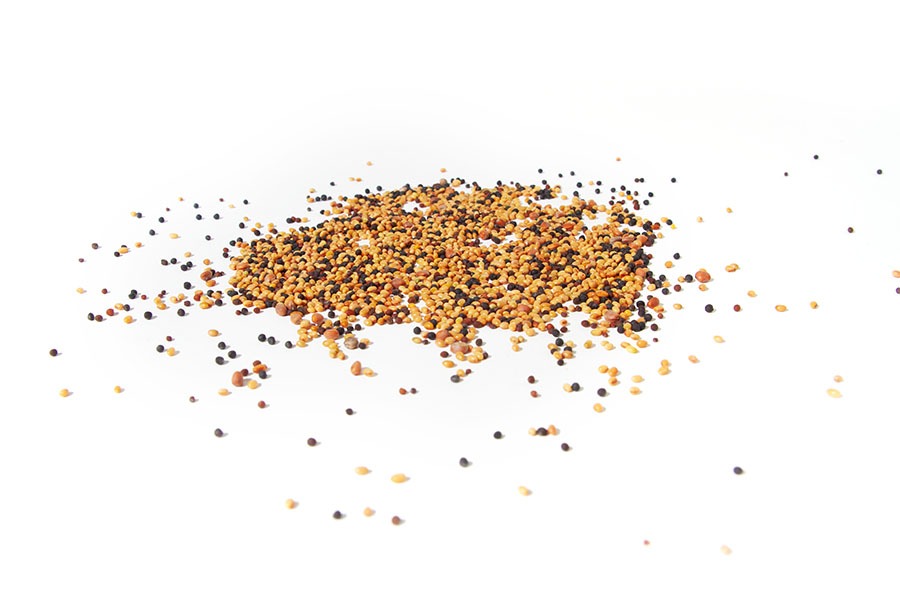
Sprossit-Mix sprout seed This wonderful sprout mix was created by sprout expert Angelika Fürstler. It contains: Brussels clover seeds Broccoli seeds Kohlrabi seeds Radish seeds Rapeseed Why Sprossit sprouts are healthy Sprossit sprouts are characterised by the following ingredients: Vitamin C Bitter and flavouring substances dietary fibre secondary plant substances Usage You can eat Sprossit sprouts on their own or mix them into salads. They are also suitable as a topping for your fitness sandwich and for garnishing main dishes. Germinating Sprossit seeds 3.1 litre sprout jar: Soak 2 heaped tablespoons for 10 hours. 1.7 litre sprout jar: soak 1.5 heaped tablespoons for 10 hours. Then germinate in the sprout jar for 6-7 days. Rinse every morning and evening. The sprouts can then be stored in the fridge for about a week. Further information on Sprossit sprout seeds Bag contents: 250g. Country of origin of sprouts: Italy Storage: Store in a cool, dark and dry place Organic certification: CH-BIO-006
Content: 250 Gramm (CHF 4.75 / 100 Gramm)
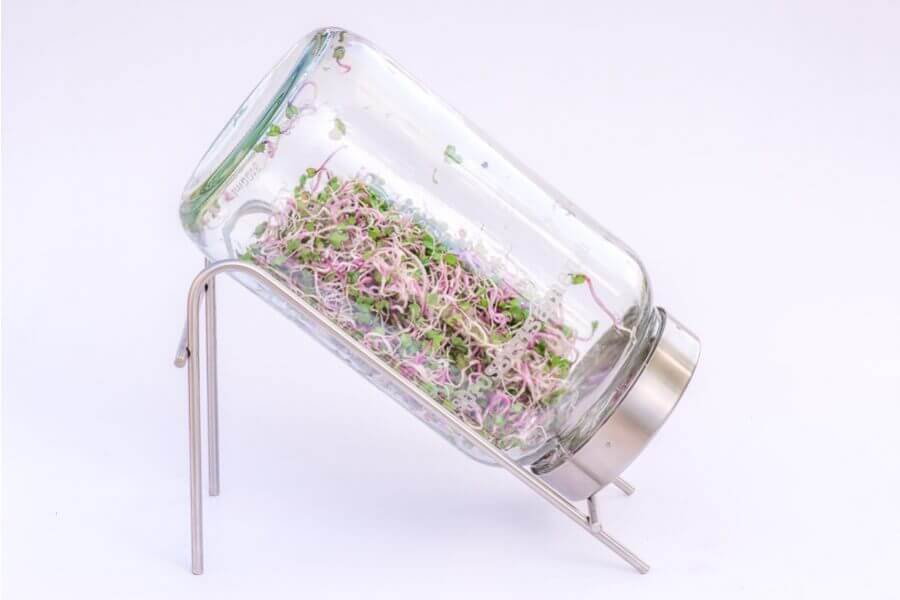
Sprout jar with stand - 1700ml or 3100ml version Start growing sprouts now. All you need is this glass sprouter with lid, sieve and stand including rubber feet, as well as a sprouting seed and very little time. Two different jar sizes: The sprouter is available in two sizes: 1700ml for CHF 69 → suitable for new users 3100ml for CHF 79 → suitable for frequent users and families Sprouter made of glass and stainless steel In contrast to many plastic sprouters, our sprouter is made of glass (with food certification) and all metal materials are made of 1.4301 stainless steel. If you want to expand your sprout farm and organise it in rows, you can also purchase an additional stand connector for CHF 5 to connect the stands. Advantages of glass sprouting units Health and safety: Glass is an inert material that does not release any harmful chemicals or toxins. When sprouting food, it is important that it does not come into contact with harmful substances to ensure the quality and health of the sprouts and sprouted food. Sustainability: Glass is an environmentally friendly material that is recyclable and reusable. Using glass sprouting equipment helps to reduce the ecological footprint and pave the way to a more sustainable future. Durability: Glass is generally more durable and resistant. It retains its original shape and transparency over a longer period of time without discolouring or deforming. This means that glass sterilisers retain their functionality and aesthetics even after frequent use and many sterilisation processes. No odour absorption or discolouration: Glass does not absorb odours or flavours, so it does not cause any undesirable changes in the taste of the sprouted food. In addition, glass does not discolour, so it retains its clear and attractive appearance. Hygiene: Glass is easier to clean and has a smooth, non-porous surface on which fewer bacteria can colonise. This makes it easier to clean glass sterilisers thoroughly and ensure a high level of hygiene, which is particularly important when it comes to food.
Content: 1700 ml (CHF 38.56 / 1000 ml)
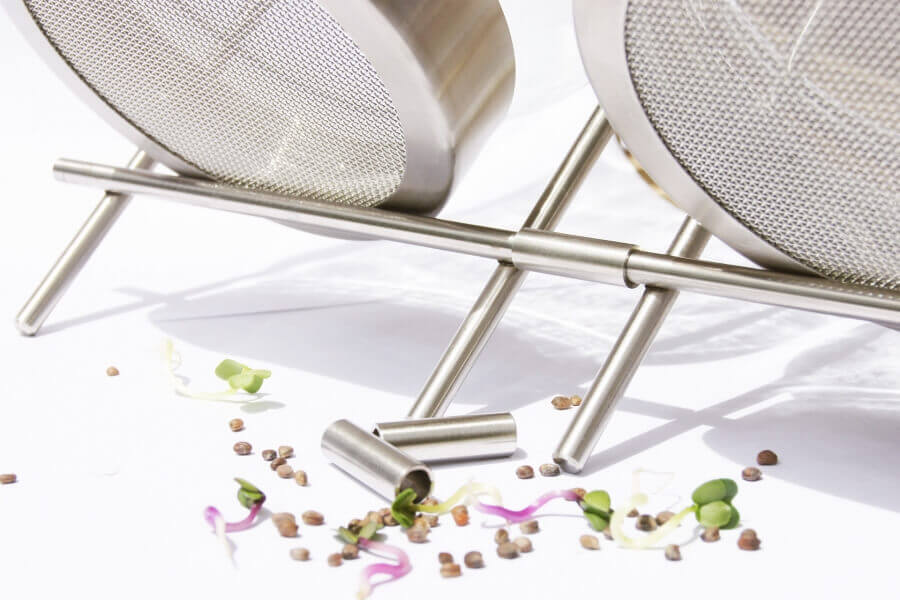
Stand connector for sprout stands Do you have several sprout stands of the "Sprout seeds" brand and don't want them to stand individually in your kitchen? With the matching stainless steel stand connector, you can connect as many sprout stands as you like and create a small production line with different types of sprouts. Contents: 1 pair each, i.e. 2 stand connectors are included to connect the sprout stands at the top and bottom.
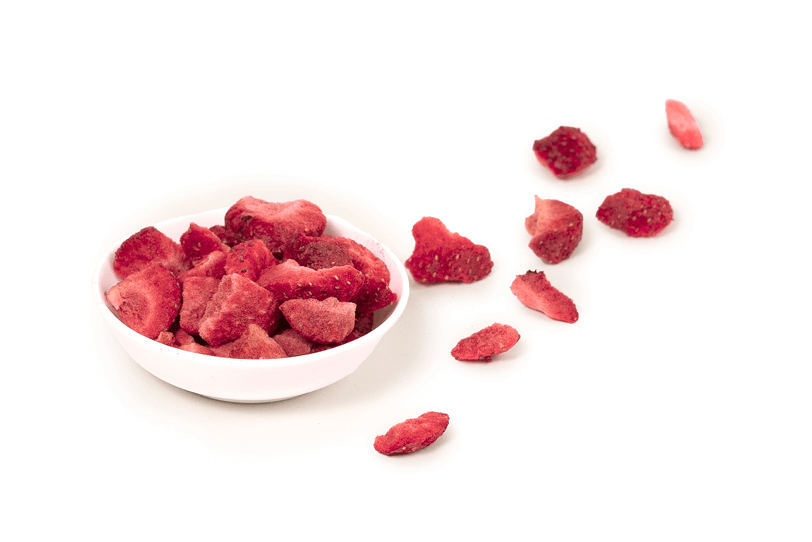
Organic freeze-dried strawberries Crispy, flavoursome, delicious freeze-dried strawberries that give you that summery fruit feeling all year round. What makes our freeze-dried organic strawberries special? The sun-ripened organic strawberries from Serbia are processed on site immediately after harvesting. They are freeze-dried using high-quality technology, whereby the water bound as ice is removed in a vacuum. The strawberries lose 90% of their weight in the process, but retain their natural appearance, intense flavour and most of their nutrients. In addition, the strawberries remain in raw food quality. Contents: Bag with 50g. Recommendations for use With their delicious fruity flavour, these freeze-dried, whole strawberries are perfect in muesli and as a topping for desserts. Also delicious with nuts and other dried fruit as a snack between meals. The freeze-dried strawberries can also be soaked briefly in water to make them juicy again. Nutritional information sprouted freeze-dried strawberries Energy / nutrient per 100gg/mg/μg%*1*1 Reference quantity/daily dose for an average adult (8400kJ/2000kcal) Energy 1608kJ (383kcal) 19% fat 0.4g 1% of which saturated fatty acids 0.04g 0% Carbohydrates 89.3g 34% thereof sugar 63.8g 71% Dietary fibre 14.7g 29% Protein 4.4g 9% salt 0.01g 0% Vitamin C 485mg 606%
Content: 50 Gramm (CHF 22.62 / 100 Gramm)
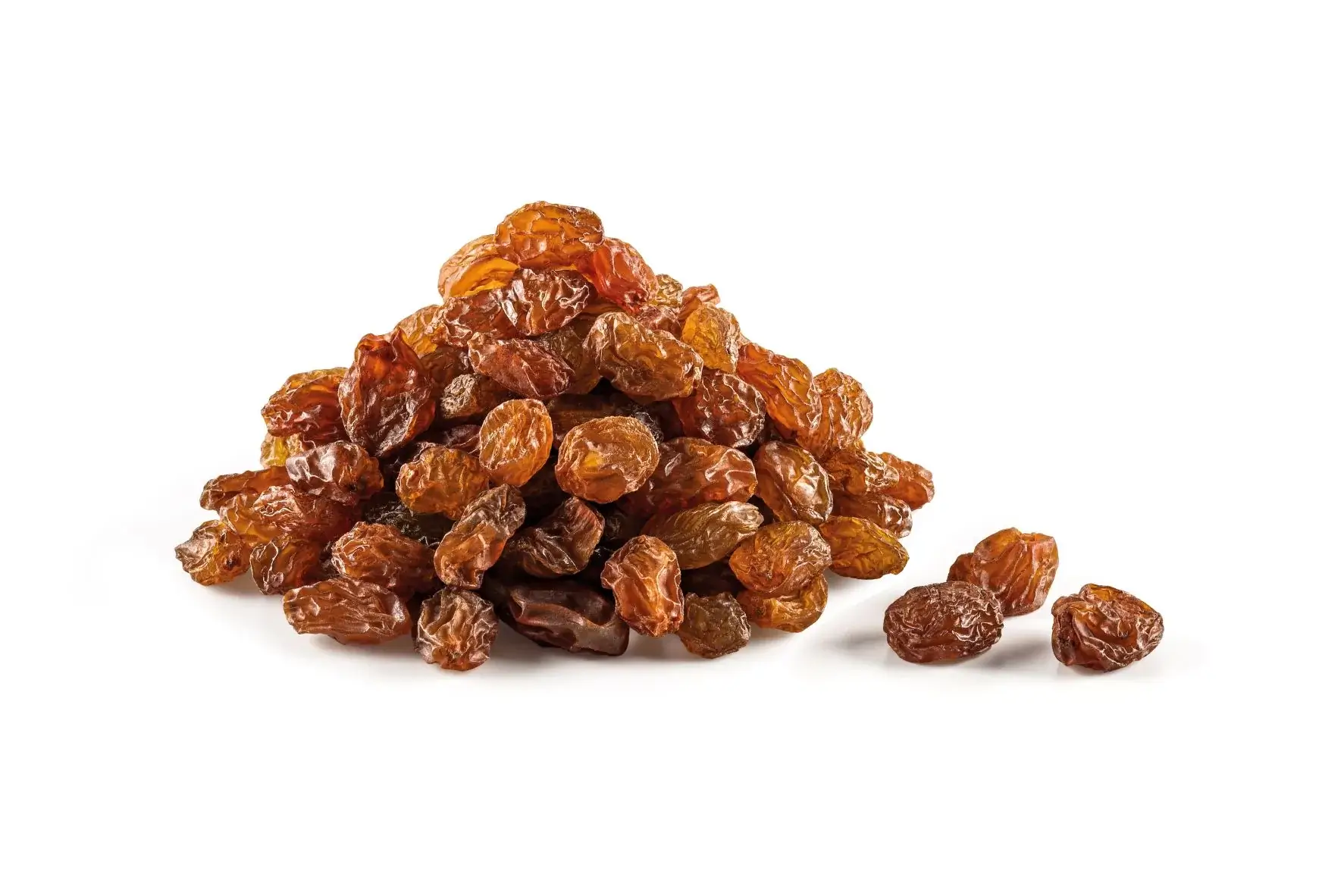
Sultana Organic Raisins The unoiled, unsulphurised organic Sultana sultanas have a sweet taste and are gently dried at below 42°C. They are naturally rich in fibre, phosphorus and iron. They are naturally rich in fibre, phosphorus and iron. Sultanas are seedless, flavourful and have a soft skin. Warnings May contain traces of nuts. Nutritional values of Sultana sultanas per 100g Energy value 1262 kJ / 298 kcal Fat 0.6g - of which saturated fatty acids 0.2g Carbohydrates 68g - of which sugar 67gDietary fibre 5.2g Protein 2.5g Salt 0.05gPhosphorus 110mg (16%)*Iron 2.27mg (16%)* *according to nutrient reference values
Content: 425 Gramm (CHF 2.01 / 100 Gramm)
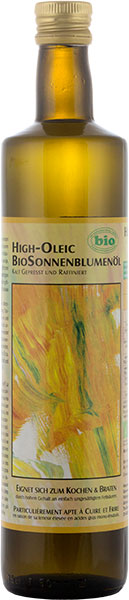
Cold-pressed high-oleic organic sunflower oil from Soyana This certified organic high-oleic sunflower oil comes from specially cultivated sunflowers. It contains approx. 75% monounsaturated fatty acids and is therefore particularly suitable for heating and frying. Normal sunflower oil, on the other hand, contains only approx. 23% monounsaturated (omega-9 fatty acids), but around 60% polyunsaturated fatty acids. Safflower oil, tree nut oil, pumpkin seed oil and linseed oil also have a high proportion (>50%) of polyunsaturated fatty acids, so-called MUFS. These are essential omega-3 and omega-6 fatty acids, which the body needs to produce important endogenous substances. Essential means that our body cannot produce these fatty acids itself, which is why we need to consume 19g per day through our diet. The oils mentioned are basically healthy as long as they are not heated. This is because the MUFAs break down and toxic degradation products and free radicals are formed. Therefore, use high-oleic oils (also known as HO or HOLL), coconut oil (contains many saturated fatty acids) or frying butter for frying. You can find a somewhat older but clear article in the Ktipp of 8 September 2009. Production and origin Sunflower oil is produced in Italy. The pressed sunflower seeds come from the European Union. Nutritional values of High-Oleic Organic Sunflower Oil per 100ml Energy values 3700 kJ / 900 kcalFat 100gof which saturated fatty acids 7gmonounsaturated fatty acids 75gPolyunsaturated fatty acids 13gCarbohydrates 0gSugar 0gProtein 0gSalt 0gVitamin E approx. 50mg
Content: 750 ml (CHF 1.51 / 100 ml)
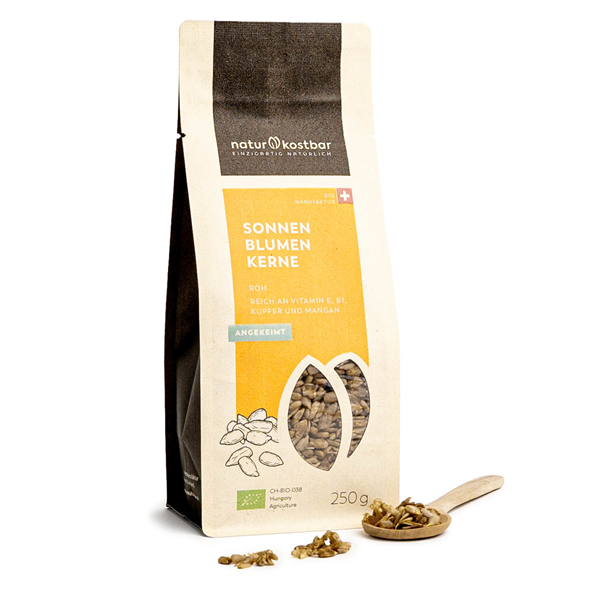
Sunflower seeds sprouted - better digestible These sprouted organic sunflower seeds are easier to digest due to the sprouting process and have more enzymes and a significantly higher nutrient density. The sunflower seeds come from a family farm in Transylvania, Romania. The small farm specialises in sprouted raw food and processes the harvest of numerous organic farmers from Europe. The mindful, natural philosophy is reflected in the excellent quality of the sunflower seeds. Contents: Bag with 250g. Use These sprouted sunflower seeds have a mild, nutty flavour. Thanks to their crunchy consistency, sunflower seeds add flavour to salads, muesli, porridge, dips and are a perfect snack between meals. Nutritional information sprouted sunflower seeds Energy / nutrient per 100gg/mg/μg%*1*1 Reference amount/daily intake for an average adult (8400kJ/2000kcal) Energy 2749kJ (665kcal) 33% fat 61.4g 88% of which saturated fatty acids 6.7g 34% Carbohydrates 5.7g 2% thereof sugar 2.6g 3% Protein 20g 40% salt 0.04g 1%
Content: 250 Gramm (CHF 2.62 / 100 Gramm)
Wird über eine gesunde Lebensweise und Ernährung diskutiert, fallen rasch die Worte Rohkost und Vitalkost. Auch bei Entschlackung und Detox-Diäten spielen Rohkost sowie Vitalkost eine wichtige Rolle. Und das hat einen Grund. Denn diese Lebensmittel sind weitestgehend naturbelassen und werden bei der Verarbeitung möglichst wenig erhitzt und beinhalten daher noch praktisch alle der wichtigen Inhaltsstoffe, die dem Körper guttun. Viele Lebensmittel werden heute gekocht, pasteurisiert oder auf andere Weise verarbeitet, bevor sie abgepackt und zum Verkauf angeboten werden. Dabei gehen eine Menge der wesentlichen Vitamine und Enzyme verloren, die eigentlich in den Nahrungsmitteln stecken würden. Bei Rohkost und Vitalkost ist dies anders. Hier wird darauf geachtet, dass diese möglichst schonend verarbeitet werden.
Bio- & Rohkostqualität, wo möglich
Das Ziel von SamaraNatura ist es, möglichst viele Lebensmittel in Bio- & Rohkostqualität anzubieten. Seit Herbst 2015 sind wir zudem als Unternehmen selbst nach Schweizer Recht Bio-zertifziert. Diese Zertifizierung wird jährlich von der Zertifizierungsstelle bio.inspecta in Frick überprüft und sämtliche Produkte sind auf Easy-Cert aufgeführt. Auch unser Logistiker ist Bio-zertifiziert. Leider sind nicht alle Produkte, welche ohne Pestizide angebaut werden auch Bio-zertifiziert. Aufgrund des grossen Einzugsgebietes ist beispielsweise der Sanddorn Ursaft aus Wildsammlung nicht zertifiziert, obwohl er vollkommen unbehandelt ist. Auch Rohkostqualität ist nicht in jedem Fall möglich. In diesem Fall streben wird danach, die bestmögliche Alternative zu bieten, um auch Nahrungsmittel, die etwa aufgrund der Haltbarkeit pasteurisiert werden müssen, so naturnah wie möglich anzubieten und die Verarbeitung so gering und schonend wie möglich zu halten.
Vitalkost einfach in den Alltag integrieren
Ein wesentlicher Vorteil von Vitalkost besteht darin, dass diese Lebensmittel oft direkt in der Form verzehrt werden können, in der sie angeboten werden und in den Handel kommen. Vitale Lebensmittel in Rohkostqualität, die sich sehr einfach in jeden Speiseplan einfügen lassen und sich auch als schmackhafte Snacks für zwischendurch eignen sind beispielsweise:
- Goji-Beeren aus biologischem Anbau
- Cashewkerne
- Nussmuse
- Weisse Maulbeeren in Bio-Qualität
- Kokos-Chips
- Hunza-Aprikosen (Wildaprikosen mit Stein) aus biologischem Anbau
- Kokoswasser als kühle Erfrischung
- Granatapfelkerne
Die Lebensmittel sind praktisch abgepackt, sodass sie sich leicht mitnehmen und auch unterwegs einfach verzehren lassen. Immer genau dann, wenn ein neuer Energieschub nötig ist oder auch einfach nur, um den Körper auch im Alltag mit all den Stoffen zu versorgen, die er benötigt. Denn viele Menschen tun sich schwer damit, in unserer schnelllebigen Zeit gesund zu essen und einen Speiseplan zu verfolgen, der dem Körper all die Nährstoffe liefert, die nötig wären.
Warum ist Superfood so gesund?
Bei vielen Nahrungsmitteln, die als Rohkost oder Vitalkost verfügbar sind, handelt es sich um so genannte Superfoods. Als solche werden Früchte, Nüsse, Algen, Wurzeln und andere Produkte der Natur bezeichnet, die aufgrund ihrer Inhaltsstoffe als wahre Wunder-Nahrung bezeichnet werden können. Vielfach werden und wurden diese in der traditionellen Medizin verschiedener Regionen und Kulturen als Heilpflanzen angesehen. Ihre grosse Stärke liegt darin, dass sie eine überdurchschnittlich hohe Menge an Vitaminen, Enzymen, Mineralstoffen und anderen Elementen enthalten, die dazu beitragen, uns vital und gesund zu fühlen und auch zu sein.
Werden diese in Form von Rohkost verzehrt, also ohne sie vorher beim Konservieren oder Trocknen über 42 Grad Celsius zu erhitzen, zu kochen oder ähnlich zu verarbeiten, ist der Effekt natürlich umso grösser, da die Inhaltsstoffe auch wirklich noch vorhanden sind. Sämtliche Nuss-Muse unseres Berner Lieferanten werden im schonenden Steinmahlverfahren während 2 bis 3 Tagen produziert. Dadurch bleiben auch die natürlichen und leckeren Aromen optimal erhalten.
Vitalkost als Pulver
Nicht immer muss Vitalkost als Rohkost verzehrt werden. Die grosse Auswahl an Produkten ermöglicht es, die wertvollen Zutaten auch beim Kochen einfach und praktisch zu verwenden. Ein Klassiker darunter ist selbstverständlich das Kurkuma-Pulver. Das Gewürz, das in der Ayurvedischen Ernährung vielseitige Anwendung findet, sieht auf den ersten Blick dem Curry sehr ähnlich und wird auch gerne zu Curry-Rezepten verwendet. Darüber hinaus wird es in Suppen, Aufläufen und Reisspeisen ebenso gerne verwendet wie auch in Smoothies. Ein in unseren Breitengraden noch weniger bekanntes Nahrungs- und Würzmittel in Pulverform ist hingegen Mesquite. DasMesquite-Pulver findet in der traditionellen Küche nord- und südamerikanischer Ureinwohner-Völker Anwendung und eignet sich perfekt als gesundes Süssungsmittel. Mit seinem relativ hohen Proteingehalt sowie vielen Mineralstoffen wie Eisen, Kalzium, Magnesium, Eisen und Zink versorgt es den Körper mit wichtigen Nährstoffen und fasziniert gleichzeitig durch einen besonderen, Caramel ähnlichen Geschmack.
Öle zum Verfeinern und Abschmecken
Perfekt zur Zubereitung von Rohkost wie etwa für Salate eignen sich wirklich kaltgepresste Öle. Die Öle im Shop von SamaraNatura sind alle kalt gepresst und aus biologischen Samen. Durch die schonende Gewinnung bleiben die natürlichen Aromen, Vitamine und die Fettsäuren optimal erhalten. Einige unserer Öle werden darüber hinaus aus Schweizer Ölsamen hergestellt wie etwa das kaltgepresste Schweizer Bio-Hanföl oder das Leindotteröl. Kaltgepresste Öle sind hitzeempfindlich. Bei starkem Erhitzen, z.B. Braten, können giftige Verbindungen entstehen. Eine der wenigen Ausnahmen ist das Kokosöl, welches vorwiegend aus gesättigten Fettsäuren besteht sowie das High-Oleic Bio Sonnenblumenöl.
Wertvolle Rohkost aus dem Meer
Nicht nur der biologische Anbau an Land bietet wertvolle Superfoods und energie- wie auch vitaminreiche Rohkost. Eine Vielzahl an nähr- und mineralstoffreichen Nahrungsmitteln stammt auch aus dem Meer.
Dazu gehören:
- Meeresalgen-Würz-Mix, sehr praktisch, da die kleingehackten Algen sich einfach in fast alle Gerichte streuen lassen und den Gerichten KEINEN bzw. einen kaum bemerkbaren Algengeschmack geben
- Meeres-Algen für Salat
- Fingertang oder Atlantischer Kombu
- Riementang
- Dulse oder Lappentang
- Kelp-Nudeln als Alternative zu Pasta: einfach einweichen und mit einer Pasta-Sauce mischen
Einige dieser Meeresgemüse enthalten hohe Mengen an Eisen, Folsäure, Magnesium, Selen, Chrom und vielen anderen Elementen, die wir im normalen Alltag oft nur zu selten und in zu geringen Mengen zu uns nehmen. Darüber hinaus geben Algen und Tang verschiedenen Rezepten eine ganz besondere Geschmacksnote, die vor allem bei Freunden mediterraner und asiatischer Küche sehr gut ankommt. Damit sorgt auch diese Rohkost sowie Vitalkost für willkommene kulinarische Abwechslung. Wir beziehen den grössten Teil unserer Meeresgemüse aus dem wilden, wenig berührten Nordwesten von Irlands Atlantikküste.
Mikroalgen aus Aquakultur
Neben den oben beschriebenen Meeresgemüse (Makroalgen) bieten sich Mikroalgen als natürliche Nahrungsergänzung wunderbar an. Sie haben mit rund 60% Anteil nicht nur den weitaus höchsten Gehalt an Proteinen aller natürlicher Lebensmittel, sondern sind auch reich an anderen wichtigen Nährstoffen wie Mineralien und Chlorophyll. Mikroalgen für die Ernährung werden in Aquakultur angebaut. SamaraNatura bietet u.a. folgende Mikroalgen für die menschliche Ernährung an:
- Spirulina mit seinen leicht verdaulichen Proteinen, in Pulver- oder Tablettenform
- Chlorella, in Tablettenform
- Marines Phytoplankton, in ionischer Spurenelement-Lösung